
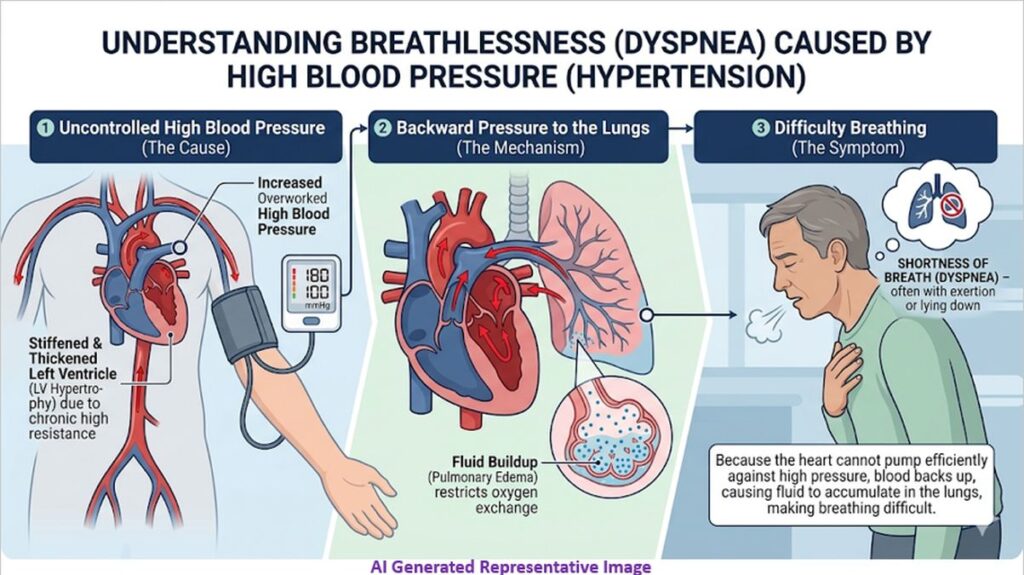

Yes. While mild to moderate, uncomplicated essential hypertension is generally asymptomatic, dyspnea becomes a prominent symptom once the chronically elevated systemic vascular resistance begins to cause structural and hemodynamic changes in the heart. The breathlessness is rarely a direct sensation of the high systemic pressure itself; rather, it is driven by the backward transmission of pressures into the pulmonary circulation or by ischemia.
Primary Pathophysiological Drivers
1. Diastolic Dysfunction and HFpEF
This is the most common mechanism linking chronic hypertension to breathlessness.
- Mechanism: Sustained pressure overload induces concentric left ventricular hypertrophy (LVH) and myocardial fibrosis. The thickened, stiffened myocardium impairs active early diastolic relaxation and decreases passive chamber compliance.
- Hemodynamics: To maintain adequate end-diastolic volume and stroke volume, the left ventricular end-diastolic pressure (LVEDP) must rise. This elevated filling pressure transmits backward, causing left atrial enlargement and pulmonary venous hypertension.
- Clinical Presentation: Exertional dyspnea is often the earliest sign. As exercise-induced tachycardia shortens the diastolic filling time, LVEDP spikes disproportionately, driving fluid into the pulmonary interstitium.
2. Acute Afterload Mismatch (Flash Pulmonary Edema)
In hypertensive emergencies, a sudden and extreme spike in blood pressure can acutely overwhelm the left ventricle’s compensatory mechanisms.
- Mechanism: The acute afterload mismatch acutely drops forward stroke volume.
- Hemodynamics: This frequently triggers Sympathetic Crashing Acute Pulmonary Edema (SCAPE). A massive sympathetic surge dramatically increases vascular tone, shifting fluid from venous capacitance reservoirs (like the splanchnic bed) directly into the pulmonary circulation.
- Clinical Presentation: Abrupt, severe dyspnea at rest, accompanied by hypoxia, requiring rapid afterload and preload reduction.
3. Ischemia as an Angina Equivalent
Hypertension accelerates macrovascular coronary artery disease (CAD) and is a primary driver of coronary microvascular dysfunction (CMD).
- Mechanism: The hypertrophied myocardium has significantly increased oxygen demand due to elevated wall stress, while compromised macro- or micro-vessels limit supply.
- Clinical Presentation: The resulting subendocardial ischemia frequently manifests as exertional breathlessness (an “angina equivalent”) rather than classic angina pectoris, particularly in patients with concentric LVH.
4. Progression to HFrEF
In the late stages of hypertensive heart disease, the chronically overloaded and hypertrophied left ventricle may eventually undergo adverse remodeling, dilating and losing contractility (the “burnt-out” phase). This leads to heart failure with reduced ejection fraction (HFrEF) and the classic congestive symptoms of orthopnea and paroxysmal nocturnal dyspnea (PND).