
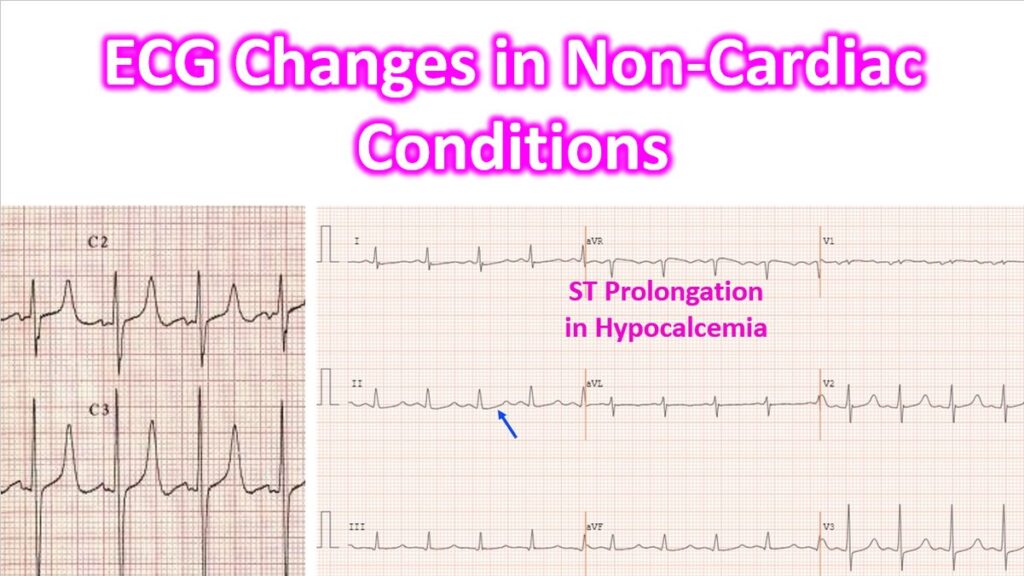

It is a common clinical pitfall to assume every ST-segment elevation or T-wave inversion points to a primary coronary event. In reality, the heart is often an “innocent bystander” reflecting systemic derangements. Here is a breakdown of significant ECG changes seen in non-cardiac conditions:
1. Electrolyte Imbalances
Electrolytes govern the action potential; when they shift, the surface ECG reflects it immediately.
| Condition | Classic ECG Findings |
| Hyperkalemia | Peaked T-waves (narrow/tented), PR prolongation, loss of P-wave, widened QRS (“sine wave” in extremes). |
| Hypokalemia | Flattened T-waves, prominent U-waves, ST-depression, prolonged QU interval. |
| Hypercalcemia | Shortened QT interval (the ST segment practically disappears). |
| Hypocalcemia | Prolonged QT interval (primarily via ST-segment lengthening) |
2. Neurological Events (The “Cerebral T-Wave”)
Acute intracranial insults—particularly Subarachnoid Hemorrhage (SAH) or massive stroke—can cause dramatic repolarization changes due to a massive “catecholamine storm” affecting the myocardium.
- Massive, deeply inverted, wide-based T-waves (Cerebral T-waves) and a prolonged QTC.
- Unlike Ischemic T-waves, these are usually much more diffuse and wider.
3. Pulmonary Embolism
While Sinus Tachycardia is the most common finding, look for signs of acute right ventricular (RV) strain:
- S1Q3T3 Pattern: A deep S-wave in Lead I, a Q-wave in Lead III, and an inverted T-wave in Lead III (present in only ~20% of cases).
- Right Axis Deviation: Shifting of the QRS axis to the right.
- RBBB: New-onset Right Bundle Branch Block, often transient.
- T-wave Inversions: Specifically in the right precordial leads (V1–V4).
4. Metabolic & Endocrine
- Hypothermia: Look for the Osborn Wave (J-wave)—a hump at the junction of the QRS and ST segment. You may also see shivering artifact or bradyarrhythmias.
- Hypothyroidism (Myxedema): Low voltage QRS complexes, sinus bradycardia, and flattened T-waves.
- Thyrotoxicosis: Sinus tachycardia and a high incidence of new-onset Atrial Fibrillation.
5. Gastrointestinal Conditions
- Acute Abdomen/Pancreatitis: Can occasionally mimic an inferior MI with ST-segment elevations or T-wave inversions. The exact mechanism is debated but likely involves vagal reflexes or proteolytic enzyme effects on the pericardium.
- Pneumoperitoneum: Can cause shifted axis or loss of R-wave progression due to the diaphragm being pushed upward.