
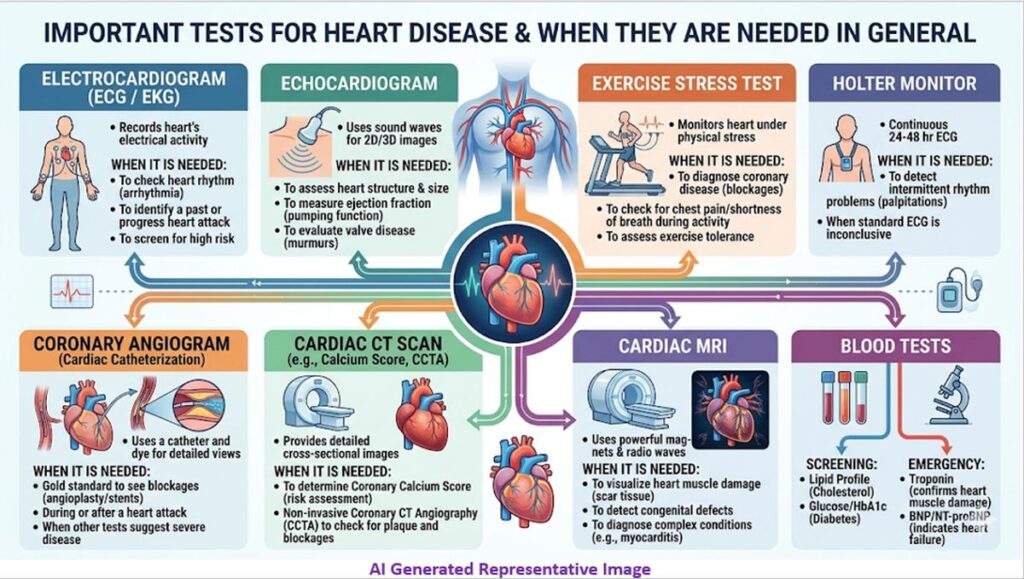

Diagnosing heart disease typically involves a combination of electrical, imaging, and laboratory tests. The specific tests a doctor orders depend on the patient’s symptoms, risk factors, and the suspected condition. Here is a breakdown of the most common tests used to evaluate cardiovascular health and when they are generally needed.
Electrical Activity and Rhythm
Electrocardiogram (ECG or EKG)
An ECG is a quick, painless test that records the electrical signals traveling through the heart. Small sticky sensors (electrodes) are placed on the chest, arms, and legs.
- When it’s needed: This is usually the first test performed if a patient experiences chest pain, palpitations, or shortness of breath. It helps detect arrhythmias (irregular heartbeats), structural abnormalities, and whether a heart attack is currently happening or has happened in the past.
Holter Monitor
A Holter monitor is a portable ECG device worn continuously for 24 to 72 hours (or sometimes up to a couple of weeks).
- When it’s needed: If a standard ECG doesn’t capture an intermittent arrhythmia, a Holter monitor tracks the heart’s electrical activity during regular daily routines to catch fleeting irregularities that only happen occasionally.
Imaging and Structural Tests
Echocardiogram (Echo)
An echocardiogram uses high-frequency sound waves (ultrasound) to create real-time, moving images of the heart.
- When it’s needed: It is used to evaluate the heart’s physical structure and function. It can identify problems with the heart valves (like narrowing or leaking), assess how well the heart muscle is pumping blood (ejection fraction), and detect congenital heart defects or muscle damage after a heart attack.
Cardiac Computed Tomography (CT) Scan
A cardiac CT scan uses an X-ray machine that rotates around the body to collect detailed cross-sectional images of the heart and chest.
- When it’s needed: It is often used to check for calcium buildup in the coronary arteries (a sign of plaque and coronary artery disease) or to view the heart’s anatomy in highly detailed 3D before certain structural procedures.
Cardiac Magnetic Resonance Imaging (MRI)
A cardiac MRI uses a powerful magnetic field and radio waves to create highly detailed images of the heart without using ionizing radiation.
- When it’s needed: MRIs are excellent for tissue characterization. They are used to detect scar tissue from previous heart attacks, assess severe structural damage, and diagnose conditions like myocarditis (inflammation of the heart muscle).
Performance and Blockage Evaluation
Exercise Stress Test
A stress test monitors the heart’s electrical activity, heart rate, and blood pressure while the patient walks on a treadmill or rides a stationary bike. If a patient cannot exercise, medication can be given to simulate the effects of exercise on the heart.
- When it’s needed: It evaluates how well the heart handles increased physical demand. This helps diagnose coronary artery disease by revealing if the heart muscle is getting enough blood flow when it is working hard.
Cardiac Catheterization and Coronary Angiogram
This is an invasive procedure where a long, thin, flexible tube (catheter) is inserted into a blood vessel in the groin, arm, or neck and threaded up to the heart. A special contrast dye is injected through the catheter, and X-ray images are taken as the dye flows through the arteries.
- When it’s needed: It is the gold standard for diagnosing coronary artery disease. It shows exactly where and how severely the coronary arteries are blocked. It is often performed during or immediately after a heart attack, allowing doctors to treat the blockages during the exact same procedure using balloons or stents.
Blood Tests
Blood work provides a biochemical snapshot of cardiovascular risk and acute cardiac events.
- Lipid Profile: Measures total cholesterol, LDL (bad cholesterol), HDL (good cholesterol), and triglycerides to assess the long-term risk of plaque buildup.
- Troponin: Troponin is a protein found in heart muscle cells. If the heart muscle is damaged, troponin leaks into the bloodstream. A high-sensitivity troponin test is the primary biomarker used to confirm a heart attack.
- BNP (B-type Natriuretic Peptide): This hormone is released when the heart is stretched or working unusually hard. Elevated levels are a key indicator used to diagnose and monitor heart failure.