
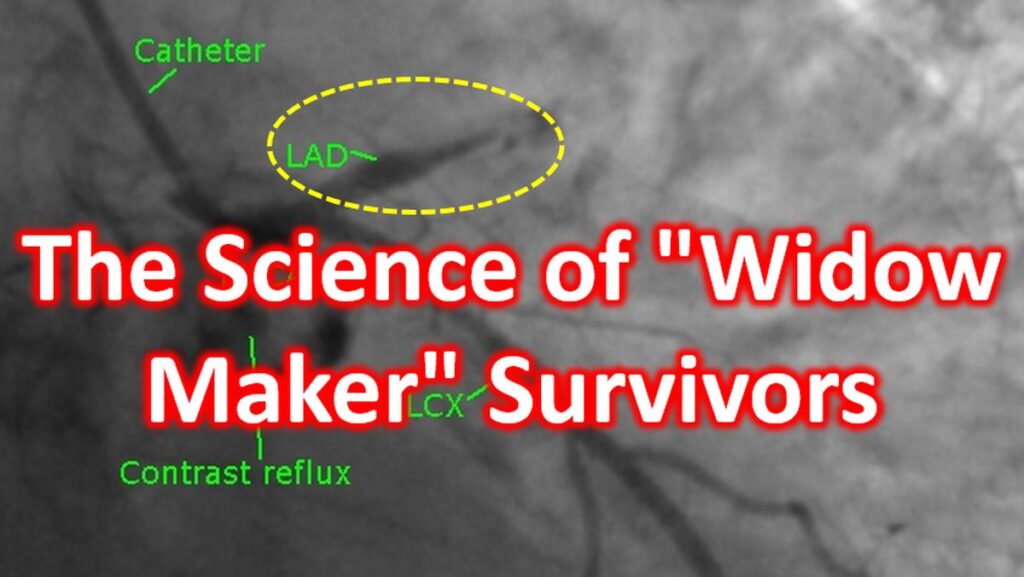

The term “Widow Maker” refers to a specific, life-threatening blockage of the Left Anterior Descending (LAD) coronary artery. When this “widow maker” vessel is 100% blocked, the heart’s main pumping chamber (the left ventricle) loses a major part of its blood supply. Without immediate intervention, the survival rate is grim. However, thanks to advances in emergency medicine, the “science of survival” has shifted significantly.
1. The Critical Anatomy
The LAD is often called the “widow maker” because it supplies blood to roughly 50% of the heart muscle.
- The Problem: A blockage here is like a block in the main water supply line of a house. It doesn’t just affect one room; it threatens the entire structure.
- The Consequence: If blood flow isn’t restored quickly, the heart muscle begins to die within minutes, often leading to ventricular fibrillation (a chaotic heart rhythm) and sudden cardiac arrest.
2. The Science of the “Golden Hour”
Survival hinges on a single metric: Total Ischemic Time. This is the duration from the start of the chest pain to the moment the artery is physically reopened.
- Door-to-Balloon Time: Hospitals strive for a “Door-to-Balloon” (D2B) time of under 90 minutes. This is the time it takes from a patient entering the ER to a cardiologist inflating a balloon in the artery to restore flow.
- The Physics of Reperfusion: Modern survival often involves Percutaneous Coronary Intervention (PCI). A tiny wire is threaded through the wrist or groin to the heart, where a stent—a mesh tube—is expanded to keep the vessel open.
3. Post-Survival: The Biology of Recovery
For those who survive the initial event, the focus shifts from “unclogging the pipe” to “repairing the pump.”
- Stunning vs. Infarction: In survivors, some heart cells are “stunned” (alive but not moving) while others are “infarcted” (dead). The goal of medication is to help the stunned cells wake up and prevent the heart from remodeling—a process where the heart stretches and weakens like a worn-out balloon.
- Ejection Fraction (EF): This is the key metric of survival health. It measures the percentage of blood the left ventricle pumps out with each beat.
- Normal: 55% to 70%
- Survivor Goal: Keeping the EF high through beta-blockers and ACE inhibitors to reduce the heart’s workload.
4. Why Some Survive
Science shows that survival isn’t always down to luck. Two biological factors often play a role:
| Factor | Description |
| Collateral Circulation | Some people naturally grow “backroad” vessels that bypass the main blockage, providing a trickle of blood that keeps the muscle alive just long enough. |
| Ischemic Preconditioning | Brief, prior “mini-episodes” of low blood flow can actually “train” the heart cells to survive a major blockage better. |
The Modern Outlook: While the name “Widow Maker” suggests a 0% survival rate, modern cardiac care has turned it into a treatable emergency. Quick recognition of symptoms (heavy chest pressure, pain radiating to the jaw/arm, and shortness of breath) is the most potent “science” we have.