
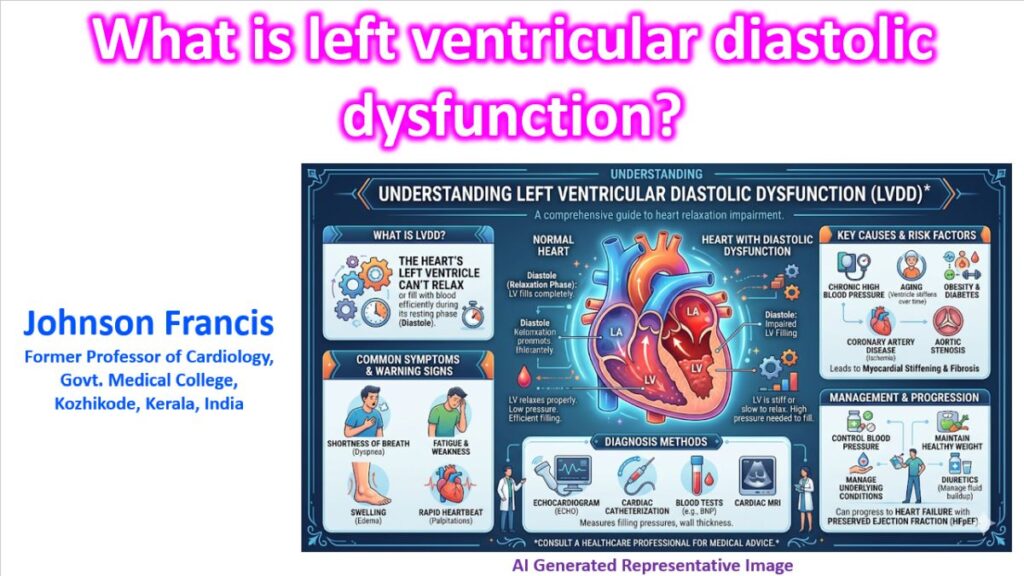

Left ventricular diastolic dysfunction (LVDD) is a condition where the heart’s main pumping chamber (the left ventricle) becomes abnormally stiff or fails to relax properly between heartbeats.
To understand what goes wrong, it helps to look at the two main phases of a normal heartbeat:
- Systole: The ventricle contracts to pump blood out to the body.
- Diastole: The ventricle relaxes and expands to fill with oxygen-rich blood coming from the lungs.
In LVDD, the heart’s ability to squeeze (systolic function) is usually completely normal. The problem lies entirely in the relaxation phase. Because the ventricle is too stiff or slow to relax, it resists filling with blood.
The Domino Effect
To compensate for a stiff ventricle and ensure enough blood fills the chamber to supply the body, the heart has to operate at higher internal pressures. This elevated filling pressure causes a chain reaction:
- The high pressure backs up into the left atrium (the upper chamber that feeds the ventricle), causing it to stretch and enlarge over time.
- From the left atrium, the pressure backs up further into the pulmonary veins and the lungs.
- This pressure pushes fluid out of the blood vessels and into the air sacs of the lungs (pulmonary congestion).
This fluid backup is what causes the hallmark symptom of LVDD: shortness of breath, particularly during physical exertion or when lying flat at night. If LVDD becomes severe enough to cause overt symptoms of fluid overload, it crosses the threshold into Heart Failure with preserved Ejection Fraction (HFpEF), historically known as diastolic heart failure.
Common Causes
Diastolic dysfunction is rarely an isolated issue; it is usually a structural response to long-term wear and tear, stress, or metabolic changes in the heart muscle:
- Chronic Hypertension (High Blood Pressure): This is the most common cause. Pumping against high pressure forces the heart muscle to thicken (left ventricular hypertrophy). A thicker muscle is a stiffer muscle.
- Aging: The heart naturally loses some of its elasticity and replaces pliable tissue with stiffer collagen fibers as we get older.
- Ischemia (Coronary Artery Disease): Muscle relaxation is actually an active process that requires energy. If the heart muscle isn’t getting enough oxygen-rich blood, it can’t relax efficiently.
- Aortic Stenosis: A narrowing of the aortic valve that forces the ventricle to work harder, leading to the same thickening and stiffening seen in high blood pressure.
- Diabetes and Obesity: Both conditions can drive systemic inflammation, leading to microvascular damage and fibrosis (scarring) within the heart tissue.