
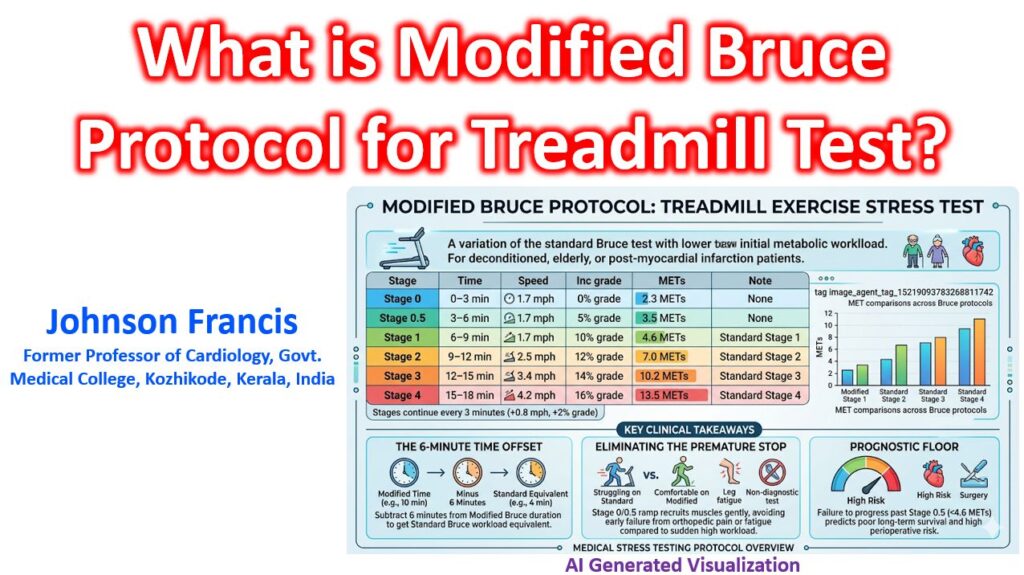
The Modified Bruce Protocol is a variation of the standard Bruce treadmill exercise stress test designed to lower the initial metabolic workload. It is primarily utilized for deconditioned, elderly, or post-myocardial infarction patients whose clinical history suggests they might experience early peripheral muscle fatigue before reaching a true ischemic or cardiopulmonary endpoint.
The defining mechanical difference is that it adds two 3-minute warm-up stages at the beginning of the test, keeping the belt moving at a slow 1.7 mph while gradually introducing the incline.
The Protocol Stages
To maintain data continuity in digital stress-testing systems, the two lead-in stages are typically designated as Stage 0 and Stage 0.5 so that once the patient reaches a 10% grade, the stage numbering aligns directly with the Standard Bruce protocol.
| Stage | Total Time | Speed | Grade / Incline | Approx. METs | Standard Bruce Equivalent |
| Stage 0 | 0 – 3 min | 1.7 mph | 0% | 2.3 | None (Flat walk) |
| Stage 0.5 | 3 – 6 min | 1.7 mph | 5% | 3.5 | None (Half incline) |
| Stage 1 | 6 – 9 min | 1.7 mph | 10% | 4.6 | Standard Stage 1 |
| Stage 2 | 9 – 12 min | 2.5 mph | 12% | 7.0 | Standard Stage 2 |
| Stage 3 | 12 – 15 min | 3.4 mph | 14% | 10.2 | Standard Stage 3 |
| Stage 4 | 15 – 18 min | 4.2 mph | 16% | 13.5 | Standard Stage 4 |
(Stages continue upwards from here matching standard Bruce increments of +0.8 mph and +2% grade every 3 minutes). An alternate stage naming is making Stage 0 as Stage 1 and continuing upwards. In that system, Modified Bruce Protocol Stage 3 will be equivalent to Stage 1 of Standard Bruce Protocol.
Key Clinical Takeaways
- The 6-Minute Time Offset: Because of the two added 3-minute warm-up stages, you can instantly convert a Modified Bruce exercise duration to its Standard Bruce prognostic equivalent simply by subtracting 6 minutes. For example, a patient who exercises for 10 minutes on the Modified protocol has achieved the exact metabolic workload of 4 minutes on the Standard protocol.
- Eliminating the “Premature” Stop: The Standard Bruce forces a patient immediately onto a 10% grade at 4.6 METs. For a frail or sedentary patient, this sudden step-up frequently triggers orthopedic pain, extreme calf fatigue, or anxiety-induced dyspnea within the first 120 seconds, resulting in a non-diagnostic test. The Stage 0/0.5 ramp recruits the lower-extremity musculature much more gently.
- Prognostic Floor: If a patient cannot progress past Stage 0.5 (failing to cross the 4.6 MET threshold into standard Stage 1), it serves as a strong independent predictor of poor long-term survival and indicates a high risk for perioperative complications during major non-cardiac surgeries.