
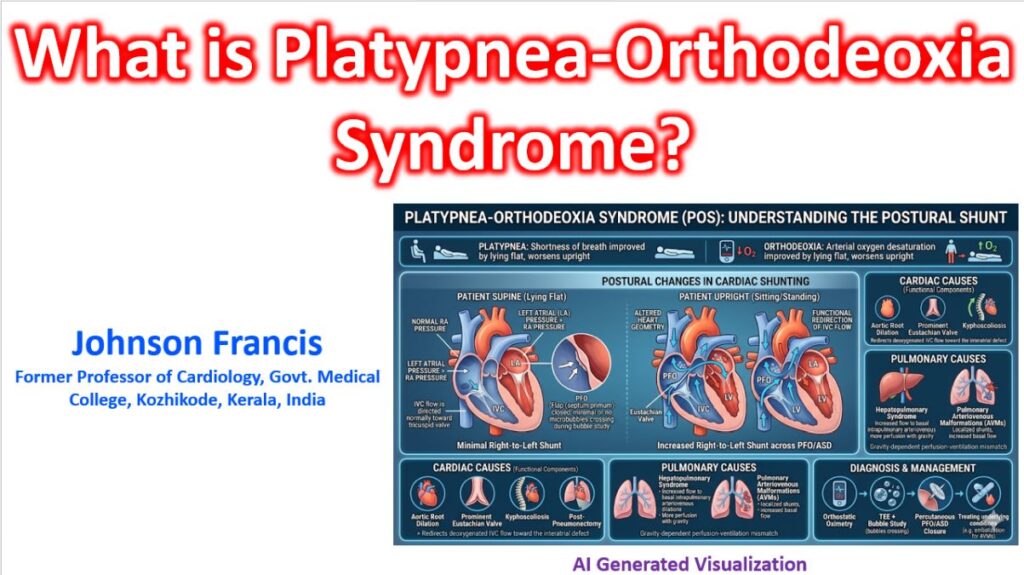

Platypnea-orthodeoxia syndrome (POS) is a rare clinical condition characterized by dyspnea (platypnea) and arterial desaturation (orthodeoxia) that occur in the upright position and resolve when the person is supine.
For POS to occur, two distinct components must be present simultaneously:
- An anatomical defect: A communication allowing a right-to-left shunt (most commonly interatrial).
- A functional component: A condition that mechanically promotes flow across this defect specifically when the patient assumes an upright posture.
Pathophysiology
The most common etiology is cardiac, primarily involving a patent foramen ovale (PFO), an atrial septal defect (ASD), or an atrial septal aneurysm. In a normal heart, right atrial pressures are lower than left atrial pressures, keeping the PFO flap closed. However, in POS, a right-to-left shunt occurs without the strict need for elevated right heart pressures, though decreased right ventricular compliance can contribute.
Instead, postural changes alter the cardiac geometry. When the patient stands, the spatial relationship between the inferior vena cava (IVC) and the interatrial septum shifts.
The functional component essentially redirects the column of deoxygenated venous return from the IVC directly toward the septal defect. Common triggers that alter this geometry include:
- Aortic root dilatation or aneurysm: A dilated aortic root can impinge on the right atrium, altering the septal angle and aligning the PFO directly with the IVC inflow.
- Prominent Eustachian valve or Chiari network: These embryologic remnants can actively direct IVC flow toward the interatrial septum.
- Post-pneumonectomy or kyphoscoliosis: Mediastinal shift (especially after a right pneumonectomy) or severe spinal deformity can rotate the heart, changing the angle of caval inflow.
- Pericardial effusion or constrictive pericarditis: These can selectively alter right-sided compliance and filling dynamics, exaggerating the pressure gradient during inspiration or an upright posture.
Pulmonary Causes
While cardiac shunting is the most frequent cause, POS can also be driven by pulmonary pathology:
- Hepatopulmonary syndrome: Intrapulmonary arteriovenous dilations are predominantly located in the lung bases. When the patient stands, gravity shifts pulmonary blood flow to these basal segments, increasing the right-to-left shunt fraction and worsening hypoxemia.
- Pulmonary arteriovenous malformations (AVMs): Similar gravity-dependent perfusion mismatch occurs with AVMs localized in the lower lobes.
Diagnostic Workup
The diagnosis hinges on demonstrating the postural dependency of the shunt and the hypoxemia:
- Orthostatic oximetry: Documenting a drop in oxygen saturation (often >5%) or a substantial fall in PaO2 upon standing that corrects upon lying flat.
- Echocardiography: A transesophageal echocardiogram (TEE) or transthoracic echocardiogram (TTE) with a bubble study (agitated saline contrast) is the gold standard for cardiac causes. The defining finding is a negative or weakly positive bubble study while supine, converting to a strongly positive right-to-left shunt (appearance of microbubbles in the left atrium within 3 cardiac cycles) when the patient is tilted upright or performs a Valsalva maneuver.
Management
For cardiac POS, percutaneous closure of the PFO or ASD is highly effective. It is generally considered the definitive treatment and often results in immediate and dramatic resolution of symptoms, provided there is no severe irreversible pulmonary hypertension. For pulmonary causes, management is directed at the underlying disease (e.g., liver transplantation for hepatopulmonary syndrome, or percutaneous embolization of pulmonary AVMs).