


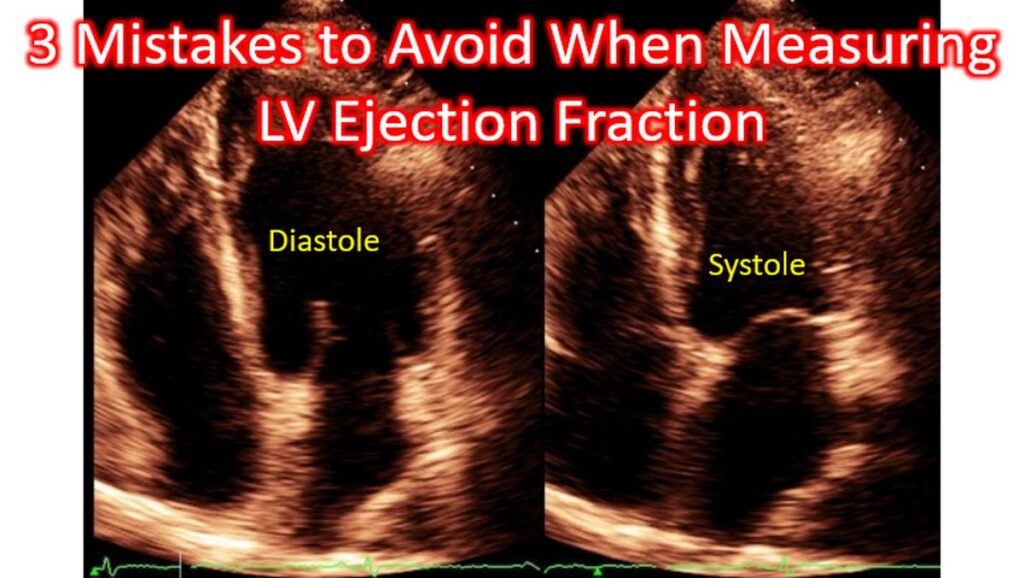
Measuring Left Ventricular Ejection Fraction (LVEF) is a cornerstone of cardiac assessment, but it’s surprisingly easy to get “pretty numbers” that don’t reflect the heart’s true function.
Whether you are using the modified Simpson’s method (biplane method of disks) or 3D modeling, avoiding these three common pitfalls will significantly improve your diagnostic accuracy.
1. Foreclosure of the Apex (Apical Foreshortening)
This is perhaps the most frequent error in echocardiography. When the transducer is not placed at the true apex, the ventricle appears more spherical and shorter than it actually is.
- The Mistake: Cutting across the “side” of the ventricle rather than its long axis. This leads to an underestimation of the end-diastolic volume (EDV) and can make the EF appear falsely higher or lower depending on regional wall motion.
- How to avoid it: Move the transducer down an intercostal space or more laterally. Look for the longest possible long-axis dimension. If the apex isn’t moving or looks “thick,” you are likely foreshortening.
2. Poor Endocardial Border Definition
If you can’t see it, you shouldn’t trace it. Guessing where the wall ends leads to “border drift,” where the trace includes trabeculations or papillary muscles.
- General rule is that papillary muscles should be excluded from the cavity tracing. More important is to have consistency across measurements to enable comparison.
- How to avoid it: Optimize your gain settings. If the endocardial border is still ambiguous (especially in the “echo-drop out” areas of the lateral wall), use an ultrasound enhancing agent (contrast) to clearly opacify the chamber.
3. Ignoring Arrhythmias (The “Single-Beat” Trap)
Calculating LVEF based on a single cardiac cycle is risky, especially in patients with atrial fibrillation or frequent ectopy.
- The Mistake: Measuring a beat following a long R-R interval (which allows for extra filling and a stronger contraction) or a premature beat (which has poor filling and a weak contraction). This results in a measurement that doesn’t represent the patient’s “average” hemodynamic state.
- How to avoid it: * For Sinus Rhythm: Average at least 3 beats.
- For Atrial Fibrillation: Average at least 5 to 10 beats to account for the beat-to-beat variability in filling time. Alternatively, look for the “index beat”—a beat where the preceding and pre-preceding R-R intervals are nearly equal.
Summary Checklist for LVEF
| Step | Action |
| View | Ensure the apex is not foreshortened; maximize LV length. |
| Tracing | Trace the interface between the compact myocardium and the blood pool. |
| Anatomy | Exclude papillary muscles from the LV cavity. |
| Timing | Select the frames with the largest (EDV) and smallest (ESV) volumes carefully. |