


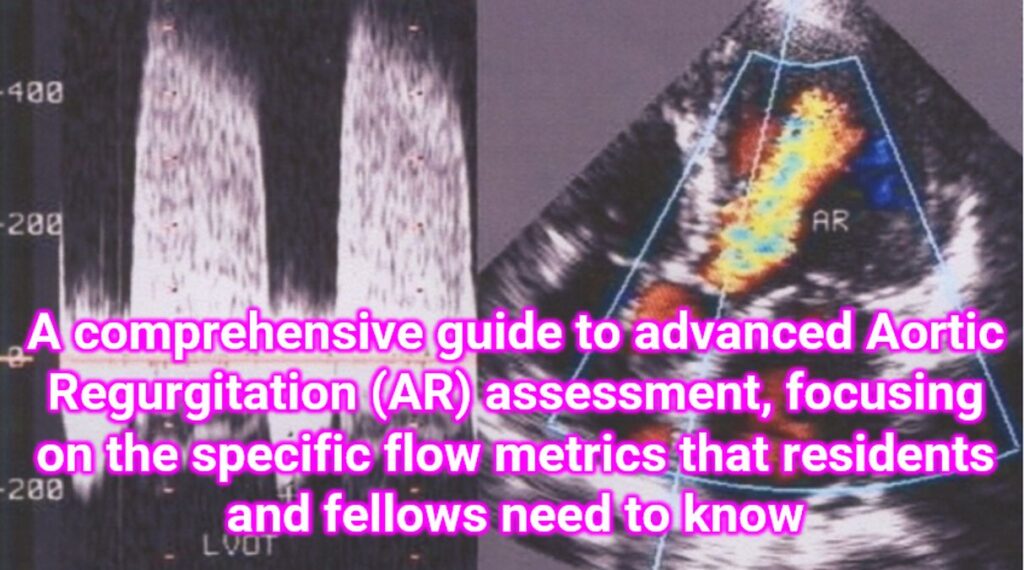

Assessing chronic Aortic Regurgitation (AR) requires a multi-parametric approach. For residents and fellows, the challenge lies in moving beyond simple color Doppler and mastering the quantitative metrics that dictate surgical timing.
The following guide breaks down the “gold standard” flow metrics and quantitative assessments used in advanced echocardiography.
1. The Quantitative Triad
The American Society of Echocardiography (ASE) emphasizes three primary quantitative measures to define Severe AR.
| Metric | Mild | Moderate | Severe |
| Effective Regurgitant Orifice Area (EROA) | < 0.10 cm2 | 0.10 – 0.29 cm2 | ≥ 0.30 cm2 |
| Regurgitant Volume (RVol) | < 30 mL/beat | 30 – 59 mL/beat | ≥ 60 mL/beat |
| Regurgitant Fraction (RF) | < 30% | 30 – 49% | ≥ 50% |
The PISA Method
Proximal Isovelocity Surface Area (PISA) is often more difficult in AR than in Mitral Regurgitation because the flow convergence zone is frequently constrained by the LVOT walls.
- Formula: EROA = (2πr2 x Valias)/Vmax
- Clinical Tip: Shift the baseline toward the direction of the jet (usually downward for AR) to a Nyquist limit of 30 – 40 cm/s.
2. Spectral Doppler Flow Metrics
While PISA provides a “snapshot,” spectral Doppler provides insight into the hemodynamics of the entire cardiac cycle.
Pressure Half-Time (PHT)
This measures the rate of pressure equalization between the aorta and the LV during diastole.
- Severe AR: < 200 ms
- Mechanism: As the LV fills rapidly from the aorta, the pressure gradient drops quickly.
- Pitfall: PHT is highly dependent on LV compliance and systemic vascular resistance. In acute AR or patients with high LV end-diastolic pressure, the PHT will be short regardless of severity.
Holodiastolic Flow Reversal (HDFR)
This is one of the most specific markers for severe AR. Measure this in the proximal descending aorta (using the Suprasternal notch view) or the abdominal aorta.
- Severe AR: A sustained retrograde flow throughout the entire duration of diastole.
- Metric: An end-diastolic velocity > 20 cm/s (measured at the end of the envelope) strongly correlates with severe AR.
3. Structural Vena Contracta (VC)
The VC represents the narrowest portion of the jet. It is relatively independent of flow rate and driving pressure.
- Severe AR: > 0.6 cm
- Advanced Technique: Vena Contracta Area (VCA) using 3D echo is superior for eccentric or multiple jets where a single linear diameter might underestimate the true orifice.
4. Volume-Flow Method (Doppler Continuity)
When PISA is non-contributory (e.g., eccentric jets), use the continuity equation to calculate RVol.
- Calculate Total Stroke Volume: SVtotal = CSALVOT x VTILVOT
- Calculate Systemic Stroke Volume: SVsystemic = CSAMV x VTIMV (assuming no MR)
- Regurgitant Volume: RVol = SVtotal – SVsystemic
Important!
The “Low-Flow” Caveat: If the LV is severely dilated or systolic function is low, traditional velocity-based metrics may underestimate severity. Always correlate flow metrics with LV dimensions (e.g., LVESD > 50 mm or 25 mm/m2 ).
5. Summary Checklist for Fellows
When presenting a case of advanced AR, ensure you have checked the following:
- [ ] Jet Width/LVOT Ratio: Is it >65%?
- [ ] PHT: Is it <200 ms?
- [ ] Abdominal Aorta: Is there holodiastolic reversal?
- [ ] PISA EROA: Does it match the visual assessment?
- [ ] LV Dimensions: Is the ventricle remodeling in response to the volume overload?