


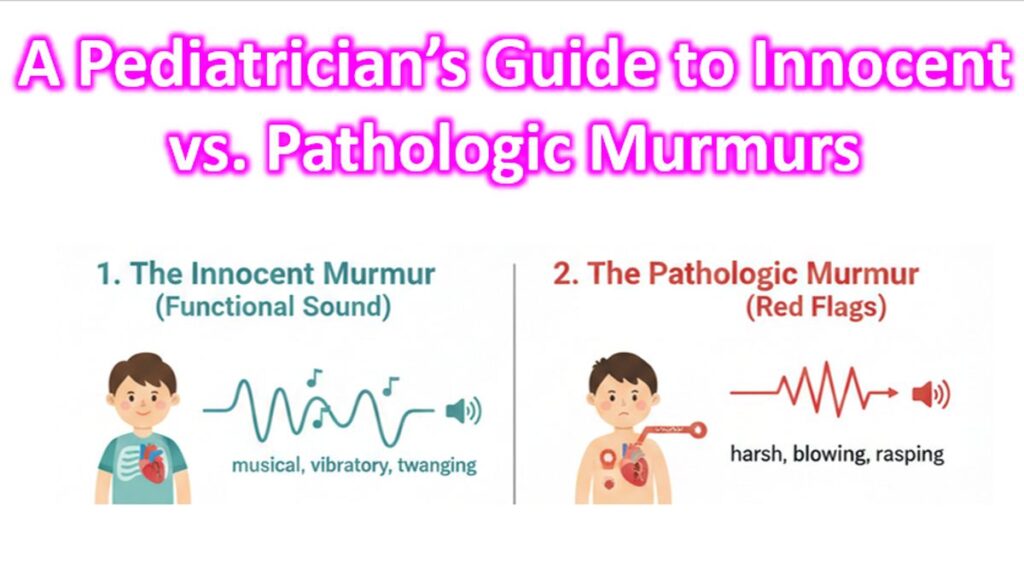

Hearing a heart murmur during a routine sports physical or a well-child check can be nerve-wracking for parents, but for a clinician, it’s usually a puzzle of acoustics. About 75% of children will have an innocent murmur at some point during development. The goal is to differentiate the “musical” sounds of normal flow from the “harsh” sounds of structural turbulence.
1. The Innocent Murmur (The “Functional” Sound)
Innocent murmurs are caused by normal blood flow through normal structures. Think of it like the sound of water rushing through a garden hose—sometimes you hear the vibration, but the hose isn’t leaking.
Key Acoustic Features:
- Timing: Always systolic (occurs between S1 and S2). An innocent murmur never occurs during diastole.
- Pitch/Quality: Characteristically vibratory, musical, or twanging. The classic “Still’s Murmur” sounds like a plucked string.
- Intensity: Usually Grade I or II. Crucially, the intensity changes with position; it often softens or disappears when the child sits up or stands.
- Location: Usually loudest at the Left Lower Sternal Border or the pulmonic area.
2. The Pathologic Murmur (The Red Flags)
Pathologic murmurs indicate structural heart disease, such as a hole in the heart (VSD/ASD) or a narrowed valve (stenosis).
Key Acoustic Features:
- Timing: Any diastolic murmur is pathologic until proven otherwise. Additionally, holosystolic murmurs (lasting the entire duration of systole) are high-risk.
- Pitch/Quality: Described as harsh, blowing, or rasping. It sounds more like static or wind than a musical note.
- Intensity: Grade III or higher. If you can feel a “thrill” (a physical vibration on the chest wall), it is Grade IV and most likely pathologic.
- Radiation: Does the sound travel to the back, the axilla, or up into the neck? If it radiates widely, it likely points to a structural issue.
Comparison at a Glance
| Feature | Innocent Murmur | Pathologic Murmur |
| Timing | Midsystolic only | Diastolic, Holosystolic, or Late Systolic |
| Quality | Musical, vibratory, “sweet” | Harsh, blowing, grinding |
| Grade | I–II (Quiet) | III–VI (Loud) |
| Position | Changes/disappears with sitting | Remains constant |
| S2 Sound | Normal splitting | Fixed split S2 or single S2 |
Even if a murmur sounds innocent, we always correlate with the clinical picture—poor weight gain, cyanosis, or fainting during exercise warrants an immediate Echocardiogram.