



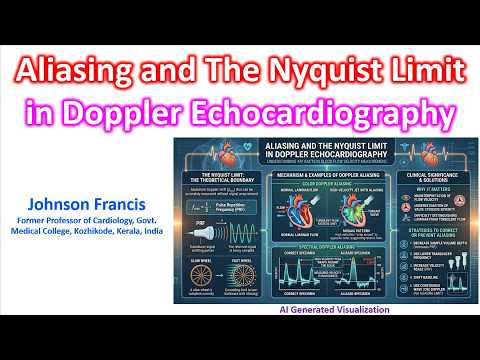
In Doppler echocardiography, aliasing is an artifact that occurs when the Doppler shift frequency exceeds the system’s ability to sample it accurately. The threshold at which this signal distortion begins is known as the Nyquist limit.
The Nyquist limit dictates that the maximum measurable Doppler shift without aliasing is exactly half of the Pulse Repetition Frequency (PRF)—the rate at which the transducer emits ultrasound pulses:
Nyquist Limit = PRF/2
If the blood flow velocity creates a Doppler shift that exceeds this limit, the system “wraps” the signal, displaying the high velocities as moving in the opposite direction.
Spectral (Pulsed Wave) Aliasing
In Pulsed Wave (PW) Doppler, aliasing appears as the peak of the waveform being “cut off” at the top of the spectral display and wrapping around to appear at the bottom, mimicking flow in the opposite direction. This is a primary limitation of PW Doppler when evaluating high-velocity jets like stenotic valves or regurgitant orifices.
Color Flow Aliasing
Color flow mapping is essentially multigated PW Doppler, meaning it is subject to the exact same physical limitations. When flow velocities exceed the Nyquist limit set by the color scale, the color wraps from the forward flow spectrum directly into the reverse flow spectrum.
Instead of a smooth transition through black (which represents zero velocity), the display shows a chaotic, bright mosaic pattern. You will see the highest velocity forward flow (e.g., bright yellow/orange) immediately adjacent to the highest velocity reverse flow (e.g., bright cyan/blue).
Clinical Exception: While aliasing is usually an artifact to be corrected, it is intentionally exploited when calculating the Proximal Isovelocity Surface Area (PISA) for quantifying mitral regurgitation. By intentionally lowering the Nyquist limit (shifting the color baseline), you create a distinct aliasing boundary that corresponds to a known, specific velocity.
Strategies to Eliminate Unwanted Aliasing
When evaluating high velocities where aliasing is hindering your measurement, you can manipulate several parameters on the machine to resolve it:
- Increase the PRF (Scale): Increasing the velocity scale directly increases the PRF, which raises the Nyquist limit.
- Shift the Baseline: If the flow is unidirectional, dropping the baseline gives the entire spectral display over to one direction. This effectively doubles the unaliased velocity range for that specific direction without changing the PRF.
- Decrease Sample Volume Depth: Deep sample volumes require a longer “listen” time for the pulse to return, which forces the machine to lower the PRF. Moving the sample volume to a shallower depth (if a different acoustic window allows) enables a higher PRF.
- Use a Lower Frequency Transducer: The Doppler equation demonstrates that the Doppler shift (△f) is directly proportional to the transmitted transducer frequency (f0):
- △f = [f0vcos(θ)]/c
- Lowering the frequency decreases the Doppler shift for any given blood velocity (v), helping to keep it under the Nyquist limit.
- Switch to Continuous Wave (CW) Doppler: CW Doppler continuously transmits and receives using two distinct crystals. Because it does not pulse, it does not have a PRF or a Nyquist limit. It can measure theoretically infinite velocities without aliasing, though it sacrifices range resolution (depth specificity).