


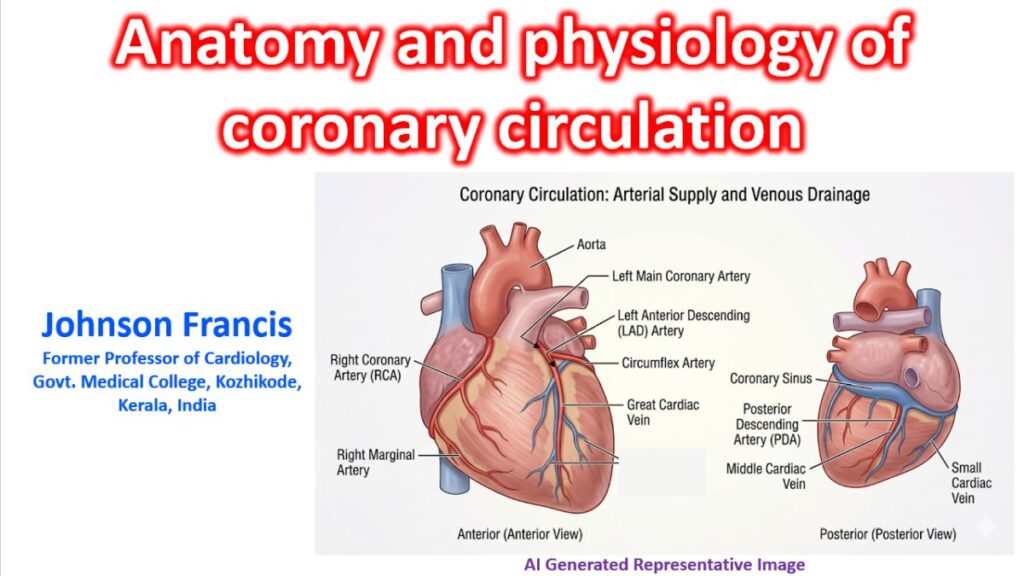

Here is a comprehensive breakdown of the anatomy and physiology of coronary circulation.
I. Anatomy of Coronary Circulation
The coronary circulation consists of the blood vessels that supply the heart muscle (myocardium) with oxygen and nutrients, and those that remove deoxygenated blood. It is primarily divided into the arterial supply and venous drainage.
1. Arterial Supply
The heart is supplied by two main coronary arteries that originate from the root of the aorta, just above the aortic valve (at the sinuses of Valsalva).
- Left Main Coronary Artery (LMCA): The LMCA is typically short and bifurcates into two major branches:
- Left Anterior Descending (LAD): Often referred to clinically as the “widow-maker” when blocked at its origin, it courses down the anterior interventricular sulcus. It supplies the anterior wall of the left ventricle (LV), the anterior two-thirds of the interventricular septum, the apex, and the bundle branches.
- Left Circumflex Artery (LCx): Courses along the atrioventricular (AV) groove toward the posterior aspect of the heart. It primarily supplies the lateral and posterior walls of the left ventricle, and the left atrium.
- Right Coronary Artery (RCA): Originates from the right aortic sinus and travels down the right AV groove. It typically supplies the right atrium, the right ventricle, the sinoatrial (SA) node (in ~60% of people), and the atrioventricular (AV) node (in ~90% of people).
- Coronary Dominance: This is determined by the artery that supplies the Posterior Descending Artery (PDA), which runs in the posterior interventricular sulcus and supplies the inferior wall of the LV and the posterior third of the septum.
- Right Dominant (~70-80%): The PDA arises from the RCA.
- Left Dominant (~10%): The PDA arises from the LCx.
- Co-dominant (~10-20%): The posterior septum is supplied by branches from both the RCA and LCx.
2. Venous Drainage
Deoxygenated blood is returned to the right atrium through three main pathways:
- The Coronary Sinus: The primary collector of venous blood from the left side of the heart. It sits in the posterior AV groove and empties directly into the right atrium. Major tributaries include the great cardiac vein, middle cardiac vein, and small cardiac vein.
- Anterior Cardiac Veins: These drain the anterior right ventricle and empty directly into the right atrium, bypassing the coronary sinus. They may occasionally drain into the small cardiac vein.
- Thebesian Veins (Venae Cordis Minimae): Minute veins that drain directly into all four cardiac chambers, though most notably into the right atrium and right ventricle. They contribute to a small physiological right-to-left shunt.
II. Physiology of Coronary Circulation
The myocardium has a continuous, extremely high demand for oxygen. The physiology of the coronary system is designed to meet this demand under varying conditions of physical and emotional stress.
1. Phasic Blood Flow
Coronary blood flow is not continuous; it is highly dependent on the phases of the cardiac cycle.
- Left Ventricle: Blood flow to the LV occurs primarily during diastole. During systole, the strong contraction of the thick LV myocardium compresses the subendocardial blood vessels, dropping arterial flow to near zero. When the ventricle relaxes during diastole, the compressive forces are released, and maximum flow occurs.
- Right Ventricle: Because the right ventricle pumps at a much lower pressure, the compressive forces during systole are less severe. Therefore, blood flow to the RV remains relatively continuous throughout both systole and diastole.
2. High Oxygen Extraction
At rest, the myocardium extracts 70% to 80% of the oxygen delivered to it by arterial blood. Because extraction is nearly maximal even at rest, the heart cannot simply extract more oxygen if demand increases (unlike skeletal muscle). Therefore, the only way the heart can meet increased metabolic demands (e.g., during exercise) is to significantly increase coronary blood flow.
3. Autoregulation and Metabolic Control
Coronary blood flow is tightly coupled to myocardial oxygen consumption. This local autoregulation overrides other systemic signals.
- Adenosine: When myocardial oxygen demand outpaces supply, ATP degrades to adenosine. Adenosine is a potent vasodilator that acts locally on the smooth muscle of coronary arterioles to increase blood flow.
- Other Metabolites: Hypoxia, increased carbon dioxide (PCO2), hydrogen ions (H+), potassium ions (K+), and nitric oxide (NO) also contribute to local vasodilation to ensure flow matches demand.
4. Autonomic Nervous Control
While metabolic control is the primary driver of coronary vascular tone, the autonomic nervous system plays a secondary role:
- Sympathetic Stimulation: Activation of alpha-1 receptors causes vasoconstriction, while activation of beta-2 receptors causes vasodilation. However, sympathetic stimulation also increases heart rate and contractility (beta-1 receptors on the myocardium), increasing overall metabolic demand. This local metabolic demand triggers the release of vasodilators (like adenosine), which completely overrides the direct alpha-mediated vasoconstriction (active hyperemia).
- Parasympathetic Stimulation: Vagal nerve stimulation mildly dilates the coronary arteries, but its primary effect is slowing the heart rate, thereby decreasing overall oxygen demand and ultimately reducing total coronary flow.