


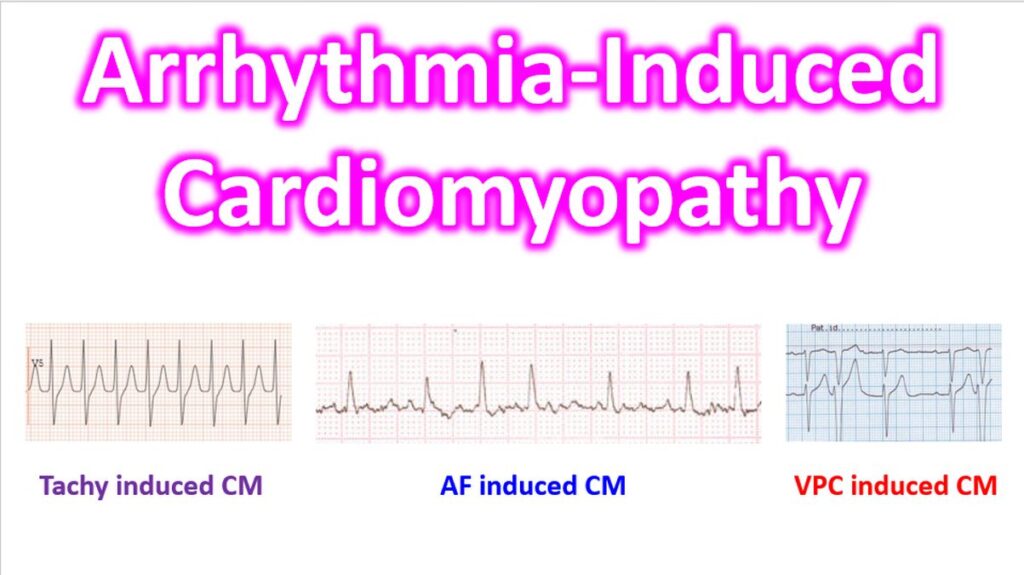

Arrhythmia-induced cardiomyopathy encompasses three subgroups with left ventricular dysfunction induced by arrhythmia. They are tachycardia with mean heart rate about 100 beats/min, atrial fibrillation and frequent premature ventricular complexes with a PVC burden more than 10%. Arrhythmia-induced cardiomyopathy is confirmed when the cardiomyopathy reverses on cure of the arrhythmia which caused the cardiomyopathy. Thus arrhythmia-induced cardiomyopathy is a reversible form of dilated cardiomyopathy. The term does not encompass the cardiomyopathy associated with chronic right ventricular pacing, left bundle branch block and pre-excitation, which are due to left ventricular contractile dyssynchrony as a result of change in sequence of left ventricular activation [1].
Tachycardia induced cardiomyopathy, also known as tachycardiomyopathy, was probably the first of the three varieties of arrhythmia-induced cardiomyopathy, to be documented, early in 20th century. Risk of developing tachycardiomyopathy depends on the type, duration and rate of the tachycardia. It has been reported to occur in up to 37% of those with incessant atrial tachycardia [2]. Permanent junctional reciprocating tachycardia may be having the greatest association with tachycardiomyopathy of 20-50% as it presents with incessant supraventricular tachycardia due a posteroseptal accessory pathway [3]. In one study, 4% of patients referred for pulmonary vein isolation for atrial fibrillation had tachycardia induced cardiomyopathy [4].
Supraventricular arrhythmias like atrial fibrillation and atrial flutter with rapid ventricular response are probably the most common causes of tachycardiomyopathy. Atrial tachycardia, atrioventricular reciprocating tachycardia, AV nodal reentrant tachycardia, sustained sinus tachycardia, different types of ventricular tachycardia and even pacemaker mediated tachycardia can also cause tachycardia induced cardiomyopathy.
Structural and functional changes can occur in the myocardium in tachycardia induced cardiomyopathy. There is electrical and calcium remodeling leading to impaired excitation-contraction coupling and diastolic dysfunction. Impaired calcium handling dynamics include reduced calcium transients, L-type calcium current and basal adenosine triphosphatase activity which correlate with reduced left ventricular ejection fraction [1].
In case of atrial fibrillation induced cardiomyopathy, pathophysiologic mechanisms include irregular heart rate leading to abnormal calcium dynamics and loss of atrial contractility and emptying which triggers sympathetic activation. These can lead to restricted ventricular filling, diastolic dysfunction, increased filling pressures and functional mitral regurgitation. Atrial mitochondrial dysfunction with reduced adenosine triphosphate has been documented in atrial fibrillation, mainly in those with persistent AF and heart failure [5].
Several mechanisms are probably involved in premature ventricular complex induced cardiomyopathy of which main cause seems to be disruption in calcium induced calcium release mechanism. There is electrophysiological remodeling and fibrosis. Premature ventricular complexes can disrupt cardiac autonomic balance leading to imbalanced sympathetic overload. Most potent disruption of cardiac autonomic balance seems to be with premature ventricular complexes with variable coupling intervals, usually attributed to multifocal origin [6].
References
- Shoureshi P, Tan AY, Koneru J, Ellenbogen KA, Kaszala K, Huizar JF. Arrhythmia-Induced Cardiomyopathy: JACC State-of-the-Art Review. J Am Coll Cardiol. 2024 Jun 4;83(22):2214-2232. doi: 10.1016/j.jacc.2024.03.416. PMID: 38811098.
- Huizar JF, Ellenbogen KA, Tan AY, Kaszala K. Arrhythmia-Induced Cardiomyopathy: JACC State-of-the-Art Review. J Am Coll Cardiol. 2019 May 14;73(18):2328-2344. doi: 10.1016/j.jacc.2019.02.045. PMID: 31072578; PMCID: PMC6538508.
- Moore JP, Patel PA, Shannon KM, Albers EL, Salerno JC, Stein MA, Stephenson EA, Mohan S, Shah MJ, Asakai H, Pflaumer A, Czosek RJ, Everitt MD, Garnreiter JM, McCanta AC, Papez AL, Escudero C, Sanatani S, Cain NB, Kannankeril PJ, Bratincsak A, Mandapati R, Silva JN, Knecht KR, Balaji S. Predictors of myocardial recovery in pediatric tachycardia-induced cardiomyopathy. Heart Rhythm. 2014 Jul;11(7):1163-9. doi: 10.1016/j.hrthm.2014.04.023. Epub 2014 Apr 19. PMID: 24751393.
- Gentlesk PJ, Sauer WH, Gerstenfeld EP, Lin D, Dixit S, Zado E, Callans D, Marchlinski FE. Reversal of left ventricular dysfunction following ablation of atrial fibrillation. J Cardiovasc Electrophysiol. 2007 Jan;18(1):9-14. doi: 10.1111/j.1540-8167.2006.00653.x. Epub 2006 Nov 1. PMID: 17081210.
- Ozcan C, Li Z, Kim G, Jeevanandam V, Uriel N. Molecular Mechanism of the Association Between Atrial Fibrillation and Heart Failure Includes Energy Metabolic Dysregulation Due to Mitochondrial Dysfunction. J Card Fail. 2019 Nov;25(11):911-920. doi: 10.1016/j.cardfail.2019.08.005. Epub 2019 Aug 12. PMID: 31415862; PMCID: PMC7144800.
- Kawamura M, Badhwar N, Vedantham V, Tseng ZH, Lee BK, Lee RJ, Marcus GM, Olgin JE, Gerstenfeld EP, Scheinman MM. Coupling interval dispersion and body mass index are independent predictors of idiopathic premature ventricular complex-induced cardiomyopathy. J Cardiovasc Electrophysiol. 2014 Jul;25(7):756-62. doi: 10.1111/jce.12391. Epub 2014 Mar 19. PMID: 24612052.