


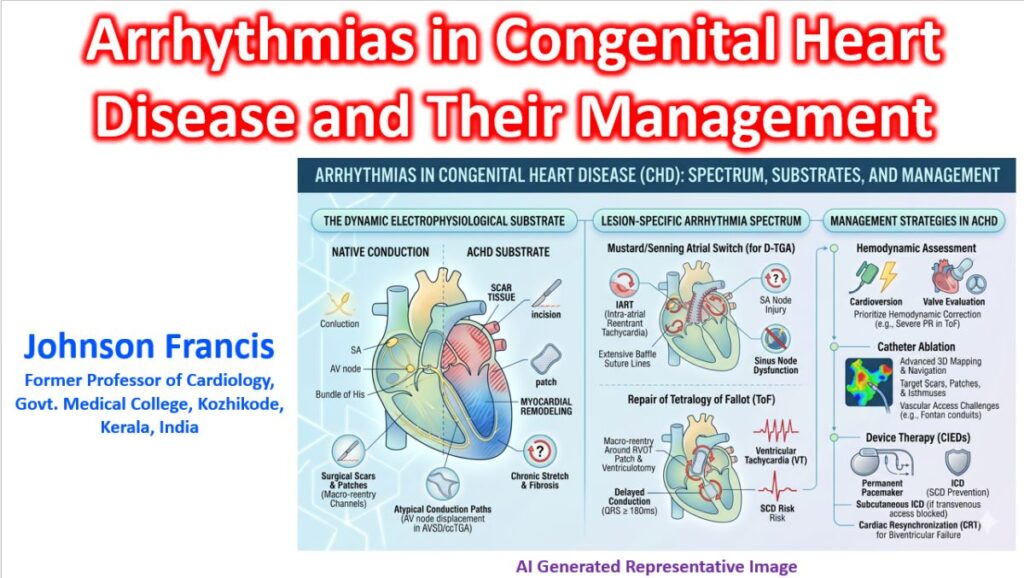

Arrhythmias represent the leading cause of morbidity, unplanned hospitalization, and death in adults with congenital heart disease (ACHD). Managing them requires shifting focus from simple rate or rhythm control to an assessment of the underlying substrate—which is an intricate blend of altered native anatomy, chronic hemodynamic stress, and surgical scarring.
1. The Dynamic Electrophysiological Substrate
The arrythmogeneric substrate in ACHD is rarely static; it evolves over decades due to several distinct factors.
Anatomy & Embryology
Malformations of the native conduction system are common. For example, in congenital corrected transposition of the great arteries (ccTGA) or atrioventricular septal defects (AVSD), the AV node is frequently displaced. This atypical positioning creates elongated, fragile bundle branches that are highly susceptible to progressive, spontaneous fibrosis and complete heart block.
Surgical Scarring (The Incisional Substrate)
Surgical incisions (atriotomies, ventriculotomies), patch materials (Dacron, bovine pericardium), and direct trauma from suture lines create non-conducting, fixed anatomical barriers.
- These borders form ideal, protected channels for macro-reentrant tachycardias.
- The classic example is intra-atrial reentrant tachycardia (IART) utilizing the cavotricuspid isthmus or an atriotomy scar.
Chronic Hemodynamic Remodeling
Long-term volume or pressure overload leads to progressive myocardial stretch, myofibrillar hypertrophy, and interstitial fibrosis. This mechanical disruption physically separates myocytes, altering gap junction distribution and causing slow, heterogeneous conduction—the classic trigger for localized reentrant loops.
2. Spectrum of Arrhythmias by Anatomical Lesion
The clinical presentation varies significantly based on the specific type of congenital defect and the surgical strategy used to repair it.
| Condition | Primary Arrhythmia Types | Common Mechanisms / Anatomical Triggers |
| Tetralogy of Fallot (ToF) | • Ventricular Tachycardia (VT) • Monomorphic Reentrant VT • Advanced AV Block | • Macro-reentry around the RVOT surgical scar, VSD patch, or ventriculotomy. • Chronic PR-induced RV dilation. • Surgical trauma to the right bundle branch. |
| Transposition of the Great Arteries (D-TGA) (Atrial Switch: Mustard/Senning) | • Intra-atrial Reentrant Tachycardia (IART) • Sinus Node Dysfunction (SND) | • Extensive suture lines along atrial baffles. • Direct surgical injury or ischemic necrosis of the SA node artery. |
| Single Ventricle / Fontan Circulation | • Refractory IART • Atrial Fibrillation (AF) • Focal Atrial Tachycardia | • Severe, chronic atrial stretch and elevated intra-atrial pressures. • Extensive atriopulmonary connection scars (lower incidence in modern total cavopulmonary connections). |
| Ebstein’s Anomaly | • Atrioventricular Reentrant Tachycardia (AVRT) • Atrial Fibrillation / Flutter | • High prevalence (up to 30%) of accessory pathways, frequently right-sided, multiple, and manifesting as WPW. • Severe right atrial dilation. |
3. Clinical Evaluation Challenges
Evaluating an ACHD patient presenting with new-onset palpitations, syncope, or a decline in functional class requires deep consideration of their unique anatomy:
- Hemodynamic Changes: A sudden tachyarrhythmia can completely destabilize a marginal circulation. For instance, in a Fontan patient, the loss of organized atrial contraction and a rapid ventricular rate can abruptly eliminate forward flow, leading to immediate hepatic congestion, systemic hypotension, or syncope.
- Risk Stratification in ToF: Identifying patients at risk for Sudden Cardiac Death (SCD) involves looking at multiple factors. A QRS duration greater than or equal to 180 ms on a standard 12-lead ECG remains a classic marker of severe RV dilation and delayed conduction. This finding should be interpreted alongside cardiovascular magnetic resonance (CMR) imaging to quantify the RV volume index and late gadolinium enhancement (LGE), as well as looking for inducible VT during electrophysiology studies (EPS).
- Diagnostic Limitations: Thick scar tissue, patches, and dilated chambers can significantly attenuate surface ECG signals, making it difficult to distinguish IART from focal atrial tachycardias without advanced mapping tools.
4. Management Framework
Phase 1: Initial Assessment & Hemodynamic Stabilization
- Hemodynamic Evaluation: Immediate assessment of stability is paramount, as new-onset tachyarrhythmias can completely destabilize marginal circulations (e.g., Fontan or Mustard/Senning circuits).
- Acute Stabilization: Urgent electrical cardioversion is required for poorly tolerated rhythms. For stable loops, highly tailored antiarrhythmic choices or rate-control strategies are utilized to prevent circulation collapse.
- Follow-up & Advanced Imaging: Comprehensive anatomical reviews are conducted using Cardiovascular Magnetic Resonance (CMR) to quantify ventricular volumes, assess valvular dysfunction, and track progressive myocardial fibrosis or remodeling.
Phase 2: Substrate Correction & Structural Optimization
- Addressing Residual Lesions: Before relying solely on rhythm suppression, underlying hemodynamic stressors must be managed.
- Surgical or Transcatheter Intervention: Correcting underlying structural failures—such as a pulmonary valve replacement for severe pulmonary regurgitation (PR) in repaired Tetralogy of Fallot (ToF)—is critical to reduce chronic atrial or ventricular stretch and eliminate the mechanical driver of the arrhythmia.
Phase 3: Advanced Mapping & Catheter Ablation
- High-Density 3D Electroanatomical Mapping: Critical for navigating distorted anatomy and identifying slow conduction channels or critical isthmuses tucked between non-conducting surgical scars, incisions, and patches.
- Vascular Access Challenges: Catheter manipulation is frequently limited by surgically altered venous anatomy, anomalous systemic venous return, or occluded vessels, often necessitating specialized transhepatic, superior, or transbaffle puncture techniques.
- Targeting the Incisional Substrate: Direct ablation lines are anchored to unexcitable anatomical boundaries or surgical borders to permanently interrupt macro-reentrant circuits.
Phase 4: CIEDs & Risk Stratification
| Therapy Type | Clinical Considerations & Access Stratagems |
| Device Selection | Includes permanent pacemakers for sinus node dysfunction/complex AV block, and Implantable Cardioverter-Defibrillators (ICDs) for sudden cardiac death (SCD) prevention. |
| Alternative Lead Routes | Because standard transvenous access to the ventricles can be blocked by baffles or conduits, epicardial lead placement or Subcutaneous ICDs (s-ICDs) are frequently utilized. |
| Long-Term Risk Profiling | Continuous risk stratification relies on surface ECG parameters—such as a prolonged QRS duration (180 ms or more) in ToF—alongside serial imaging to monitor the progression of diffuse fibrosis and refine cardiac resynchronization therapy (CRT) strategies for biventricular failure. |
Pharmacotherapy Considerations
Antiarrhythmic drugs are often poorly tolerated or ineffective as a long-term strategy in this population:
- Class IC agents (e.g., flecainide): Contraindicated in patients with structural ventricular disease, such as repaired ToF, due to proarrhythmic risks.
- Class III agents (e.g., amiodarone, sotalol): Effective for rhythm control, but long-term amiodarone use carries a high burden of extracardiac toxicities (thyroid, pulmonary, hepatic). This is a major concern for young ACHD patients who face decades of anticipated treatment.
- Beta-blockers: Essential for heart failure management, but they can exacerbate pre-existing sinus node dysfunction or AV block.
Catheter Ablation
Catheter ablation has shifted from a last-resort option to a frontline management strategy for recurrent atrial and ventricular tachyarrhythmias.
- Advanced Mapping: Ultra-high-density 3D electroanatomical mapping systems are crucial for reconstructing complex cardiac chambers and identifying channels of slow conduction between unexcitable surgical patches or scars.
- Anatomical Barriers: Traditional femoral venous access may be blocked or absent due to interrupted inferior vena cava layout, surgical ligations, or baffle configurations. Interventionalists often must use transhepatic or superior access routes, or perform transbaffle punctures to reach the target substrate.
Device Therapy (CIEDs)
Implantable Cardioverter-Defibrillators (ICDs) and permanent pacemakers face unique structural challenges in ACHD patients:
- Venous Access Limitations: In patients with a Fontan circuit or Mustard/Senning baffles, transvenous access to the subpulmonary or systemic ventricle may be anatomically impossible or restricted to prevent thromboembolic events across a fenestration.
- Alternative Approaches: Epicardial lead placement or subcutaneous ICDs (s-ICDs) are frequently used. However, s-ICDs require careful screening due to the high prevalence of RBBB configurations and T-wave oversensing caused by severe right ventricular hypertrophy.
5. Emerging Paradigms
The long-term approach to these patients is shifting toward proactive, early intervention. When an ACHD patient undergoes surgical revision—such as a pulmonary valve replacement for severe, chronic pulmonary regurgitation in ToF—surgeons increasingly perform intraoperative arrhythmia surgery. By placing prophylactic cryoablation lines between surgical scars and anatomical boundaries (like the tricuspid annulus), they can eliminate the substrate for IART and VT at the time of the structural repair.