


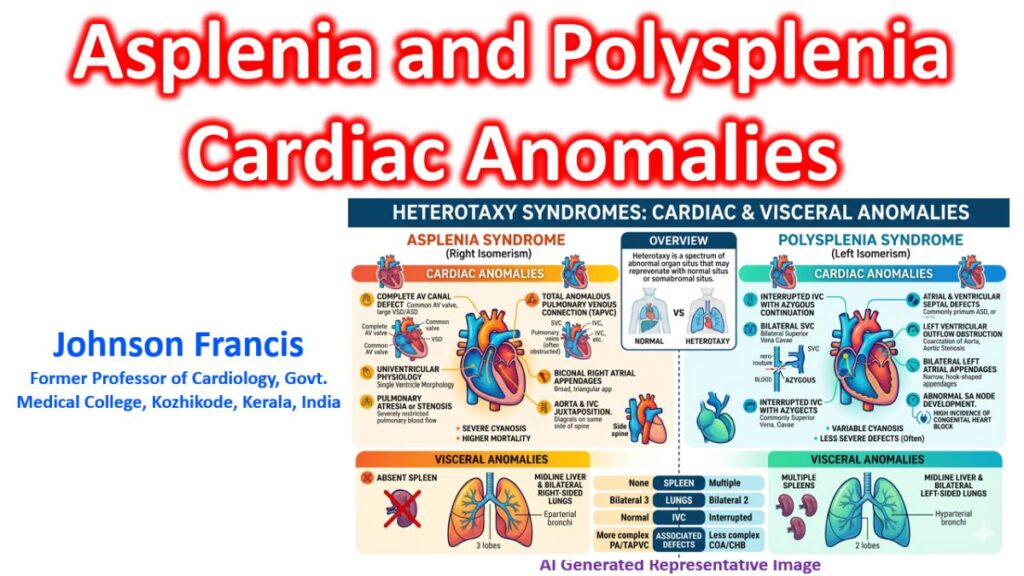

Asplenia and polysplenia syndromes represent the two primary phenotypic expressions of heterotaxy (situs ambiguus), resulting from a failure to establish normal left-right asymmetry during embryonic development. In clinical practice, these are best understood through the framework of cardiac isomerism, where paired structures exhibit bilateral symmetry of either the right-sided or left-sided morphology.
Right Isomerism (Asplenia Syndrome)
Right isomerism is characterized by the bilateral tendency of organs to develop right-sided characteristics (“bilateral right-sidedness”). From a cardiac perspective, this syndrome presents with highly complex, cyanotic anomalies that often require early surgical intervention.
Key Cardiac & Vascular Anomalies:
- Atrial Morphology: Bilateral right atria. Both atrial appendages are broad, triangular, and have pectinate muscles extending around the entire atrioventricular junction. The coronary sinus is typically absent.
- Atrioventricular Septal Defects (AVSD): Almost universally present as a complete AVSD with a common atrioventricular valve, secondary to severe endocardial cushion defects.
- Ventricular and Great Artery Anomalies:
- High incidence of a univentricular heart (single ventricle morphology).
- Double Outlet Right Ventricle (DORV) or Transposition of the Great Arteries (TGA) are highly prevalent.
- Pulmonary Outflow Obstruction: Severe pulmonary stenosis (PS) or pulmonary atresia (PA) is present in the vast majority of cases, significantly restricting pulmonary blood flow.
- Total Anomalous Pulmonary Venous Connection (TAPVC): The pulmonary veins fail to connect to the morphologic left atrium (as it does not exist). Instead, they drain anomalously into systemic veins (e.g., SVC, IVC, or portal vein), and this connection is frequently obstructed.
- Systemic Venous Return: Bilateral Superior Vena Cava (SVC) is common. The Inferior Vena Cava (IVC) and abdominal aorta typically run on the same side of the spine (juxtaposition).
Left Isomerism (Polysplenia Syndrome)
Left isomerism is characterized by the bilateral development of left-sided characteristics (“bilateral left-sidedness”). While the cardiac defects are structurally less severe than those seen in right isomerism, they carry significant morbidity, particularly regarding the cardiac conduction system.
Key Cardiac & Vascular Anomalies:
- Atrial Morphology: Bilateral left atria. Both atrial appendages are narrow, finger-like, and hook-shaped, with pectinate muscles confined strictly to the appendages.
- Interrupted IVC with Azygous Continuation: The classic vascular hallmark. The hepatic portion of the IVC is absent; hepatic veins drain directly into the floor of the atrium, while systemic venous return from the lower body routes via an enlarged azygous or hemiazygous vein into the SVC.
- Septal Defects: Atrial septal defects (often primum or secundum type) and ventricular septal defects are common, though a intact ventricular septum or partial AVSD is more frequently seen here than complete AVSD.
- Pulmonary Venous Return: Partial Anomalous Pulmonary Venous Connection (PAPVC) is common, with pulmonary veins often draining symmetrically into both morphologic left atria. Obstruction is rare.
- Conduction System Anomalies: Because a morphologic right atrium is absent or malformed, the sinoatrial (SA) node is frequently absent or hypoplastic. This leads to a high incidence of congenital complete heart block (CHB) and bradyarrhythmias, often requiring early pacing.
- Outflow Tracts: Left ventricular outflow tract obstruction (LVOTO), aortic stenosis, or coarctation of the aorta occur more frequently here than pulmonary atresia.
Diagnostic Comparison Table
| Anatomical Feature | Right Isomerism (Asplenia) | Left Isomerism (Polysplenia) |
| Atrial Appendages | Bilateral right (Broad, triangular) | Bilateral left (Narrow, finger-like) |
| Sinoatrial Node | Duplicated (Dual pacemaker sites) | Absent or hypoplastic (High rate of CHB) |
| Inferior Vena Cava (IVC) | Intact, juxtaposed to the aorta | Interrupted with azygous continuation |
| Pulmonary Veins | TAPVC (Frequently obstructed) | PAPVC or normal drainage |
| Pulmonary Outflow | Severe Stenosis or Atresia (Common) | Normal or mildly restricted |
| AV Valve | Common AV Valve (Complete AVSD) | Two valves or single common valve (Variable) |
| Associated Ventricle | Single ventricle common (~50%) | Two ventricles more common |