


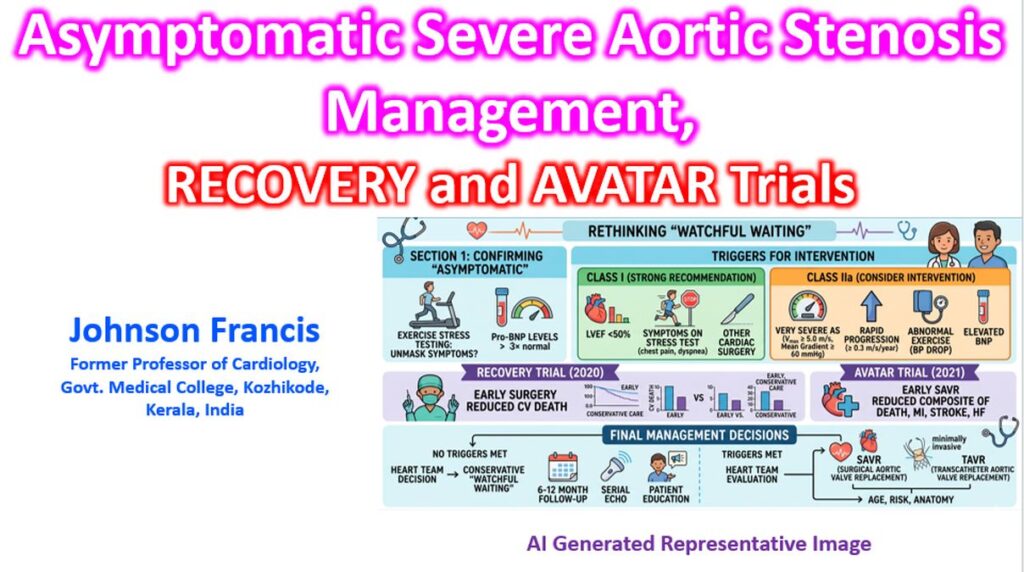

The management of asymptomatic severe aortic stenosis (AS) has undergone a paradigm shift. While “watchful waiting” was the historical standard, recent clinical trials (RECOVERY and AVATAR) have pushed the medical community toward earlier intervention for specific high-risk subgroups. The core challenge is balancing the low but real risk of sudden cardiac death (<1% per year in truly asymptomatic patients) against the procedural risks of Surgical Aortic Valve Replacement (SAVR) or Transcatheter Aortic Valve Replacement (TAVR).
1. Confirming the “Asymptomatic” Status
The first step is ensuring the patient is truly asymptomatic. Many patients subconsciously limit their physical activity to avoid symptoms.
- Exercise Stress Testing: Recommended (Class I or IIa) to unmask symptoms or an abnormal blood pressure response.
- Pro-BNP Levels: Markedly elevated levels (>3 times age-corrected normal) can indicate early left ventricular (LV) decompensation.
2. Risk Stratification and Triggers for Intervention
Guidelines suggest intervention in asymptomatic patients if any of the following high-risk features are present:
Class I Recommendations
- LVEF <50%: Decreased systolic function without another identified cause.
- Symptoms on Exercise Test: If the patient develops chest pain, dyspnea, or syncope during supervised testing.
- Undergoing other Cardiac Surgery: If the patient is already having surgery on the aorta or other valves.
Class IIa Recommendations
- Very Severe AS and low surgical risk: Defined as a peak velocity ≥ 5.0 m/s or a mean gradient ≥ 60 mmHg.
- Rapid Progression: An increase in peak velocity by ≥ 0.3 m/s per year and low surgical risk.
- Abnormal Exercise Response: A drop in systolic BP (≥ 10 mmHg) below baseline during exercise and low surgical risk.
- BNP Levels: BNP levels elevated more than 3 times normal and low surgical risk.
3. The “Early Intervention” Evidence Base
Two landmark trials have recently challenged the “watchful waiting” approach:
| Trial | Population | Key Finding |
| RECOVERY (2020) | Very severe AS (Vmax ≥ 4.5 m/s) | Early surgery significantly reduced cardiovascular death compared to conservative care (1% vs. 15% at 6 years). |
| AVATAR (2021) | Severe AS with normal LVEF and negative exercise test | Early SAVR reduced the composite of death, MI, stroke, or HF hospitalization. |
4. The Management Algorithm
Step A: Initial Evaluation
Confirm severity using the standard hemodynamic criteria:
- Aortic Valve Area (AVA) ≤ 1.0 cm2
- Peak Velocity (Vmax) ≥ 4.0 m/s
- Mean Gradient ≥ 40 mmHg
Step B: The “Wait and See” Strategy
If the patient is truly asymptomatic and has no high-risk triggers:
- Clinical Follow-up: Every 6–12 months.
- Serial Echocardiography: Every 6–12 months to monitor for LV changes or progression of stenosis.
- Patient Education: Explicit instructions on recognizing “symptom equivalents” like decreasing exercise tolerance or dizziness.
Step C: The “Heart Team” Decision
When triggers are met, the choice between SAVR and TAVR depends on age, surgical risk (STS score), and anatomical feasibility. In younger, low-risk asymptomatic patients, SAVR remains the gold standard due to valve durability data.
AVATAR Trial
AVATAR trial (Aortic Valve Replacement Versus Conservative Treatment in Asymptomatic Severe Aortic Stenosis) was an investigator-initiated international prospective randomized controlled trial that evaluated the safety and efficacy of early surgical aortic valve replacement in the treatment of asymptomatic patients with severe aortic stenosis. Inclusion criteria were aortic valve area ≤1 cm2 with aortic jet velocity >4 m/s or a mean transaortic gradient ≥40 mm Hg, and with normal left ventricular function. Negative exercise testing was also a mandatory inclusion criterion. The study had 157 patients with mean age of 67 years. The study concluded that in asymptomatic patients with severe aortic stenosis, early surgery reduced a primary composite of all-cause death, acute myocardial infarction, stroke, or unplanned hospitalization for heart failure compared with conservative treatment.
RECOVERY Trial
RECOVERY trial funded by the Korean Institute of Medicine had 145 asymptomatic patients with very severe aortic stenosis, defined as an aortic-valve area of ≤0.75 cm2 with either an aortic jet velocity of ≥4.5 m per second or a mean transaortic gradient of ≥50 mm Hg. They were assigned to either early surgery or to conservative care according to the recommendations of current guidelines. The study concluded that among asymptomatic patients with very severe aortic stenosis, the incidence of the composite of operative mortality or death from cardiovascular causes during the follow-up period was significantly lower among those who underwent early aortic-valve replacement surgery than among those who received conservative care.