


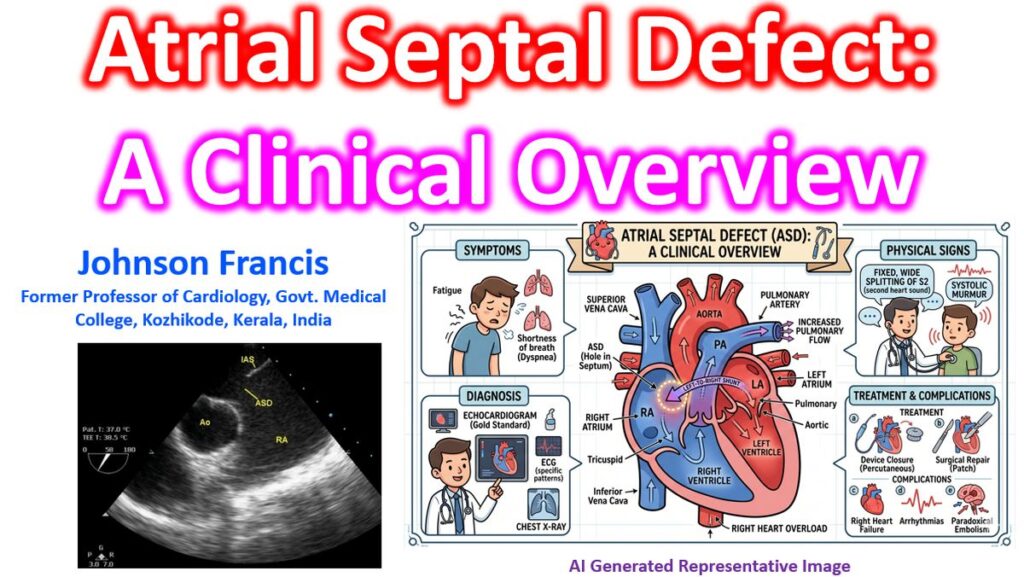

Atrial Septal Defect (ASD) is one of the most common congenital heart diseases encountered in adulthood. While frequently asymptomatic during childhood, its long-term hemodynamic consequences demand precise anatomical and clinical differentiation.
Here is a comprehensive, clinically focused breakdown of Atrial Septal Defects, structured from embryology to management.
Anatomical Classifications
Not all atrial septal defects are created equal. They are classified based on their embryological mechanisms and anatomical locations within the interatrial septum.
| ASD Type | Prevalence | Location & Embryological Defect | Key Clinical Associations |
| Ostium Secundum | ~70–80% | Fossa ovalis region; caused by excessive resorption of the septum primum or inadequate growth of the septum secundum. | Most common type; amenable to percutaneous device closure if adequate tissue rims (≥ 5 mm) exist. |
| Ostium Primum | ~15% | Lower portion of the septum, adjacent to the AV valves; failure of the septum primum to fuse with the endocardial cushions. | Often associated with a cleft mitral valve or broader Atrioventricular Septal Defects (AVSD). Requires surgical repair. |
| Sinus Venosus | ~5–10% | Superior: Near the SVC entrance (more common). Inferior: Near the IVC entrance. | Strongly associated with Partial Anomalous Pulmonary Venous Return (PAPVR), where right pulmonary veins drain into the SVC or RA. |
| Coronary Sinus | <1% | Located at the roof of the coronary sinus; caused by the “unroofing” or fenestration of the tissue separating the coronary sinus from the left atrium. | Rare; causes a left-to-right shunt via the coronary sinus ostium. |
Pathophysiology & Hemodynamics
The physiological consequence of an ASD is primarily driven by a left-to-right shunt, determined by the size of the defect and the relative compliance of the ventricles. Because the right ventricle (RV) is more compliant than the left ventricle (LV), blood preferentially flows from the left atrium to the right atrium throughout the cardiac cycle.
Volume Overload Chain Reaction
- Increased Right Atrial (RA) volume -> Right Ventricular (RV) Volume Overload.
- RV dilation and paradoxical septal motion (flattening of the interventricular septum during diastole).
- Increased pulmonary blood flow (Qp) relative to systemic blood flow (Qs).
The severity of the shunt is quantified using the pulmonary-to-systemic flow ratio:
Qp/Qs = Stroke Volumepulmonary/Stroke Volumesystemic
Hemodynamic Threshold: A ratio of Qp/Qs ≥ 1.5 indicates a hemodynamically significant shunt capable of inducing long-term RV remodeling and pulmonary vascular remodeling over decades.
Clinical Presentation & Physical Signs
Many patients remain asymptomatic until the third or fourth decade of life, when subtle exertional dyspnea, fatigue, or supraventricular arrhythmias prompt evaluation.
Pathognomonic Physical Findings
- Fixed, Wide Splitting of the Second Heart Sound (S2): The split is wide because the increased RV stroke volume delays pulmonic valve closure (P2). It is fixed because the respiratory variations in systemic venous return are equalized across the large atrial defect, maintaining a constant volume discrepancy between the ventricles.
- Systolic Ejection Murmur: Heard best at the left upper sternal border. Note that this murmur is not caused by flow across the ASD itself (which is a low-pressure, low-velocity flow), but rather by increased functional volume blasting across the pulmonic valve.
- Mid-Diastolic Rumble: Heard at the lower left sternal border in large shunts (Qp/Qs > 2.0), representing increased tricuspid valve flow.
Diagnostic Workup
1. Electrocardiogram (ECG)
ECG findings vary distinctively by anatomical type:
- Ostium Secundum: Right axis deviation, incomplete or complete Right Bundle Branch Block (RBBB) due to RV volume overload. Look for the Crochetage Sign—a specific notch near the apex of the R wave in inferior leads (II, III, aVF) that correlates with shunt size.
- Ostium Primum: Characterized by a Left Axis Deviation (“counter-clockwise loop”) due to early activation of the posterobasal LV wall, alongside an RBBB.
2. Echocardiography (TTE & TEE)
Echocardiography is the diagnostic gold standard.
- Transthoracic Echocardiography (TTE): Evaluates RV enlargement, paradoxical septal motion, and estimates pulmonary artery systolic pressures. Color Doppler visualizes the trans-septal flow.
- Agitated Saline Contrast (Bubble Study): Evaluates for right-to-left or transient bidirectional shunting (bubbles appearing in the left atrium within 1–3 beats).
- Transesophageal Echocardiography (TEE): Essential for checking the precise anatomy of the defect, mapping out the superior, inferior, aortic, and posterior rims, and ruling out anomalous pulmonary venous connections prior to intervention.
Management & Intervention
Asymptomatic small defects (Qp/Qs < 1.5) without evidence of RV enlargement or pulmonary hypertension generally do not require closure and can be monitored clinically.
Indications for Closure
- RV enlargement (volume overload) on echocardiography, regardless of symptoms.
- Hemodynamically significant shunt (Qp/Qs ≥ 1.5).
- History of paradoxical embolism (cryptogenic stroke).
- Documented orthodeoxia-platypnea syndrome.
Intervention Modalities
- Percutaneous Device Closure: The treatment of choice for Ostium Secundum defects. It requires a circumferential tissue rim of at least 5 mm (except for the deficient anterior/aortic rim, which can often be accommodated by modern occluders) to safely anchor the device.
- Surgical Repair: Mandatory for Ostium Primum, Sinus Venosus, and Coronary Sinus defects, or secundum defects lacking adequate anatomical rims. It involves patch closure (using autologous pericardium or synthetic material) and concurrent redirection of anomalous pulmonary veins if PAPVR is present. Interventional management has also been described in some cases of superior sinus venosus ASD recently.
The Point of No Return: Eisenmenger Syndrome
If a large ASD is left untreated for decades, severe irreversible pulmonary vascular disease can develop. When pulmonary vascular resistance rises to systemic levels, the shunt reverses to a right-to-left shunt, leading to cyanosis, clubbing, and erythrocytosis.
Critical Contraindication: Once Eisenmenger syndrome is established and fixed pulmonary hypertension is confirmed (PVR > 5 Wood Units that doesn’t respond to vasodilators), closure of the defect is strictly contraindicated, as the defect now acts as a vital pop-off valve for the failing right ventricle.