


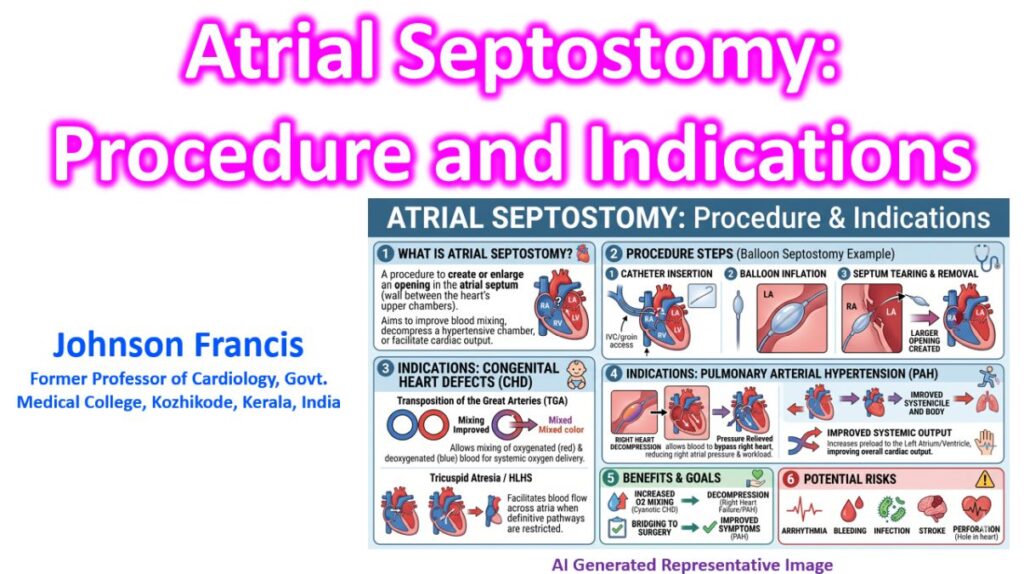

An atrial septostomy is an interventional or surgical procedure used to create or enlarge an opening in the interatrial septum, establishing a controlled right-to-left (or bidirectional) shunt. Depending on the clinical context, the primary goal is either to facilitate intercirculatory mixing of oxygenated and deoxygenated blood or to decompress a hypertensive right heart.
Key Indications
1. Congenital Heart Defects (Neonatal/Pediatric)
In certain cyanotic congenital heart diseases, an atrial septostomy is a critical, often life-saving bridge to definitive surgery:
- Transposition of the Great Arteries (TGA): Essential when the patent ductus arteriosus (PDA) or existing ASD is restrictive, ensuring adequate mixing of the parallel circulations to improve systemic oxygenation.
- Tricuspid Atresia: Required to allow systemic venous return to escape the right atrium and reach the left side of the heart.
- Total Anomalous Pulmonary Venous Return (TAPVR): Necessary when there is obstruction or restriction at the atrial level to allow pulmonary venous blood to reach the systemic circulation.
- Hypoplastic Left Heart Syndrome (HLHS): Performed if the interatrial communication is restrictive, preventing pulmonary venous congestion and ensuring adequate cardiac output.
2. Pulmonary Arterial Hypertension (PAH) & Right Heart Failure (Adult/Pediatric)
In advanced, refractory PAH or chronic thromboembolic pulmonary hypertension (CTEPH), a palliative atrial septostomy is utilized to:
- Decompress a failing, hypertensive right ventricle (RV).
- Increase left ventricular (LV) filling (preload) and subsequent systemic cardiac output, at the expense of mild systemic desaturation.
- Reduce right atrial pressure and alleviate severe right-sided heart failure symptoms or recurrent syncope.
Procedural Techniques
The choice of approach depends heavily on the patient’s age, anatomy, and tissue characteristics of the septum:
- Balloon Atrial Septostomy (Rashkind Procedure):
- Mechanism: A balloon-tipped catheter is advanced percutaneously (usually via the umbilical or femoral vein) into the left atrium, inflated, and forcefully pulled back across the fossa ovalis into the right atrium to tear the septum.
- Primary Use: Neonates with compliant, thin septa (e.g., urgent stabilization in TGA).
- Blade Atrial Septostomy (Park Procedure):
- Mechanism: Utilizes a catheter with a retractable micro-blade to incise a thick or restrictive septum before subsequent balloon dilation.
- Primary Use: Older infants or children where the septum has become too thick or rigid for a standard Rashkind procedure.
- Static Balloon Dilation / Cutting Balloon Septostomy:
- Mechanism: High-pressure or scoring balloons are used to dilate a pre-existing or needle-created defect.
- Transcatheter Atrial Stenting:
- Mechanism: Placement of a small, bare-metal stent across the septal puncture to ensure long-term patency, particularly useful in adult PAH patients where standard septostomies tend to close spontaneously.
- Surgical Atrial Septostomy (Blalock-Hanlon Operation):
- Mechanism: A closed-heart surgical excision of a portion of the atrial septum.
- Primary Use: Largely historical, but reserved for rare cases where transcatheter approaches fail or are anatomically unfeasible.
Hemodynamic Considerations
When performed for PAH, the procedure creates a controlled right-to-left shunt. While this decreases systemic arterial oxygen saturation (SaO2), the concurrent increase in stroke volume and cardiac output typically results in a net improvement in systemic oxygen delivery (DO2), alongside a significant drop in right ventricular end-diastolic pressure.