


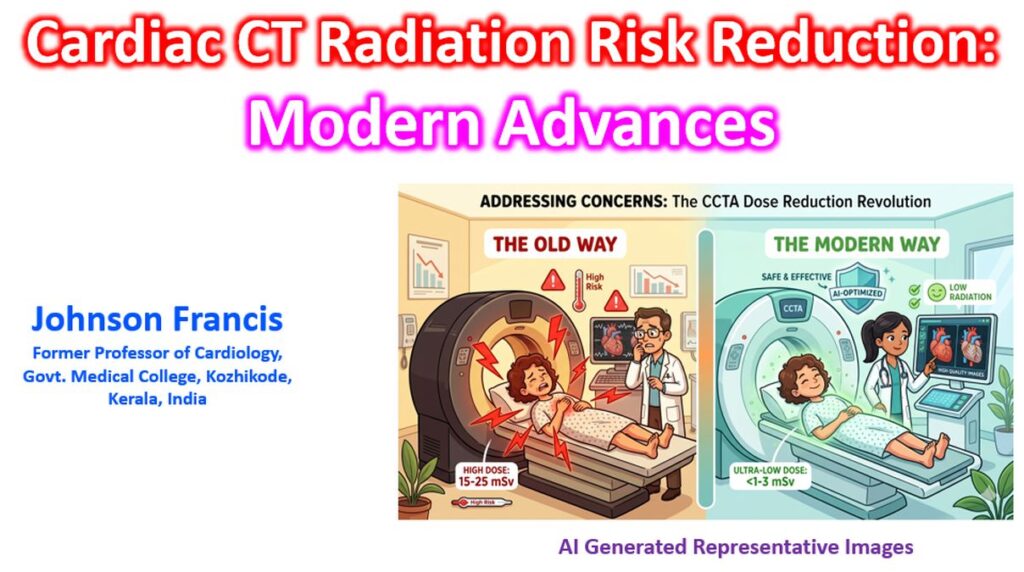

Concerns about radiation exposure in cardiac CT angiography (CCTA) are valid, but the landscape has shifted dramatically in recent years. The “standard” dose has plummeted thanks to better hardware and smarter algorithms.
1. The “Dose Revolution”: Then vs. Now
A decade ago, CCTA was often criticized for doses ranging from 15–25 mSv. Today, in high-volume centers using modern protocols, the median effective dose has dropped by nearly 80%.
- Routine Scans: Now typically range between 3–5 mSv (comparable to or lower than the natural background radiation exposure for a year, which is about 3 mSv).
- Ultra-Low-Dose Protocols: In many academic and advanced clinical settings, scans are frequently performed at sub-millisievert (< 1 mSv) levels—similar to a standard mammogram or a series of chest X-rays.
2. Key Modern Dose-Reduction Techniques
The reduction isn’t just luck; it’s the result of several synergistic technologies:
- Prospective ECG-Gating: Unlike retrospective gating (which keeps the beam on throughout the cardiac cycle), prospective gating only triggers the X-ray during a specific window (usually mid-diastole). This alone can reduce dose by 60–80%.
- High-Pitch Helical Scanning: For patients with stable, low heart rates, the scanner can cover the entire heart in a fraction of a second during a single heartbeat, drastically lowering exposure.
- Low Tube Voltage (kVp): Reducing voltage from 120 kVp to 80 or 100 kVp (especially in patients with a BMI < 30) significantly reduces dose while actually increasing the contrast-to-noise ratio of iodinated contrast.
- AI & Iterative Reconstruction (IR): Deep-learning-based reconstruction algorithms (DLR) can now “clean up” noisy images from low-dose scans, allowing for diagnostic quality at levels that would have been uninterpretable five years ago.
3. Risk Contextualization
While “stochastic risk” (the probability of induced cancer) is the primary concern, it must be weighed against the diagnostic benefit and alternative risks:
- Comparison to Invasive Angiography: CCTA is non-invasive, avoiding the 0.1% risk of major complications (stroke, MI, or vascular injury) associated with catheterization.
- Comparison to Nuclear Stress Tests: Traditional SPECT scans often carry a higher radiation burden (8–12 mSv) than modern CCTA.
- Real-World Risk: Statistical models suggest the lifetime attributable risk (LAR) of a fatal malignancy from a single 5 mSv CCTA is roughly 1 in 2,000 to 1 in 5,000, which is significantly lower than the risk of missing significant left main or multivessel disease.
4. Factors That Increase Dose
It is worth noting that certain clinical factors still necessitate higher doses to maintain image quality:
- High or Irregular Heart Rates: May require retrospective gating to “capture” a clear window.
- High BMI: Requires higher tube current to penetrate tissue, though AI-assisted reconstruction is mitigating this.
- Lack of Sinus Rhythm: Atrial fibrillation remains a challenge for low-dose prospective triggering.