


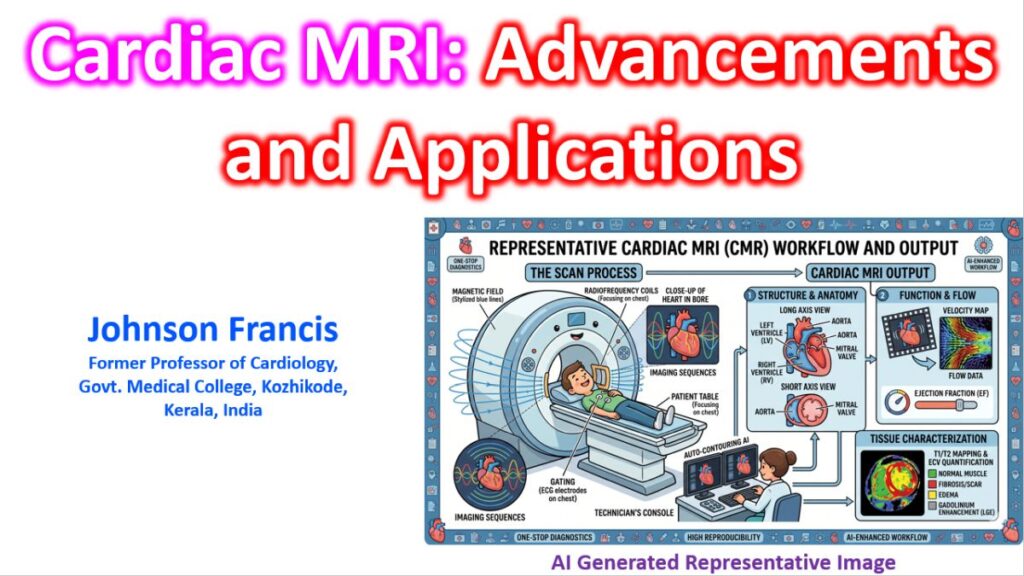

Cardiac Magnetic Resonance (CMR) has solidified its position as the “gold standard” for non-invasive assessment of cardiac structure and function. Currently, the field has moved beyond simple volumetric analysis into sophisticated tissue characterization and AI-driven predictive modeling.
Current Clinical Landscape
The shift in clinical cardiology focuses on “One-Stop Non-Invasive Diagnostics,” where CMR is increasingly used to replace multiple diagnostic steps (Echo, Stress Test, and diagnostic Cath) in a single session.
1. Key Clinical Indications
- Viability & Ischemia: Late Gadolinium Enhancement (LGE) remains the definitive tool for distinguishing hibernating myocardium from scar tissue.
- Cardiomyopathies: Essential for phenotypic differentiation (e.g., HCM vs. Amyloidosis vs. Athlete’s Heart) using T1/T2 mapping and Extracellular Volume (ECV) quantification.
- Myocarditis: CMR is the primary modality for diagnosis, following the updated Lake Louise Criteria, identifying edema and necrosis without the need for biopsy.
- Congenital Heart Disease (CHD): Unmatched for RV assessment and complex anatomy, particularly in post-operative surveillance (e.g., Fontan or Tetralogy of Fallot).
2. Technical Advantages Over Echocardiography
While echo remains the first-line bedside tool, CMR offers critical advantages for complex cases:
- Geometric Independence: Unlike echo, CMR does not rely on geometric assumptions (like the Simpson’s method), making it far more accurate for the Right Ventricle (RV) and distorted Left Ventricles (LV).
- Tissue Characterization: The ability to “see” the interstitium (fibrosis, edema, iron, fat) is a capability unique to MRI.
- High Reproducibility: Vital for longitudinal tracking of Ejection Fraction (EF) in patients where minor changes (e.g., cardiotoxicity from chemotherapy) dictate treatment changes.
Emerging Advancements
AI-Enhanced Workflow
AI is no longer experimental. Modern CMR platforms now feature Auto-Contouring, which provides instantaneous quantification of volumes and mass, reducing post-processing time from 20 minutes to seconds.
4D Flow MRI
Real-time visualization of blood flow dynamics is now standard for assessing valvular heart disease and aortic pathologies. It allows for precise quantification of:
- Qp/Qs ratios in shunts.
- Wall shear stress in aortic aneurysms.
- Regurgitant volumes without the acoustic shadowing limitations of ultrasound.
Contrast-Free Mapping
Advancements in native T1 mapping and Diffusion Tensor Imaging (a specialized MRI sequence that measures the natural Brownian motion of water molecules) are allowing for more detailed tissue analysis in patients with severe renal dysfunction, where Gadolinium-based agents are contraindicated.