


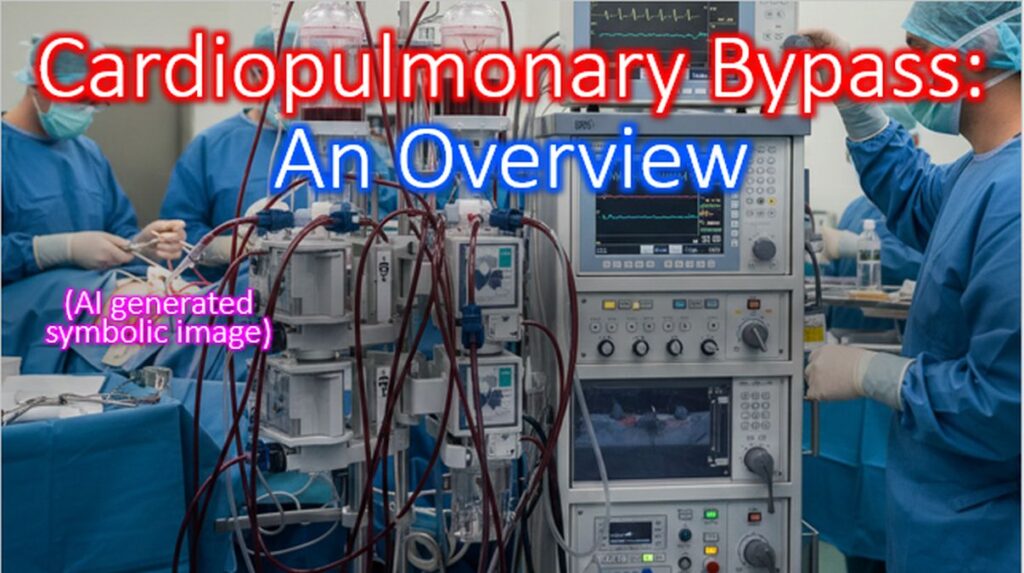

Cardiopulmonary bypass (CPB) is a technique that temporarily takes over the function of the heart and lungs during surgery, maintaining the circulation of blood and the oxygen content of the patient’s body. Often referred to as the heart-lung machine, it creates a “still, bloodless field” for the surgeon to operate on the heart.
How the Circuit Works
The CPB machine functions as an extracorporeal circuit. Blood is diverted away from the heart and pumped through a series of components before being returned to the arterial system.
- Venous Cannulation: Blood is drained by gravity or vacuum from the right atrium or vena cavae.
- The Reservoir: Acts as a holding tank for the blood and allows air bubbles to escape.
- The Oxygenator (The “Lungs”): This is where gas exchange occurs. Oxygen is added to the blood, and carbon dioxide is removed.
- Heat Exchanger: Integrated into the oxygenator, it controls the patient’s body temperature, often inducing hypothermia to reduce systemic oxygen demand.
- The Pump (The “Heart”): Usually a roller pump or centrifugal pump that provides the force to propel blood back into the body.
- Arterial Filter: A final safety mechanism to catch any micro-emboli or debris before the blood enters the aorta.
Key Physiological Management
Managing a patient on CPB requires a delicate balance of several factors:
| Factor | Description |
| Anticoagulation | Heparin is administered to prevent blood from clotting within the plastic tubing and components. The Activated Clotting Time (ACT) is monitored to ensure therapeutic levels (usually >400–480 seconds). |
| Cardioplegia | A potassium-rich solution is infused into the coronary arteries to intentionally stop the heart (asystole), protecting the myocardium during the “cross-clamp” period. |
| Hemodilution | The circuit is often primed with crystalloid fluids, which reduces blood viscosity and improves microcirculation during hypothermia, though it lowers the hematocrit. |
| Mean Arterial Pressure | Typically maintained between 50–80 mmHg to ensure adequate perfusion to the brain and kidneys. Upper end is meant for those with chronic hypertension. |
Common Complications
While life-saving, CPB triggers a systemic inflammatory response syndrome (SIRS) because the blood is exposed to non-physiological surfaces.
- Coagulopathy: Destruction of platelets and consumption of clotting factors.
- Neurological Deficits: Often called “pump head,” or Postperfusion syndrome ranging from mild cognitive impairment to stroke.
- Renal Dysfunction: Potential for acute kidney injury due to non-pulsatile flow and inflammatory mediators.
Transitioning a patient off cardiopulmonary bypass (CPB) is one of the most critical phases of cardiac surgery. It is a controlled “handover” where the heart and lungs must resume full physiological responsibility after being dormant.
The Pre-Conditioning Checklist
Before the “cross-clamp” is removed and the pump is slowed, the team must ensure the following parameters are met:
- Rewarming: The patient’s core temperature is typically brought back to approximately 36.5°C–37°C.
- Metabolic Balance: Electrolytes (especially Potassium and Calcium) and acid-base status must be normalized.
- De-airing: The surgeon must meticulously remove any air from the heart chambers and aorta to prevent systemic or coronary air emboli.
- Rhythm Restoration: If the heart doesn’t spontaneously restart in a stable sinus rhythm, internal cardioversion is performed.
Hemodynamic Transition
The perfusionist slowly “weans” the patient by reducing the venous return to the machine, allowing the heart to fill and start pumping blood into the systemic circulation.
- Preload Management: As the pump flow decreases, the volume in the heart increases. The anesthesiologist monitors the Central Venous Pressure (CVP) or Pulmonary Artery Occlusion Pressure (PAOP), equivalent to pulmonary capillary wedge pressure and left atrial pressure, to ensure the heart isn’t overdistended or “running dry.”
- Contractility Support: Many patients require inotropic support (e.g., Dobutamine, Milrinone, or Epinephrine) to help the stunned myocardium overcome the systemic vascular resistance.
- Afterload Control: If the systemic vascular resistance is too high, the heart may struggle to eject blood, requiring vasodilators.
The “Off-Pump” Moment
Once the heart is maintaining adequate Mean Arterial Pressure (MAP) and Cardiac Output (CO) with minimal pump support, the venous and arterial lines are clamped. This is the moment of truth where the heart is fully “solo.”
Reversing Anticoagulation
Once the surgical team is confident the patient is stable off-pump, Protamine Sulfate is administered.
- The Reaction: Protamine neutralizes Heparin to restore normal clotting.
- Monitoring: This is a high-risk moment for Protamine reactions (which can cause severe pulmonary hypertension) and requires close observation of the right heart pressures.
Common Post-Bypass Challenges
- Vasoplegia: A state of low systemic vascular resistance caused by the inflammatory response to the bypass machine, often requiring vasopressors like Norepinephrine.
- Right Ventricular (RV) Failure: The RV is particularly sensitive to the changes in pulmonary pressures and volume shifts during weaning.
During the rewarming and weaning phases of cardiopulmonary bypass (CPB), the myocardium is transitioning from a state of controlled asystole and hypothermia back to active electrical and mechanical function. This period is highly arrhythmogenic due to electrolyte shifts, catecholamine surges, and “reperfusion injury.”
Common Rhythms During Rewarming
As the heart temperature rises, electrical activity returns, often in a predictable but chaotic sequence:
- Fine Ventricular Fibrillation (VF): This is common as the cross-clamp is removed and oxygenated blood hits the cold, potassium-laden myocardium. If it doesn’t spontaneously convert to a perfusing rhythm as the heart warms, internal defibrillation (typically 10–20 Joules) is used.
- Junctional Tachycardia: Frequently seen in the “warm-up” phase. The AV node may recover faster than the SA node, leading to an accelerated junctional rhythm that can compromise cardiac output due to the loss of “atrial kick.”
Post-Bypass Arrhythmias and ECG Challenges
1. Atrial Fibrillation (POAF)
Post-operative AF is the most common arrhythmia (occurring in 25–40% of patients).
- Mechanism: Driven by systemic inflammation, oxidative stress, and changes in atrial pressure.
- Clinical Pearl: While often transient, it can lead to hemodynamic instability in a freshly weaned heart that is preload-dependent.
2. Ventricular Tachycardia (VT) and Localization
For patients with underlying ischemia or previous scars, reperfusion can trigger VT.
- Localization: If the patient develops PVCs or VT post-weaning, clinicians look for specific morphology. For example, a Left Bundle Branch Block (LBBB) pattern with an inferior axis often suggests an origin in the Right Ventricular Outflow Tract (RVOT), which might be triggered by surgical manipulation or cannulation sites.
3. Conduction Blocks
The proximity of surgical sutures to the conduction system (especially in valve replacements) can lead to:
- Complete Heart Block (CHB): Often requiring temporary epicardial pacing wires, which are standardly placed before chest closure.
- Right Bundle Branch Block (RBBB): Very common after right ventriculotomy or even simple RV distension during the bypass.
4. The “Shark Fin” and Ischemic Patterns
In the immediate post-bypass setting, a “Shark Fin” appearance (massive ST-segment elevation) is usually a red flag for acute graft occlusion or a coronary air embolus.
- Distinction: Unlike the Brugada pattern, this is an evolving injury pattern that requires immediate surgical or interventional attention.
Management Strategies
- Epicardial Pacing: Used to maintain an optimal heart rate (usually 80–90 bpm) to optimize cardiac output while the heart is “stunned.”
- Electrolyte Optimization: Keeping K+ > 4.5 mEq/L and Mg2+ > 2.0 mg/dL is the first line of defense against both atrial and ventricular irritability.