



In the high-stakes environment of a Coronary Care Unit (CCU), Pulmonary Artery (PA) catheters—often referred to as Swan-Ganz catheters—remain a gold standard for dissecting complex shock states. While non-invasive tools are great, sometimes you need the raw data that only “the Swan” can provide.
Here is a simplified breakdown of PA catheter hemodynamics and the clinical significance of Pulmonary Capillary Wedge Pressure (PCWP).
The Core Pressures
As the catheter travels from the Right Atrium (RA) to the Pulmonary Artery, each “stop” provides a specific pressure reading that tells a story about the heart’s volume and function.
| Measurement | Normal Range (mmHg) | Clinical Indicator |
| CVP (RA) | 2 – 6 | Right ventricular preload / Fluid status. |
| RV Pressure | 15–25 / 0–8 | RV systolic and diastolic function. |
| PA Pressure | 15–25 / 8–15 | Pulmonary vascular resistance / Afterload. |
| PCWP (Wedge) | 6 – 12 | Left ventricular end-diastolic pressure (LVEDP). |
Understanding PCWP (The “Wedge”)
The PCWP is the “holy grail” of PA catheterization because it allows us to look “through” the lungs to see what is happening in the left side of the heart.
- How it works: When the balloon is inflated, it occludes a small branch of the pulmonary artery. This creates a static column of blood between the catheter tip and the left atrium.
- The Assumption: In the absence of mitral valve disease or pulmonary vein obstruction, PCWP ≈ Left Atrial Pressure ≈ LV End-Diastolic Pressure.
Clinical Interpretation of Wedge Pressure
- Low PCWP (< 6-8 mmHg): Suggests hypovolemia (dehydration, hemorrhage).
- High PCWP (> 18-20 mmHg): Suggests left heart failure or fluid overload
- High PCWP with Low Cardiac Output: The classic signature of Cardiogenic Shock.
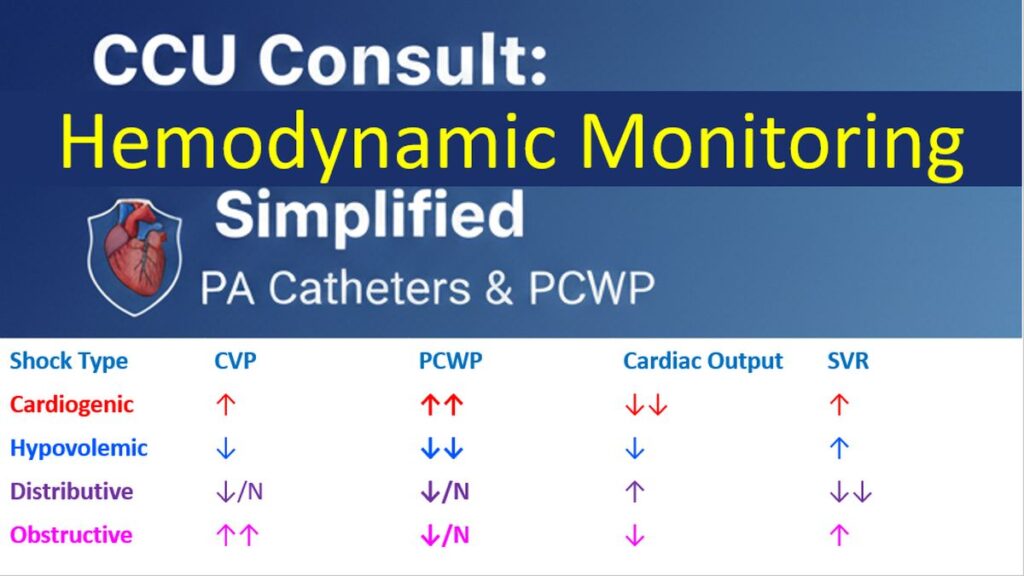
Shock Differential: A Quick Cheat Sheet
The PA catheter is most useful when you aren’t sure why the blood pressure is low.
| Shock Type | CVP | PCWP | Cardiac Output (CO) | SVR (Afterload) |
| Cardiogenic | ↑ | ↑↑ | ↓↓ | ↑ (Compensatory) |
| Hypovolemic | ↓ | ↓↓ | ↓ | ↑ (Compensatory) |
| Distributive (Sepsis) | ↓/N | ↓/N | ↑ (Early) | ↓↓ (Vasodilation) |
| Obstructive (PE) | ↑↑ | ↓/N | ↓ | ↑ |
Practical Management Pearls
- Leveling the Transducer: Always ensure the transducer is at the phlebostatic axis (mid-chest level). If it’s too low, pressures will be falsely high.
- Respiratory Variation: Always read the pressure at end-expiration. This is when pleural pressure is closest to atmospheric pressure, giving you the most “true” intracardiac reading.
- The “a” and “v” Waves: Watch for large ‘v’ waves on the wedge tracing; these often indicate acute mitral regurgitation, even before you hear a murmur.
Note: While PA catheters provide incredible data, they carry risks (arrhythmias, PA rupture). Always correlate the numbers with your clinical exam and echocardiography.