


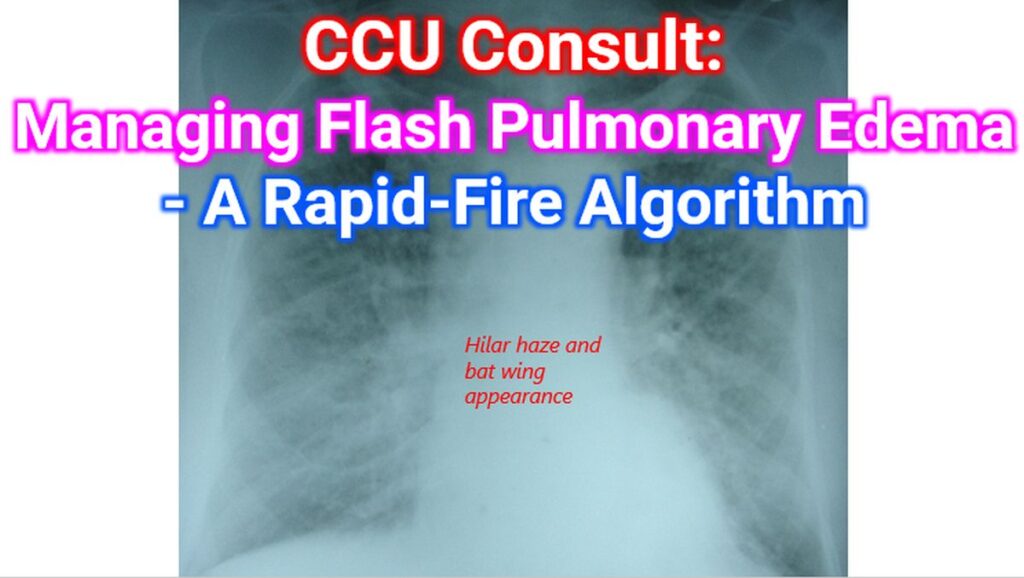

Flash Pulmonary Edema is a clinical emergency characterized by the sudden onset of pulmonary congestion, often occurring in minutes. In the Coronary Care Unit, the goal is rapid reduction of preload and afterload to “buy time” for the heart to recover or for definitive intervention.
⚡ Rapid-Fire Management Algorithm
1. Immediate Stabilization (First 0–5 Minutes)
- Positioning: Sit the patient upright (high Fowler’s) immediately to reduce venous return.
- Oxygenation: * Start NIV (CPAP or BiPAP) early. PEEP (5–10 cm H2O) increases intrathoracic pressure, which decreases preload and helps “push” fluid out of the alveoli.
- Goal: SpO2 > 90%.
- IV Access & Stat Labs: Draw ABG, Troponin, BNP, and electrolytes. Perform a point-of-care ultrasound (POCUS) to look for B-lines and assess LV/RV function.
2. Pharmacological “Triple Threat”
If the patient is hypertensive (as is common in “SCAPE” – Sympathetic Crashing Acute Pulmonary Edema), focus on aggressive vasodilation:
| Intervention | Action | Dosing Strategy |
| Nitroglycerin | Mainstay. Decreases preload (venous) and afterload (arterial). | Escalate rapidly if blood pressure remains high |
| Loop Diuretics | Reduces volume, though the initial effect is venodilation. | May need twice the regular home dose |
| Morphine | Reduces anxiety and provides mild venodilation. | Use cautiously; may increase the risk of intubation if the patient is drowsy |
3. Identify and Target the “Trigger”
FPE is rarely a primary disease; it is a symptom of an underlying “crash.” Use the CHAMP acronym:
- C – Acute Coronary Syndrome (ACS) → Go to Cath Lab.
- H – Hypertensive Emergency → Rapidly lower MAP by 20–25%.
- A – Arrhythmia (AFib with RVR) → Consider cardioversion.
- M – Mechanical (Acute Mitral Regurgitation/Aortic Dissection) → Surgical consult.
- P – Pulmonary Embolism / Pneumonia.
4. Escalation of Care (Refractory Cases)
If the patient remains in respiratory distress or becomes hypotensive (Cardiogenic Shock):
- Inotropes: Consider Dobutamine or Milrinone if there is low output (but beware of tachycardia).
- Mechanical Support: * IABP (Intra-aortic Balloon Pump) for afterload reduction and coronary perfusion.
- Impella or ECMO for severe LV failure.
- Intubation: Don’t delay if there is worsening acidosis (pH < 7.25), exhaustion, or altered mental status.
⚠️ CCU Pearls
- Avoid over-diuresing if the patient is actually euvolemic but has “shunted” fluid to the lungs due to a hypertensive surge.
- Renal Artery Stenosis (Pickering Syndrome): Suspect this in patients with flash pulmonary edema and preserved EF who have recurrent “flash” episodes.