


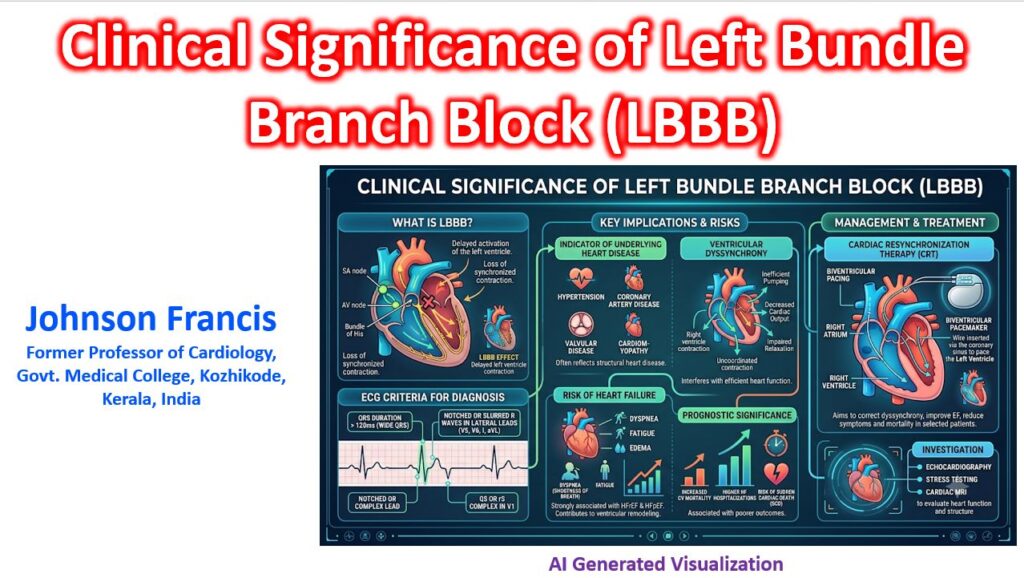

The clinical significance of Left Bundle Branch Block (LBBB) has evolved dramatically. Once viewed merely as a concerning electrocardiographic abnormality, it is now recognized as a primary driver of ventricular remodeling, a major prognostic marker, and a specific therapeutic target in heart failure management.
1. Defining “True” LBBB and CRT Patient Selection
The classic AHA/ACC criteria for LBBB (QRS ≥ 120 ms, broad notched R in lateral leads, absent Q waves in I, V5, V6) frequently capture patients with a mixture of left ventricular hypertrophy (LVH) and left anterior fascicular block, rather than a true proximal block of the left bundle.
This distinction is the primary reason approximately 30% of patients fail to respond to Cardiac Resynchronization Therapy (CRT). To identify the complete block that benefits most from biventricular pacing, the Strauss criteria have become clinically vital:
- QRS duration ≥ 140 ms in men ( ≥ 130 ms in women).
- QS or rS pattern in leads V1 and V2.
- Mid-QRS notching or slurring in at least two of leads V1, V2, V5, V6, I, or aVL.
Patients meeting the stricter Strauss criteria demonstrate significantly higher rates of reverse remodeling and survival following CRT implantation compared to those who only meet conventional criteria.
2. Mechanical Dyssynchrony and LBBB-Induced Cardiomyopathy
LBBB creates a profound electromechanical disadvantage. Because the impulse must travel trans-septally from the right ventricle, ventricular activation is delayed and uncoordinated:
- Septal Flash: The septum activates and contracts early during isovolumetric contraction while the lateral wall is still relaxed.
- Delayed Lateral Wall Contraction: By the time the LV free wall contracts, the septum has already begun to relax and is stretched paradoxically outward.
- Hemodynamic Consequences: This dyssynchrony reduces the stroke volume, decreases the dP/dt, and increases end-systolic volume. Over time, this leads to functional mitral regurgitation, asymmetric hypertrophy of the late-activated lateral wall, and progressive global LV dysfunction (LBBB-induced cardiomyopathy).
3. Masking Myocardial Ischemia
Because LBBB alters the sequence of depolarization, it obligatorily alters repolarization, resulting in ST segments and T waves that are typically discordant (opposite in direction) to the main vector of the QRS complex. This baseline distortion heavily masks the ST-segment elevation of an acute myocardial infarction.
To overcome this, the Sgarbossa Criteria (and the highly sensitive Smith-modified Sgarbossa Criteria) are utilized to identify acute occlusion MI in the presence of LBBB. The most specific finding remains concordant ST elevation ≥ 1 mm in any lead with a positive QRS complex.
4. Prognostic Implications
Even in asymptomatic individuals, new-onset LBBB is not a benign finding.
- It is an independent predictor of future heart failure, cardiovascular mortality, and sudden cardiac death.
- In the setting of acute coronary syndrome (ACS), new or presumably new LBBB has historically been treated as a STEMI equivalent (though recent guidelines prioritize symptoms and hemodynamic stability alongside the block).
- It is highly correlated with underlying structural heart disease, including ischemic cardiomyopathy, dilated cardiomyopathy, and progressive fibrotic conduction system disease (Lev’s or Lenègre’s disease).
5. Management Pathways
The initial discovery of LBBB requires a structural workup, primarily via echocardiography, to assess left ventricular ejection fraction (LVEF) and rule out occult structural disease.
For chronic management:
- Standard CRT: Indicated (Class I) for symptomatic heart failure patients (NYHA Class II-IV) with an LVEF ≤ 35%, sinus rhythm, and an LBBB with a QRS duration ≥ 150 ms.
- Conduction System Pacing (CSP): Left Bundle Branch Area Pacing (LBBAP) and His-bundle pacing are rapidly emerging as physiologic alternatives to traditional biventricular CRT. By directly capturing the distal conduction system, LBBAP can frequently correct the LBBB completely, resulting in a narrow QRS and excellent hemodynamic outcomes.