


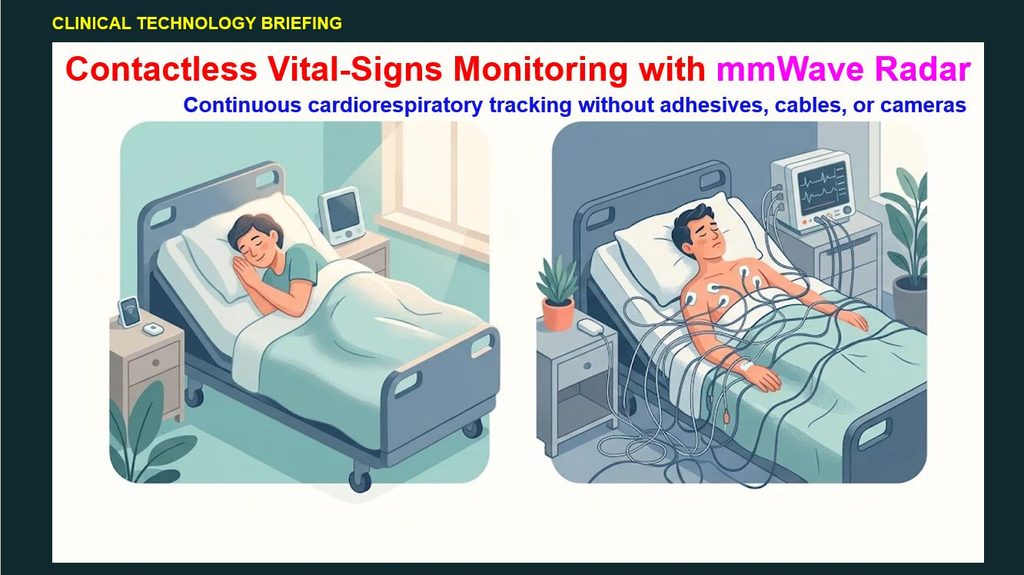

Millimeter-wave (mmWave) radar is an emerging, contactless monitoring technology that measures respiratory rate, heart rate, and sleep patterns from across a room—without adhesive electrodes, chest straps, pulse oximeters, or cameras. Operating at ultra-high radio frequencies (typically 60 GHz to 77 GHz) with ultra-low power, it translates microscopic mechanical movements of the chest wall into continuous clinical waveforms.
1. How It Works: From Chest Motion to Vital Signs
Think of mmWave radar as a contactless, distance-sensitive stethoscope that detects mechanical motion rather than acoustic sound:
- Micro-Displacement Sensing: The sensor emits harmless, low-power radio waves—comparable to or lower in power than a standard Wi-Fi router—that reflect off the patient’s chest. Because the wavelengths are only a few millimeters long, the sensor can detect physical surface movements down to a fraction of a millimeter.
- Separating Breathing from Heartbeats:
- Respiration: Normal breathing moves the chest wall by roughly 4 to 12 mm at a slow rhythm (typically 10 to 20 breaths per minute).
- Cardiac Mechanical Activity (Ballistocardiography / Seismocardiography): Each ventricular contraction sends a subtle mechanical pulse wave to the chest wall, displacing the skin by 0.01 to 0.1 mm at a faster rhythm (60 to 100+ beats per minute).
- Onboard signal filtering separates these two overlapping mechanical rhythms by their frequency and amplitude, outputting continuous respiratory and cardiac rate trends alongside heart rate variability (HRV) metrics.
- Penetration Through Bedding & Clothing: Unlike optical cameras or infrared sensors, millimeter waves pass cleanly through hospital gowns, cotton sheets, blankets, and dry dressings, allowing uninterrupted monitoring while a patient sleeps.
2. Key Clinical Advantages
- Zero Skin Contact: Eliminates medical adhesive-related skin injury (MARSI), pressure sores, and discomfort in neonates (NICU), burn patients, geriatric patients, and individuals with fragile skin or sensory agitation.
- Infection Control & Workflow Efficiency: Because nothing touches the patient, there are no leads to sanitize, replace, or reattach when a patient shifts in bed—reducing nursing workload and cross-contamination risks.
- Complete Visual Privacy: Unlike video-based monitoring systems, radar captures only distance and motion vectors, preserving patient dignity in hospital rooms, eldercare facilities, and home telemonitoring setups.
- 24/7 Ambient Operation: Functions identically in total darkness, bright sunlight, or steamy environments without requiring line-of-sight to bare skin.
3. Primary Clinical & Healthcare Applications
| Clinical Setting | Use Case | Clinical Value |
| Sleep Medicine | Contactless polysomnography screening & apnea detection | Detects central and obstructive sleep apnea events, periodic breathing, and sleep-stage transitions without wired nasal cannulas or chest belts |
| Cardiology & Heart Failure | Remote home monitoring & early decompensation alerts | Tracks resting heart rate, nocturnal respiratory rate trends, and orthopnea/restlessness to flag fluid overload before hospital readmission |
| Neonatology (NICU) | Fragile infant cardiorespiratory monitoring | Monitors breathing and heart rate through incubator walls without adhesives that can tear premature skin |
| Geriatrics & Elder Care | Continuous bedroom wellness & fall detection | Monitors nocturnal vital trends and immediately alerts caregivers to falls or prolonged apnea without invasive cameras |
| General Wards & Isolation | Spot-check-free deterioration screening | Continuously screens infectious or isolated patients for tachypnea and tachycardia without frequent PPE donning |
4. Current Clinical Limitations & Considerations
- Mechanical vs. Electrical Cardiac Signal: Radar measures the mechanical motion of the chest wall (similar to apexcardiography), not the electrical conduction system. It reliably tracks heart rate and beat-to-beat intervals at rest, but it cannot replace a 12-lead ECG for diagnosing arrhythmias such as atrial fibrillation morphology, bundle branch blocks, or myocardial ischemia.
- Motion Artifacts: Gross body movements—such as rolling over, coughing, or speaking—create chest displacements orders of magnitude larger than a heartbeat. Current systems pause cardiac rate calculation during active movement and resume once the patient settles.
- Multi-Person Environments: If a clinician stands directly between the sensor and the patient, or if two people share a bed, the radar relies on spatial beam-steering to isolate each individual’s signal, which works best when the sensor is mounted overhead or angled cleanly toward a single bed.