


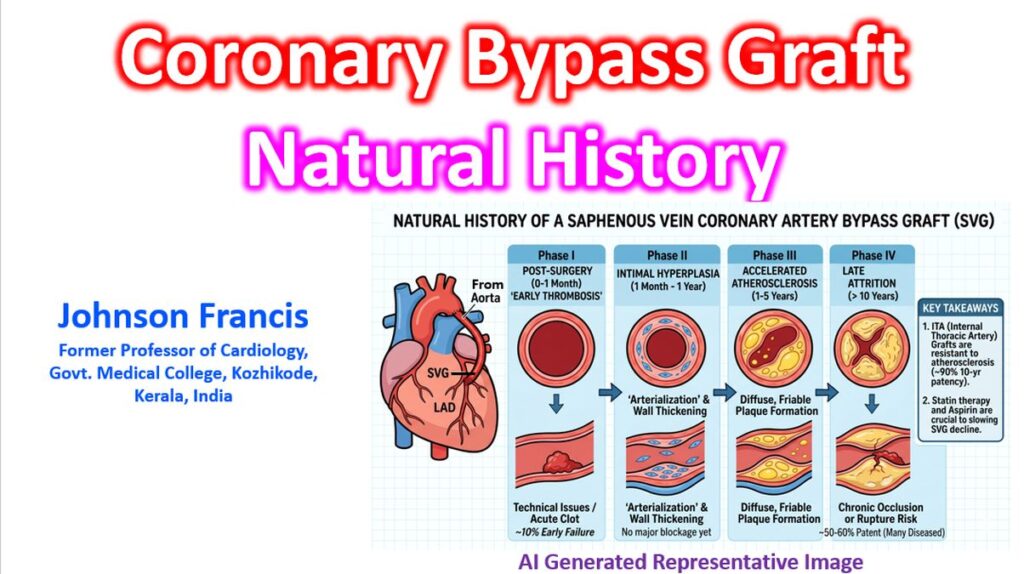

The natural history of coronary artery bypass grafts (CABG) is primarily defined by the progressive development of graft attrition, which differs significantly between arterial and venous conduits. Understanding these timelines is crucial for long-term clinical management and surveillance.
1. Internal Thoracic Artery (ITA/IMA) Grafts
The Left Internal Thoracic Artery (LITA/LIMA) to the Left Anterior Descending (LAD) artery remains the “gold standard” due to its superior long-term patency.
- Early Phase (< 30 Days): Failure is rare (< 5%) and usually due to technical issues (surgical error, kinking, or “steal” from a large side branch).
- Late Phase (> 10 Years): The ITA is resistant to atherosclerosis. It possesses a continuous internal elastic lamina and produces high levels of nitric oxide.
- Patency Rates:
- 10-year patency: ~90–95%.
- 20-year patency: ~85–90%.
2. Saphenous Vein Grafts (SVG)
The natural history of SVGs is characterized by a predictable three-stage decline. Unlike arterial grafts, SVGs are prone to Graft Vascular Disease.
Phase I: Early Thrombosis (0–1 Month)
- Incidence: 5–10% failure rate.
- Mechanism: Usually triggered by technical factors, poor distal runoff in the native vessel, or a hypercoagulable state.
Phase II: Intimal Hyperplasia (1 Month–1 Year)
- Incidence: Up to 15% occlusion by the end of the first year.
- Mechanism: The vein “arterializes” in response to high-pressure arterial flow. Smooth muscle cells migrate to the intima, causing thickening. While not obstructive on its own, it creates the soil for future atherosclerosis.
Phase III: Accelerated Atherosclerosis (> 1–5 Years)
- Mechanism: This is the dominant cause of late failure. Unlike native atherosclerosis, SVG plaques are more friable, diffuse, and lipid-rich, with a poorly developed fibrous cap.
- Timeline:
- At 5 years: ~75% of grafts remain patent.
- At 10 years: Only ~50–60% are patent, and half of those remaining will show significant stenosis.
3. Comparison of Patency Rates
| Graft Type | 1-Year Patency | 5-Year Patency | 10-Year Patency |
| LITA (to LAD) | ~98% | ~95% | ~90%+ |
| Radial Artery | ~95% | ~88–90% | ~80–85% |
| Saphenous Vein | ~85% | ~75% | ~50–60% |
4. Factors Influencing Graft Survival
- Native Vessel Characteristics: Grafts to vessels with high-grade stenosis (>70%) last longer. If the native stenosis is moderate (<50%), “competitive flow” from the native artery can lead to graft “string sign” and eventual occlusion.
- Pharmacotherapy: The use of dual antiplatelet therapy (DAPT) or aspirin, along with high-intensity statins, significantly alters the natural history by slowing intimal hyperplasia and stabilizing SVG plaques.
- Diabetes: Accelerates SVG atherosclerosis and is associated with smaller, poor-quality distal target vessels.
Because of the friable nature of late SVG plaques, percutaneous intervention (PCI) on old vein grafts carries a higher risk of distal embolization and “no-reflow” compared to native vessel PCI, often requiring the use of embolic protection devices.
“No-Touch” Saphenous Vein Grafts (SVG)
A major shift in the natural history of SVGs has been the adoption of the “no-touch” harvesting technique, which leaves a pedicle of surrounding tissue intact, which can produce nitric oxide.
- Patency Breakthrough: A study published in early 2025 demonstrated that one-year patency rates for no-touch SVGs are now comparable to LIMA grafts (~95-98%) when used in off-pump CABG.
- Mechanism: By preserving the vascular adventitia and the vasa vasorum, this technique reduces surgical trauma and preserves nitric oxide synthase activity, effectively delaying the “arterialization” and intimal hyperplasia typically seen in the first year.
Radial Artery vs. SVG (RAPCO Trial)
Long-term results from the RAPCO trials have solidified the radial artery’s position as a preferred secondary conduit over the saphenous vein.
Survival: There is a growing body of evidence suggesting a survival advantage for the radial artery in patients under 70, though large-scale meta-analyses suggest this benefit is most pronounced when the radial artery is used to target a vessel with >70% stenosis.
Patency at 10 Years: The radial artery showed an 85% patency rate compared to 71% for SVGs.