


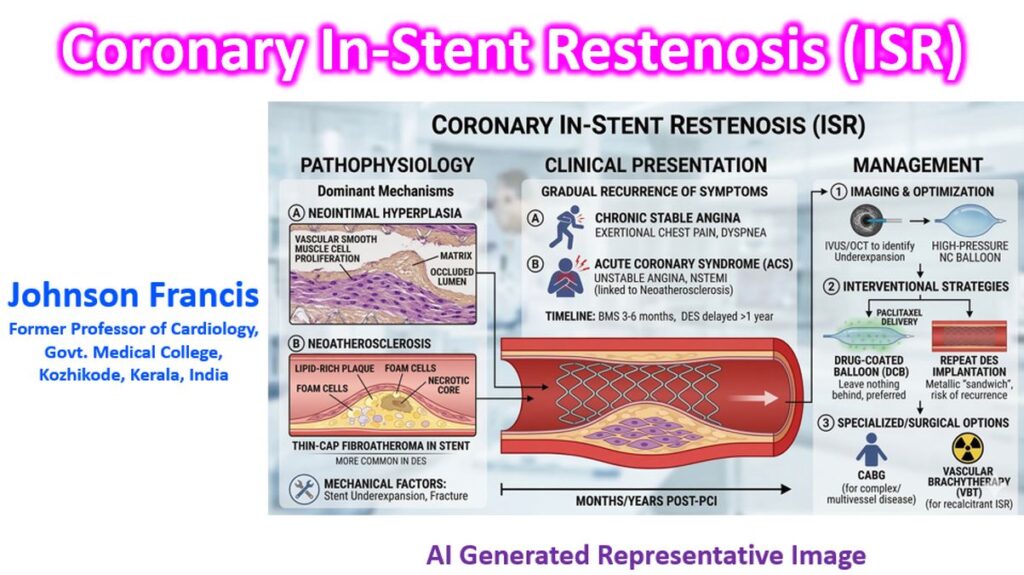

In-stent restenosis (ISR) remains a significant challenge in interventional cardiology, characterized by the narrowing of a previously stented coronary artery segment. While Drug-Eluting Stents (DES) have drastically reduced its incidence compared to Bare-Metal Stents (BMS), it still occurs in roughly 5–10% of modern DES implantations.
Pathophysiology
The underlying mechanism of ISR is essentially an exaggerated “healing” response to the vascular injury caused by stent deployment.
- Neointimal Hyperplasia: This is the primary driver. The mechanical trauma of the stent causes endothelial denudation and inflammation. This triggers smooth muscle cell (SMC) proliferation and the migration of these cells into the subendothelial space, where they produce an extracellular matrix that narrows the lumen.
- Neoatherosclerosis: More common in DES than BMS. Over time (months to years), the new endothelial layer remains dysfunctional, allowing lipid accumulation and the development of “new” atherosclerotic plaques—including thin-cap fibroatheromas—within the stent.
- Mechanical Factors: Stent underexpansion (the most common mechanical cause), stent fracture, or non-uniform strut distribution can create local flow disturbances that promote restenosis.
- Biological Factors: Hypersensitivity to the stent metal (e.g., nickel) or the polymer coating on a DES can drive localized chronic inflammation.
Clinical Presentation
The presentation of ISR can range from silent findings on surveillance imaging to acute life-threatening events.
- Chronic Stable Angina: The most frequent presentation. Patients typically describe a gradual return of exertional chest pain or dyspnea on exertion.
- Acute Coronary Syndrome (ACS): Approximately 20–30% of ISR cases present as ACS (Unstable Angina or NSTEMI). This is often linked to neoatherosclerosis, where the plaque within the stent ruptures, just as it would in a native vessel.
- Silent Ischemia: Detected during routine stress testing or follow-up angiography in high-risk patients.
Classification
Clinicians often use this to describe the pattern of ISR (Mehran Classification):
- Pattern I: Focal (length ≤ 10 mm).
- Pattern II: Diffuse intrastent (length > 10 mm, confined to the stent).
- Pattern III: Proliferative (length > 10 mm, extending beyond stent edges).
- Pattern IV: Total occlusion. TIMI flow grade of 0.
Management
Management strategies are increasingly guided by Intravascular Imaging (IVUS or OCT) to determine the underlying cause (e.g., underexpansion vs. tissue hyperplasia).
A. Initial Optimization
If stent underexpansion is identified via imaging, high-pressure balloon angioplasty using non-compliant (NC) balloons is the first step to properly seat the original stent.
B. Pharmacological/Interventional Strategies
| Strategy | Description |
| Drug-Coated Balloons (DCB) | Delivers antiproliferative drugs (e.g., Paclitaxel) directly to the vessel wall without adding a new layer of metal. This is often the preferred “leave nothing behind” strategy for ISR. |
| Cutting/Scoring Balloons | Use blades or wires to incise the tough, elastic restenotic tissue, allowing more effective expansion. Used as pretreatment before DCB or repeat DES to enhance efficacy. |
| Repeat DES | Implanting a second (usually thinner-strut) DES. While effective, it creates a “sandwich” of metal layers, which may increase the risk of future re-restenosis or thrombosis. |
| Atherectomy | Rotational or Orbital atherectomy may be used if the restenotic tissue is heavily calcified, though it is less common for ISR than for native lesions. |
C. Advanced and Surgical Options
- Vascular Brachytherapy (VBT): Localized radiation therapy used for “recalcitrant” ISR (cases that have failed multiple DES and DCB attempts). It inhibits fibroblast and SMC proliferation.
- CABG: Coronary Artery Bypass Grafting is considered if there is multivessel disease, involving the Left Main, or if the ISR is diffuse and has failed multiple percutaneous interventions.