


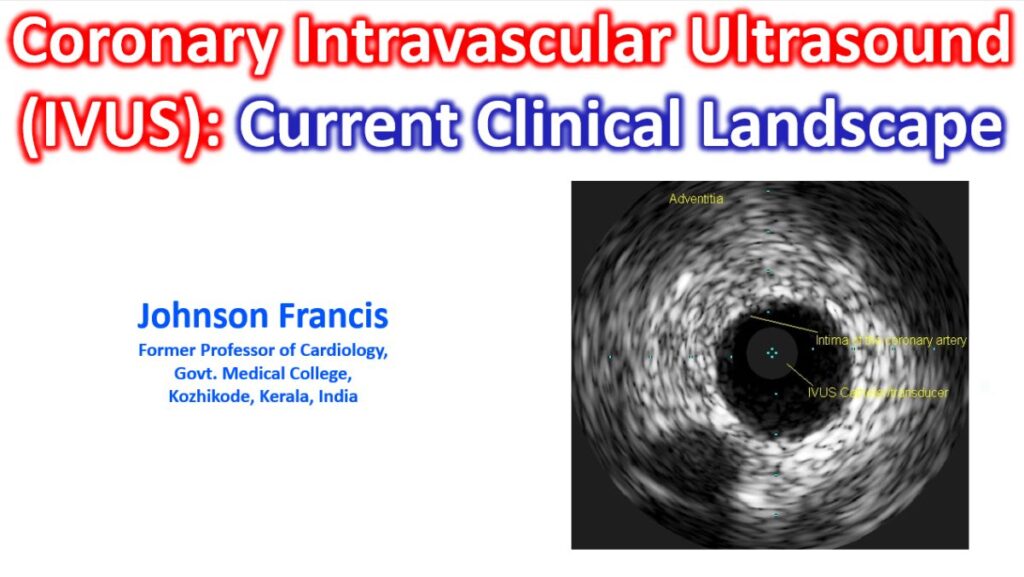

Coronary Intravascular Ultrasound (IVUS) remains a cornerstone of precision PCI, particularly as recent clinical data continues to refine its role in complex substrates. The current landscape of IVUS can be summarized through its evidence base, technical parameters, and clinical optimization criteria.
Current Clinical Evidence & Guidelines
The latest consensus, reinforces IVUS as a Class 1A recommendation for guiding PCI in left main (LM) and complex lesions.
- DKCRUSH VIII: Demonstrated that in true complex bifurcation lesions, IVUS-guided PCI significantly reduced target-vessel failure (TVF) compared to angiography alone.
- IVUS-CHIP & OPTIMAL: These trials presented a more nuanced view, suggesting that in the hands of high-volume, expert operators, angiography can achieve comparable results to IVUS in certain high-risk/LM cases. However, IVUS remains the “safety net” for ensuring optimal stent expansion and identifying mechanical causes of failure.
- RENOVATE-COMPLEX-PCI: Long-term follow-up (up to 5 years) continues to support a reduction in cardiac death and stent thrombosis with imaging-guided PCI.
Technical Specifications
Modern High-Definition (HD) IVUS has bridged the resolution gap with OCT while maintaining superior penetration.
| Feature | Standard IVUS (20 MHz) | HD-IVUS (60 MHz) |
| Axial Resolution | 100 – 200 μm | ~ 40 μm |
| Penetration Depth | 8 – 10 mm | 4 – 6 mm |
| Blood Clearance | Not required | Not required |
| Ideal Use Case | Left Main, Aorto-ostial | Fine plaque morphology, ISR |
Procedural Optimization Criteria
To achieve the clinical benefits seen in trials like ULTIMATE, specific post-PCI benchmarks should be met:
- Minimum Stent Area (MSA):
- Left Main: ≥ 6.0 mm2 (some Asian registries suggest 5.5 mm2 is acceptable).
- Non-LMCA: ≥ 4.0 mm2 or > 80% of the average reference lumen area.
- Stent Apposition: Absence of significant malapposition (separation of struts from the wall).
- Edge Issues: Plaque burden at the stent edges should ideally be < 50% to minimize the risk of edge restenosis.
- Dissection: Identification of flow-limiting edge dissections (typically > 60° arc or involving the media).
IVUS vs. OCT: Clinical Selection
While both are superior to angiography, IVUS is preferred in specific scenarios:
- Aorto-ostial lesions: Where blood clearance for OCT is technically difficult.
- Left Main disease: Due to better depth of penetration in large-caliber vessels.
- Chronic Total Occlusions (CTO): Useful for “re-entry” and confirming true lumen wire position.
- Renal Insufficiency: Allows for “zero-contrast” PCI by using IVUS to size and place stents.
Clinical Interpretation Reminders
- Calcium Assessment: IVUS identifies “acoustic shadowing,” allowing for the quantification of the calcium arc. An arc > 180° often necessitates advanced lesion preparation (Lithotripsy or Rotablation).
- Plaque Characterization: Distinguishing between soft (lipid-rich), fibrous, and calcified plaque guides the choice of inflation pressure and balloon type.
DKCRUSH VIII
The DKCRUSH VIII trial was a landmark study presented at the ACC.26 Scientific Sessions in New Orleans and simultaneously published in the Journal of the American College of Cardiology (JACC) in March 2026. The study randomized 555 patients with complex coronary bifurcation lesions (primarily defined by the DEFINITION criteria) to either IVUS-guided or angiography-guided PCI using the DK crush technique.
Key Findings
- Primary Endpoint: At 1 year, the rate of target vessel failure (TVF) was significantly lower in the IVUS-guided group compared to the angiography group (6.1% vs. 14.7%; HR 0.40; p = 0.002).
- Clinical Impact: The benefit was largely driven by reductions in target vessel myocardial infarction (TVMI) and clinically driven target vessel revascularization (TVR).
- Mechanism: The investigators concluded that the superior outcomes were achieved by reaching specific IVUS-defined optimization targets, rather than the mere use of the imaging tool itself.
IVUS-CHIP
Focus: Complex high-risk indicated procedures (CHIP) in 2,020 patients.
Finding: Routine IVUS guidance was not superior to angiography alone in reducing target-vessel failure (TVF). TVF occurred in 14% of the IVUS group vs. 11% of the angiography group (p = 0.08).
OPTIMAL
Focus: Unprotected Left Main (LM) coronary artery disease in 806 patients.
Finding: IVUS guidance yielded similar results to angiography for the primary endpoint (death, MI, stroke, or revascularization) at a median follow-up of 2.9 years (34% vs. 31%; p = 0.40).
The IVUS-CHIP and OPTIMAL trials were both presented as Late-Breaking Clinical Trials at the ACC.26 Scientific Sessions in March 2026 and simultaneously published in the New England Journal of Medicine (NEJM). Notably, both trials were neutral, showing that in the hands of expert operators at high-volume centers, IVUS-guided PCI did not significantly reduce the primary composite endpoints compared to angiography-guided PCI.
RENOVATE-COMPLEX-PCI
The RENOVATE-COMPLEX-PCI (Randomized Controlled Trial of Intravascular Imaging-Guided vs. Angiography-Guided Percutaneous Coronary Intervention in Complex Coronary Artery Lesions) trial has provided some of the strongest evidence for the long-term benefits of intravascular imaging in complex cases. 5-Year Long-Term Outcomes: Presented at the ACC.26 Scientific Sessions, this extended follow-up confirmed that the benefits of imaging guidance are sustained over the long term without a “late catch-up” phenomenon.
ULTIMATE
The ULTIMATE trial (Intravascular Ultrasound Versus Angiography-Guided Drug-Eluting Stent Implantation in “All-Comers” Coronary Lesions) is a landmark multicenter, randomized controlled trial that established the clinical benefit of IVUS in a general patient population, rather than just specific complex subgroups.
Original 12-Month Results: Intravascular Ultrasound Versus Angiography-Guided Drug-Eluting Stent Implantation: The ULTIMATE Trial DOI: 10.1016/j.jacc.2018.09.013
Long-Term 3-Year Outcomes: 3-Year Outcomes of the ULTIMATE Trial DOI: 10.1016/j.jcin.2020.10.001