


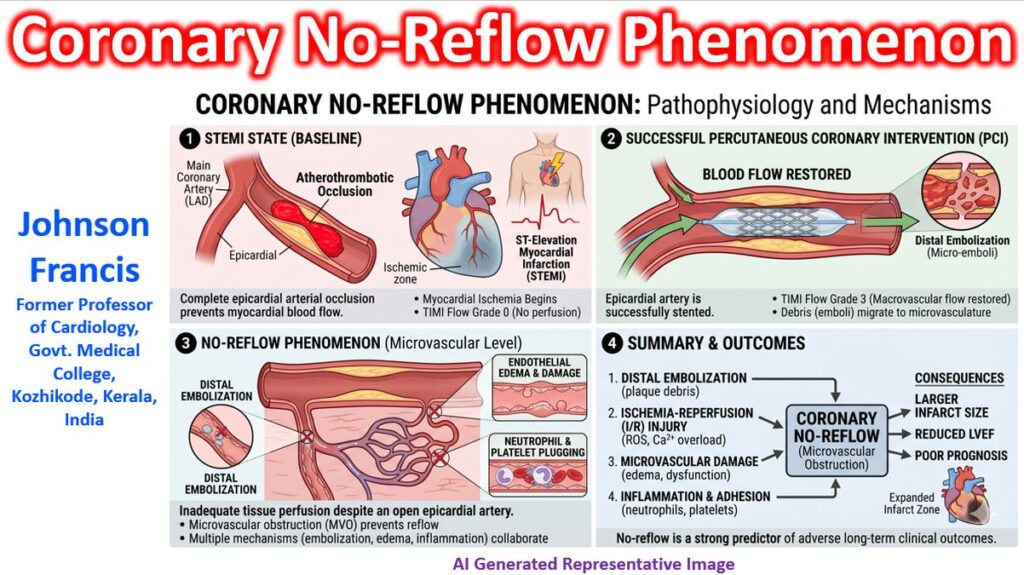

The coronary no-reflow phenomenon is a clinical condition characterized by inadequate myocardial perfusion through a given segment of the coronary circulation without evidence of mechanical obstruction in the epicardial vessel. It is most frequently encountered during primary percutaneous coronary intervention (PCI) for ST-segment elevation myocardial infarction (STEMI).
Pathophysiology
The etiology is multifactorial and often described as a combination of four distinct processes:
- Distal Embolization: Migration of plaque fragments, fibrin, and platelet aggregates from the culprit lesion into the microvasculature during balloon inflation or stent deployment.
- Ischemia-Reperfusion Injury: Damage caused by the sudden restoration of blood flow, leading to the production of reactive oxygen species (ROS), calcium overload, and the opening of the mitochondrial permeability transition pore (mPTP).
- Microvascular Damage: Structural injury to the endothelial cells, resulting in blebbing, swelling, and reduced vessel lumen. This is often exacerbated by neutrophil infiltration and “capillary plugging.”
- Individual Susceptibility: Predisposing factors such as hypercholesterolemia, diabetes, and the duration of pre-hospital ischemia.
Clinical Diagnosis
No-reflow is typically identified in the cardiac catheterization lab using the following criteria:
1. Angiographic Indicators
- TIMI Flow Grade: A grade of 0, 1, or 2 despite the absence of an epicardial dissection, spasm, or residual stenosis.
- Myocardial Blush Grade (MBG): A qualitative assessment of myocardial opacification. MBG 0 or 1 indicates significant microvascular obstruction.
2. Electrocardiographic (ECG) Findings
- ST-Segment Resolution (STR): Failure of the ST-segment to resolve by >70% within 60–90 minutes post-reperfusion suggests impaired microvascular flow.
3. Advanced Imaging
- Cardiac MRI: Considered the gold standard for identifying Microvascular Obstruction (MVO), visualized as a dark “hypo-enhanced” core within the hyper-enhanced infarcted area on Late Gadolinium Enhancement (LGE) images.
Management Strategies
Pharmacological Interventions
Intracoronary (IC) administration is generally preferred over intravenous routes to achieve higher local concentrations:
- Adenosine: A potent vasodilator that acts on A2 receptors to reduce microvascular resistance.
- Verapamil/Diltiazem: Effective in reducing microvascular spasm.
- Nitroprusside: An endothelium-independent vasodilator and nitric oxide donor.
- Nicardipine: Often used due to its high selectivity for arterial smooth muscle.
- GP IIb/IIIa Inhibitors: Such as Abciximab or Tirofiban to address the thrombotic component.
Mechanical Interventions
- Aspiration Thrombectomy: While once routine, current guidelines do not recommend routine manual thrombectomy, though it may be considered in cases of high thrombus burden.
- Distal Protection Devices: Primarily used in saphenous vein graft (SVG) interventions to capture embolic debris, though they have shown limited benefit in native coronary arteries during STEMI.
Prognostic Impact
The occurrence of no-reflow is a strong independent predictor of adverse outcomes. It is associated with:
- Increased infarct size.
- Reduced Left Ventricular Ejection Fraction (LVEF).
- Higher rates of malignant arrhythmias and heart failure.
- Increased short- and long-term mortality.
Comparative efficacy of IC vs. IV pharmacological agents
While the IC route offers a physiological advantage by achieving higher local drug concentrations and greater receptor occupancy at the microvascular level, large-scale evidence for clinical endpoint superiority remains nuanced across different drug classes.
Comparative Efficacy by Drug Class
1. Vasodilators (Epinephrine, Verapamil, Adenosine)
Recent network meta-analyses have shifted the preference toward IC epinephrine and verapamil for acute flow restoration:
- IC Epinephrine vs. IC Adenosine: The COAR trial and subsequent meta-analyses demonstrated that IC epinephrine is significantly more effective than IC adenosine in achieving final TIMI 3 flow in normotensive patients.
- Direct Efficacy: A 2025 network meta-analysis of 1,674 patients found that IC epinephrine (OR: 2.81) and IC verapamil (OR: 2.84) were associated with significantly higher odds of achieving TIMI 3 flow compared to control groups (Oliveri et al., 2026).
- ST-Resolution: While IC adenosine remains effective for improving ST-segment resolution (STR), its efficacy in restoring epicardial TIMI flow appears lower than that of epinephrine or verapamil (Oliveri et al., 2026).
2. Glycoprotein IIb/IIIa Inhibitors (GPIs)
The route of administration for GPIs remains a point of clinical debate, with a focus on local thrombus resolution:
- IC vs. IV Abciximab: Pooled individual patient data from randomized trials indicate that IC abciximab does not significantly improve TIMI 3 flow or 30-day mortality compared to the IV route. However, it does significantly improve Myocardial Blush Grade (MBG 2/3) (Piccolo et al., 2014).
- IC Tirofiban: A 2026 randomized controlled study found that IC tirofiban significantly reduced the incidence of no-reflow (20% vs. 53%) and decreased in-hospital MACE (3.33% vs. 30%) compared to placebo, though it increased minor bleeding risk (Hammad et al., 2026).
3. Fibrinolytics (Low-Dose)
The use of IC fibrinolytics is emerging as a niche strategy for dissolving microvascular thrombi that vasodilators cannot address:
- Current Status: Evidence suggests that selectively delivering approximately 20% of the systemic dose of a fibrinolytic (e.g., alteplase, prourokinase) via the IC route before PCI may ameliorate the burden of microvascular thrombus (Pelliccia & Niccoli, 2022).
- Recent Evidence: The T-TIME trial (2020) showed no benefit for unselected STEMI patients. In patients presenting with ST-segment elevation myocardial infarction and an ischemic time ≥4 to 6 h, adjunctive treatment with low-dose intracoronary alteplase during primary percutaneous coronary intervention was associated with increased microvascular obstruction. Intracoronary alteplase may be harmful for this subgroup.
Summary of IC vs. IV Advantages
| Feature | Intracoronary (IC) | Intravenous (IV) |
| Local Concentration | Extremely High (10-100 times systemic) | Moderate/Systemic |
| Onset of Action | Immediate at the target site | Delayed by circulation time |
| Systemic Side Effects | Potential for local arrhythmias (Epi) | Hypotension (Nitroprusside/Adenosine) |
| Clinical Verdict | Preferred for acute laboratory rescue | Preferred for upstream “cooling” of lesions |
Ongoing trials such as the EPIVER study (comparing the combination of IC epinephrine and verapamil against monotherapy), are expected to provide further clarity on standardized pharmacological “cocktails” for refractory cases.
References
Brugaletta, S. (2026). Slow flow and no reflow after percutaneous coronary intervention. EuroIntervention. https://eurointervention.pcronline.com/article/slow-flow-and-no-reflow-after-percutaneous-coronary-intervention
Dil, S. V. (2025). Intracoronary epinephrine and verapamil in the refractory no-reflow phenomenon in patients with acute myocardial infarction. Cardiovascular Therapy and Prevention.
Hammad, M. A. M. (2026). Assessment of No-Reflow in Patients With STEMI After Intracoronary Tirofiban After Opening of the Vessel. PMC. https://pmc.ncbi.nlm.nih.gov/articles/PMC12978383/
Oliveri, F. (2026). Intracoronary Vasoactive Therapy for No-Reflow During Primary PCI: A Network Meta-Analysis of Randomized Trials. PMC. https://pmc.ncbi.nlm.nih.gov/articles/PMC12955103/
Pelliccia, F., & Niccoli, G. (2022). Low-dose fibrinolysis during primary percutaneous intervention for preventing no-reflow: stepping back to move forward? EuroIntervention, 18(6), 452-455. https://doi.org/10.4244/eij-d-22-00250
Piccolo, R., Eitel, I., Iversen, A. Z., Gu, Y. L., Dominguez-Rodriguez, A., de Smet, B. J. G. L., Mahmoud, K. D., Abreu-Gonzalez, P., Thiele, H., & Piscione, F. (2014). Intracoronary versus intravenous bolus abciximab administration in patients undergoing primary percutaneous coronary intervention with acute ST-elevation myocardial infarction: a pooled analysis of individual patient data from five randomised controlled trials. EuroIntervention, 9(9), 1110-1120.
Rao, S. V. (2025). 2025 ACC/AHA/ACEP/NAEMSP/SCAI Guideline for the Management of Patients With Acute Coronary Syndromes. Circulation. https://www.ahajournals.org/doi/10.1161/CIR.0000000000001309