


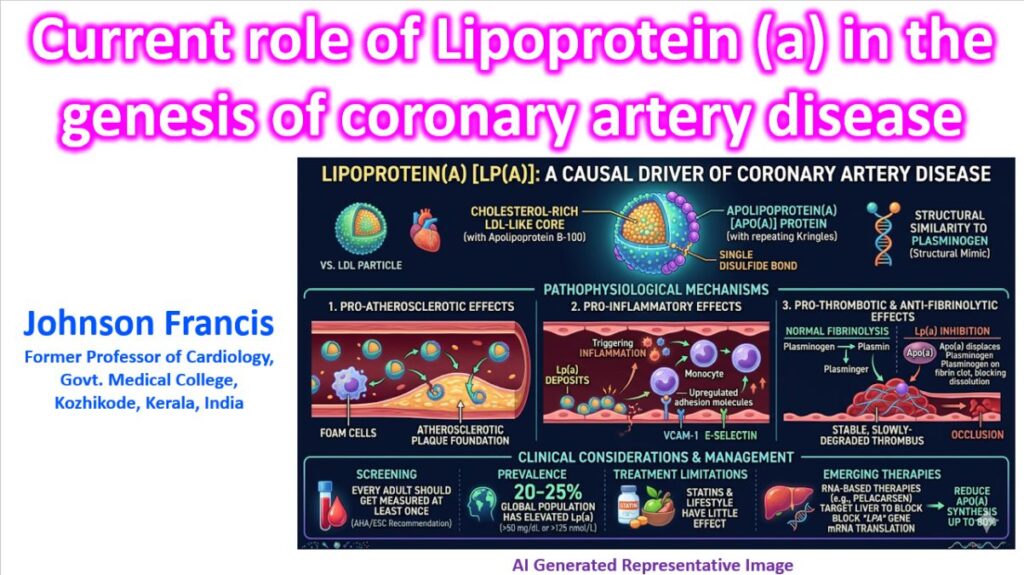

Lipoprotein(a)—commonly abbreviated as Lp(a)—has evolved from being viewed as a mere marker of residual cardiovascular risk to a recognized, independent, and causal driver of coronary artery disease (CAD) and calcific aortic valve stenosis. Unlike traditional cholesterol metrics, Lp(a) levels are predominantly dictated by genetics rather than lifestyle or diet.
The Structural Biology of Lp(a)
To understand how Lp(a) contributes to the genesis of CAD, it is essential to look at its unique molecular structure. Lp(a) is essentially a modified, highly atherogenic variant of a low-density lipoprotein (LDL) particle. It consists of:
- A cholesterol-rich LDL-like core containing one molecule of apolipoprotein B-100 (apoB).
- Apolipoprotein(a) [apo(a)], a unique, highly polymorphic glycoprotein that is covalently bound to the apoB molecule via a single disulfide bond.
The apo(a) protein is the defining feature of Lp(a). It contains multiple repeating loop-like structures known as “kringles.” Crucially, the structural sequence of apo(a) shares 75–85% of its amino acids with plasminogen, a key enzyme in the body’s natural fibrinolytic (clot-dissolving) system. However, despite this structural mimicry, apo(a) lacks the active protease domain that gives plasminogen its clot-busting ability.
Pathophysiological Mechanisms in CAD Genesis
The genesis of coronary artery disease driven by Lp(a) operates through a triad of overlapping mechanisms. It is simultaneously pro-atherosclerotic, pro-inflammatory, and pro-thrombotic.
1. Pro-Atherosclerotic Effects
Because Lp(a) contains an LDL-like core, it shares LDL’s ability to cross damaged or dysfunctional endothelial linings in coronary arteries. Once it accumulates in the subendothelial space, Lp(a) is highly prone to oxidation. It is then eagerly engulfed by surrounding macrophages, leading to the formation of cholesterol-engorged “foam cells.” The accumulation of these foam cells creates the fatty streaks that serve as the foundational architecture of atherosclerotic plaques.
2. Pro-Inflammatory Effects
Lp(a) serves as the primary carrier of oxidized phospholipids (OxPL) in the human bloodstream. When Lp(a) deposits these oxidized lipids into the arterial wall, it triggers a robust, localized inflammatory cascade. This upregulates cellular adhesion molecules—such as VCAM-1 and E-selectin—on the surface of endothelial cells, accelerating the recruitment of circulating monocytes (white blood cells) into the plaque environment. This continuous, smoldering inflammation accelerates the growth, vulnerability, and instability of the atherosclerotic lesion.
3. Pro-Thrombotic and Anti-Fibrinolytic Effects
The structural homology between apo(a) and plasminogen creates a dangerous competitive environment. Because apo(a) looks like plasminogen, it actively competes for the same binding sites on fibrin clots and endothelial surfaces. By displacing functional plasminogen with the inactive apo(a), Lp(a) effectively blocks the conversion of plasminogen into active plasmin. This inhibits fibrinolysis (the natural breakdown of blood clots). Consequently, when a microscopic rupture occurs in a vulnerable coronary plaque, the resulting thrombus is far more stable, degrades much slower, and is significantly more likely to precipitate a complete arterial occlusion (a myocardial infarction).
Clinical Implications and Management
Approximately 20% to 25% of the global population has elevated Lp(a) levels (generally defined as >50 mg/dL or >125 nmol/L), placing them at a substantially higher trajectory for premature CAD.
- Screening Consensus: Major cardiology and lipidology societies, including the American Heart Association (AHA) and the European Society of Cardiology (ESC), now recommend that every adult have their Lp(a) measured at least once in their lifetime to accurately stratify primary prevention risk.
- Treatment Limitations: Standard lipid-lowering therapies, such as statins, are generally ineffective at lowering Lp(a) mass and can occasionally slightly increase it. Traditional lifestyle modifications, such as diet and exercise, also do not meaningfully alter Lp(a) concentrations since levels are fixed by the LPA gene in early childhood.
- Emerging Therapies: Currently, the primary strategy for patients with high Lp(a) is the aggressive suppression of all other modifiable risk factors (e.g., driving LDL cholesterol as low as possible with PCSK9 inhibitors or statins). However, highly targeted RNA-based therapies—such as antisense oligonucleotides (e.g., pelacarsen)—are currently in Phase 3 cardiovascular outcome trials. These agents work in the liver to block the mRNA translation of the LPA gene, demonstrating the ability to drastically reduce the synthesis of the apo(a) protein by up to 80%.
Recent clinical trials
The treatment landscape for elevated Lipoprotein(a) [Lp(a)] is currently undergoing a rapid transformation. Because traditional lipid-lowering therapies (like statins or ezetimibe) do not meaningfully lower Lp(a), researchers are heavily focused on novel genetic therapies that target the production of the particle.
Here is a summary of the most significant recent and ongoing clinical trials for Lp(a)-lowering therapies:
1. Pelacarsen
- Modality: Antisense oligonucleotide (ASO) administered as a monthly subcutaneous injection.
- Mechanism: Works in the liver to block the mRNA translation of apolipoprotein(a), dramatically reducing its production.
- Key Trial — Lp(a) HORIZON: This is the first and most advanced cardiovascular outcomes trial (CVOT) in this therapeutic class. The trial completed enrollment of over 8,300 patients with established cardiovascular disease and elevated Lp(a). Based on the current event accrual trend, the overall study duration is anticipated to be approximately 6 years.
- Recent Trial — Pelacarsen + Inclisiran (NCT06813911) (ADD-VANTAGE): This newly recruiting Phase 3 trial evaluates the efficacy and safety of pelacarsen in ASCVD patients who are simultaneously receiving background treatment with inclisiran for LDL-C reduction.
2. Olpasiran
- Modality: Small interfering RNA (siRNA) therapy administered via injection every 12 weeks.
- Phase 2 Data: The OCEAN(a)-DOSE trial demonstrated that olpasiran safely lowered Lp(a) by more than 95% at its highest doses.
- Key CVOT — OCEAN(a)-Outcomes (NCT05581303): Also known as the TIMI 75 trial, this Phase 3 study is comparing olpasiran to a placebo in roughly 7,000 patients with a history of ASCVD and Lp(a) ≥ 200 nmol/L. The estimated primary completion date is early 2028.
- Primary Prevention Trial — OCEAN(a)-PreEvent (NCT07136012): A recently initiated Phase 3 trial focused on evaluating olpasiran specifically for the prevention of a first major cardiovascular event in high-risk individuals.
3. Lepodisiran
- Modality: Long-acting siRNA targeting apolipoprotein(a).
- Phase 2 Data: Results from the ALPACA trial recently showed that a single 400 mg dose of lepodisiran reduced Lp(a) levels by up to −93.9 percentage points, with the suppression lasting long enough to suggest it could potentially be dosed just once or twice a year.
- Key Trial — ACCLAIM-Lp(a): Currently enrolling, this Phase 3 CVOT aims to be the largest trial among these competitors, randomizing an estimated 16,700 patients across both primary and secondary prevention cohorts, with an estimated completion in 2029.
4. Muvalaplin
- Modality: Oral small molecule (a daily pill).
- Mechanism: Unlike the injectable genetic therapies that target the liver, muvalaplin works by directly disrupting the bond between apolipoprotein(a) and apolipoprotein B, effectively blocking the assembly of the Lp(a) particle.
- Status: Following the Phase 2 KRAKEN trial, which showed dose-dependent Lp(a) reductions of 47% to 86%, currently enrollment is going on for a Phase 3 cardiovascular outcomes trial.
5. Zerlasiran
Status: Phase 2 data has successfully demonstrated significant, cumulative Lp(a) reductions with successive doses, confirming the durability of the siRNA approach in a clinical setting.
Modality: siRNA targeting apolipoprotein(a).