


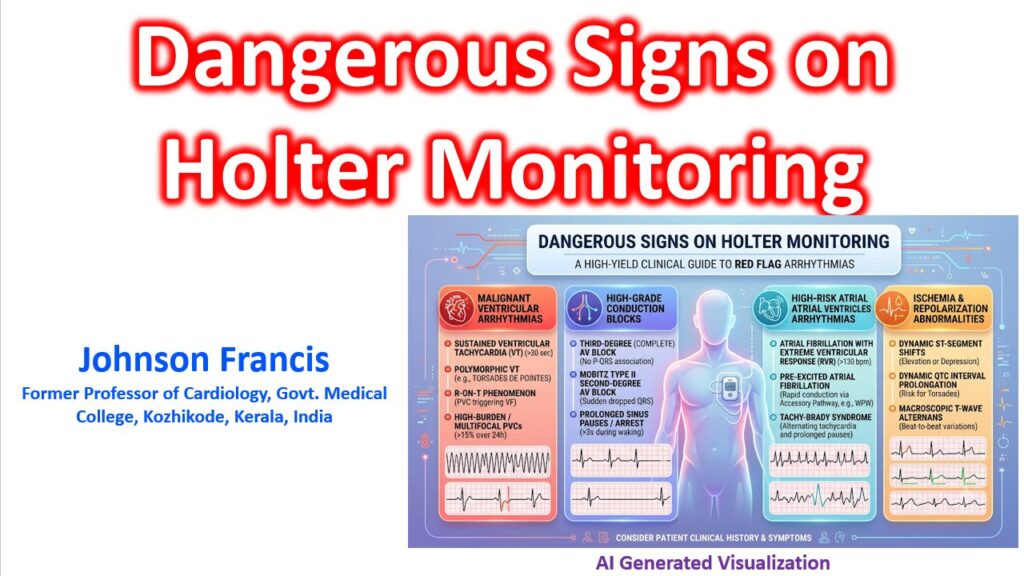

When reviewing a Holter monitor, the clinical significance of any finding heavily depends on the patient’s underlying structural heart health and symptom diary. However, certain “red flag” arrhythmias and conduction abnormalities demand immediate attention, as they represent a high risk for sudden cardiac death, syncope, or hemodynamic collapse. Here are the most dangerous signs to look for on a 24- or 48-hour Holter recording:
1. Malignant Ventricular Arrhythmias
Ventricular ectopy is common, but specific patterns indicate severe electrical instability.
- Sustained Ventricular Tachycardia (VT): Any VT lasting longer than 30 seconds, or VT that requires termination due to hemodynamic collapse (often correlated with diary entries of syncope).
- Polymorphic Non-Sustained VT (NSVT): While monomorphic NSVT might be tolerated, polymorphic NSVT suggests acute ischemia, electrolyte derangement, or a channelopathy, carrying a high risk of degenerating into Ventricular Fibrillation (VF).
- The R-on-T Phenomenon: This occurs when a premature ventricular complex (PVC) fires during the relative refractory period of the preceding beat (the peak or downstroke of the T-wave). This vulnerable period can trigger Torsades de Pointes or VF.
- High-Burden or Multifocal PVCs: A PVC burden exceeding 10–15% over 24 hours significantly increases the risk of PVC-induced cardiomyopathy. Frequent multifocal PVCs (especially couplets and triplets) in a structurally abnormal heart are also a poor prognostic marker.
2. High-Grade Conduction Blocks
While nocturnal Wenckebach (Mobitz I) or mild sinus bradycardia can be physiological variants driven by high vagal tone during sleep, infra-Hisian blocks are strictly pathological.
- Third-Degree (Complete) AV Block: Complete dissociation between P waves and QRS complexes. If the escape rhythm is slow or unstable, the risk of sudden asystole is critical.
- Mobitz Type II Second-Degree AV Block: Unlike Wenckebach, Mobitz II usually involves the His-Purkinje system and has a high rate of unpredictable progression to complete heart block.
- Significant Sinus Pauses / Arrest: Pauses strictly defined as > 3 seconds during waking hours, or significant prolonged pauses upon the termination of an atrial tachyarrhythmia (classic for Tachy-Brady Syndrome).
3. Atrial Arrhythmias with Dangerous Features
Atrial arrhythmias themselves are rarely acutely lethal, but their secondary physiological effects on the ventricles can be dangerous.
- Atrial Fibrillation/Flutter with Extreme Rates: A rapid ventricular response (RVR) sustained over 130–150 bpm can trigger demand ischemia or lead to tachycardiomyopathy. Conversely, AFib with an extremely slow ventricular response (in the absence of AV nodal blocking agents) suggests underlying conduction system disease.
- Pre-excited AFib: If the patient has a known accessory pathway (WPW), AFib can conduct rapidly down the pathway, resulting in wide-complex tachycardia that can degenerate into VF.
4. Ischemia & Repolarization Abnormalities
Holter monitors (especially 3-channel or 12-lead patches) can detect repolarization dynamics that resting ECGs miss.
- Dynamic ST-Segment Shifts: Transient, symptomatic, or asymptomatic ST elevation suggests coronary vasospasm (Prinzmetal’s angina). Deep, dynamic ST depressions often indicate demand-driven silent ischemia.
- Dynamic QTc Prolongation: Noticeable lengthening of the QTc interval, especially immediately preceding episodes of ventricular ectopy, is a major red flag for impending Torsades de Pointes.
- Macroscopic T-Wave Alternans: Beat-to-beat variation in T-wave amplitude or morphology reflects extreme spatiotemporal dispersion of repolarization, a known harbinger of imminent ventricular arrhythmias.