


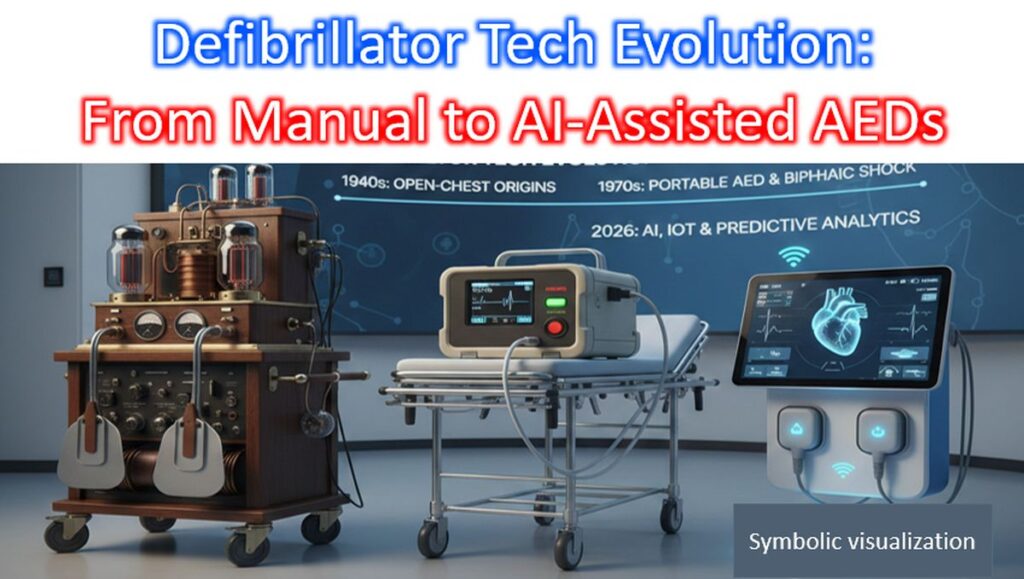

Evolution of the defibrillator is a fascinating journey from massive, 100kg+ “monsters” used only during surgery to the AI-driven, sleek devices we see in airports today. The technical leap from manual AC systems to intelligent machine-learning algorithms is particularly striking.
The Timeline of Innovation
1. The Early “Manual” Era (1899–1950s)
Originally, defibrillation was a high-risk, hospital-only procedure. In 1899 two physiologists Prevost and Batelli, at the University of Geneva documented that small electric shocks could induce ventricular fibrillation in dogs while larger shocks could reverse it.
- Open-Chest Origins: Until 1956, defibrillation required opening the chest to apply electrodes directly to the myocardium.
- The First Human Success (1947): Dr. Claude Beck performed the first successful human defibrillation on a 14-year-old boy during surgery using primitive internal paddles. That was an alternating current system.
- Bulky Hardware: Early external models (like William Kouwenhoven’s 1930 design) weighed over 120 kg—roughly the weight of a professional wrestler—making them impossible to move quickly.
2. Portability and the Rise of the AED (1960s–1990s)
The “Father of Emergency Medicine,” Prof. Frank Pantridge, changed everything by moving the tech into the field.
- The Car Battery Solution (1965): The first portable defibrillator used a car battery and weighed 70 kg. While heavy, it allowed for the first “Mobile Intensive Care Units.”
- The First AED (1978): The “Heart-Aid” was the first device to analyze heart rhythms automatically, paving the way for non-medical bystanders to save lives.
- Biphasic Waveforms: A major jump in the 90s was the shift from monophasic to biphasic shocks, which use lower energy (and thus smaller batteries/capacitors) to achieve the same efficacy with less myocardial damage.
The AI Revolution: Modern “Smart” AEDs
Today’s devices have moved beyond simple “shock/no-shock” logic. AI and Machine Learning have transformed them into responsive partners in resuscitation.
Advanced Rhythm Analysis
Traditional AEDs used static algorithms that sometimes struggled with signal noise (like muscle tremors or “artifact”).
- Machine Learning (ML): Modern AI-assisted AEDs use ML models trained on millions of ECG datasets. They can identify shockable rhythms with much higher sensitivity and specificity, even during ongoing chest compressions—reducing the “hands-off” time that is so critical for survival.
- Predictive Analytics: Some research-level AI can now predict the probability of a shock being successful before it is even delivered, allowing clinicians to adjust their approach in real-time.
Intelligent CPR Coaching
AI doesn’t just watch the heart; it watches the rescuer.
- Real-Time Feedback: Using accelerometers in the pads, AI analyzes the depth and rate of your compressions. It provides adaptive voice prompts like “Push harder” or “Good compressions,” effectively acting as a digital CCU consultant by your side.
- Contextual Guidance: If the AI detects a high-impedance patient (common in certain body types), it can automatically scale the energy delivery up to 360J to ensure the current actually reaches the heart.
IoT and Fleet Management
From an electronics perspective, the integration of IoT (Internet of Things) has solved the “dead battery” problem.
- Remote Monitoring: AI-enabled systems now perform self-checks and report their status via cellular or Wi-Fi. They alert managers if pads are expiring or if the circuitry fails, ensuring the device is 100% ready when a crisis hits.
In 2026, drone-delivered AED trials have moved beyond “proof of concept” and are now entering operational service in several countries. The most striking development is how these trials are solving the “last-meter” problem—getting a delicate electronic device safely into a bystander’s hands without landing the drone.
Active Trials and Operational Status (2026)
1. United States: The Duke Health/Forsyth County Study
Launched late in 2025 and actively expanding through 2026, this is the first major U.S. trial integrating drones into real 911 calls.
- The Workflow: When a 911 call is flagged as a suspected cardiac arrest, a drone launches simultaneously with EMS.
- Performance: Early results from early 2026 show response times dropping from a median of 7 minutes (ground EMS) to under 4 minutes for the drone.
- Engineering Highlight: The drones fly at 40+ mph and use a winch system to lower the AED from 100 feet. This avoids the safety risks of low-altitude rotors near untrained bystanders.
2. Sweden & France: Everdrone’s Regional Expansion
Everdrone remains the global leader, with its “Drone Emergency Medical Services” (DEMS) now reaching over 250,000 people.
- Sweden: In May 2025, they expanded to 10 “Skybases” in the Västra Götaland region.
- France: In late 2025, the first French deployment went operational in Normandy, fully integrated into the regional dispatch chain.
3. United Kingdom: The 3D Project & Project CAELUS
- Remote Reach: Trials led by the University of Warwick focused on “remote countryside” locations where ambulances are notoriously slow. That was a simulation study published in July 2025.
- Feasibility: They successfully demonstrated that drones can maintain real-time 4G/5G communications with dispatchers while flying, allowing the dispatcher to “see” the scene via the drone’s camera and guide the bystander through the AED setup.
Technical & Clinical Challenges in 2026
While the flight tech is mature, the trials have identified three major “human-factor” bottlenecks:
| Challenge | Current Solution being Trialed |
| Bystander Retrieval | Transitioning from “dropping” the AED to winching it to prevent damage and improve safety. |
| AED Interaction | Trial data shows bystanders often “freeze” when a drone arrives. Dispatchers now use LiveView video from the drone to provide verbal coaching. |
| Weather Hurdles | Most current trials still have a “no-fly” status during heavy rain or winds >8 m/s, though 2026 models are testing waterproof hulls. |
Why this matters for Kerala
The geography of Kerala—with its dense tropical foliage, narrow winding roads, and remote high-range areas—makes it a prime candidate for this technology. Drone delivery could bypass the “traffic gridlock” of cities like Kochi or the “hairpin curves” of the Wayanad ghats, potentially reaching a patient 15–20 minutes faster than a traditional ambulance.