


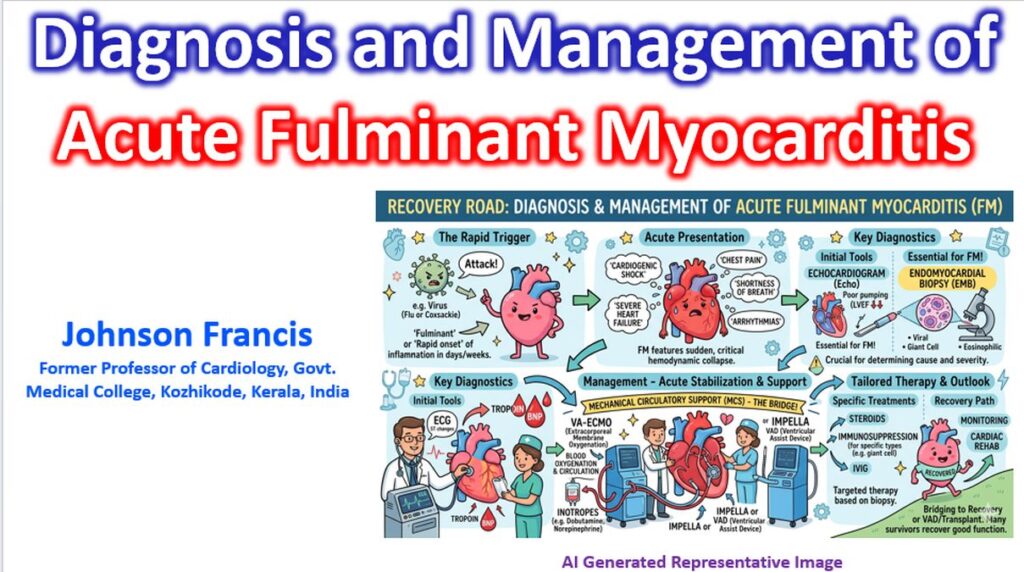

Acute Fulminant Myocarditis (FM) is a rapidly progressive and life-threatening form of myocardial inflammation characterized by sudden-onset heart failure, severe hemodynamic instability, and often cardiogenic shock or malignant arrhythmias. Unlike non-fulminant acute myocarditis, fulminant myocarditis requires aggressive intervention, including inotropic support and mechanical circulatory support, to bridge the patient to recovery or transplantation.
## Diagnostic Approach
The diagnosis of FM requires a high index of suspicion due to its ability to mimic acute coronary syndrome (ACS).
- Clinical Presentation: Patients typically present within 2–4 weeks of symptom onset with rapid deterioration. Symptoms may include severe dyspnea, chest pain, and signs of low cardiac output such as cool extremities and narrow pulse pressure.
- Biomarkers: Cardiac troponins are almost universally elevated. Recent studies indicate that the Sequential Organ Failure Assessment (SOFA) score (>12) and significantly elevated CK-MB (>94.7 ng/mL) are strong predictors of in-hospital mortality.
- Imaging:
- Echocardiography: Typically reveals severely reduced left ventricular ejection fraction (LVEF) and often increased wall thickness due to myocardial edema rather than hypertrophy.
- Cardiac MRI (CMR): The 2025 ESC Guidelines provide a Class I recommendation for CMR in suspected myocarditis. It can identify edema and Late Gadolinium Enhancement (LGE). Notably, the presence of myocardial fibrosis on CMR is associated with a lower likelihood of ventricular recovery. CMR is recognized as the definitive non-invasive tool to confirm myocarditis, capable of distinguishing between reversible inflammation and irreversible fibrosis using the revised Lake Louise criteria.
- Endomyocardial Biopsy (EMB): Remains the gold standard for definitive diagnosis and for identifying specific subtypes (e.g., giant cell or eosinophilic myocarditis) that require targeted immunosuppression. The ESC 2025 updates emphasize its use in high-risk presentations where a change in management is anticipated.
## Management Strategies
Management focuses on maintaining systemic perfusion while minimizing myocardial work.
- Mechanical Circulatory Support (MCS):
- VA-ECMO: Venoarterial Extracorporeal Membrane Oxygenation is the primary support modality for refractory cardiogenic shock, with survival rates reported around 60–70% in specialized centers.
- LV Unloading: To prevent left ventricular distension and pulmonary edema during VA-ECMO, early unloading using an Impella device or Intra-Aortic Balloon Pump (IABP) is increasingly utilized.
- Pharmacological & Immunomodulatory Therapy:
- Inotropes/Vasopressors: Initial stabilization usually involves norepinephrine and dobutamine.
- Corticosteroids: High-dose intravenous methylprednisolone may be considered, particularly in refractory cases or virus-negative inflammatory cardiomyopathy. MYTHS – MYocarditis THerapy With Steroids (MYTHS) trial is evaluating efficacy of pulsed intravenous methylprednisolone versus standard therapy on top of maximal support in patients with acute myocarditis.
- IVIG: While controversial, high-dose Intravenous Immunoglobulin (IVIG) has shown dramatic improvement in select cases, potentially due to its anti-inflammatory and antiviral effects.
## Prognosis
While fulminant myocarditis was historically thought to have a superior long-term prognosis compared to non-fulminant forms if the acute phase was survived, recent registry data suggests:
- In-hospital Mortality: Remains high even with MCS.
- Long-term Recovery: Many survivors exhibit residual LV dysfunction. Factors such as prolonged ECMO duration and extensive fibrosis on CMR are negative prognostic indicators.
## References
D’Ettore, N., Eghbalzadeh, K., Oezkur, M., Bertoldi, L., Bossard, M., & Pappalardo, F. (2025). Diagnosis and Management of Patients with Fulminant Myocarditis. European Heart Journal Supplements, 27(Supplement_A). https://doi.org/10.1093/eurheartjsupp/suaf004
Guerrero Cervera, B., et al. (2025). Fulminant Myocarditis with VA-ECMO Support: Clinical Characteristics and Prognosis in a Cohort from a Tertiary Transplant Center. Journal of Clinical Medicine, 13(9), 2146.
Karimialavijeh, E. (2025). Diagnosing acute myocarditis in the emergency department—advancing cardiac MRI with a focus on low-field MR applications. Frontiers in Radiology.
Kociol, R. D., et al. (2020). Recognition and Initial Management of Fulminant Myocarditis: A Scientific Statement From the American Heart Association. Circulation, 141(6), e69-e92. https://doi.org/10.1161/CIR.0000000000000745
Lee, Y. I., Chung, S., Yang, J. H., Sung, K., Kim, D., Choi, J. O., Jeon, E. S., Yang, J. H., & Cho, Y. H. (2021). Extracorporeal Membrane Oxygenation for Fulminant Myocarditis: Increase of Cardiac Enzyme and SOFA Score Is Associated with High Mortality. Journal of Clinical Medicine, 10(7), 1526. https://doi.org/10.3390/jcm10071526
Nakashima, H., et al. (2013). Successive immunosuppressive treatment of fulminant myocarditis that is refractory to mechanical circulatory support. Journal of Cardiology Cases, 8(1), 22-25.
Özyiğit, T., et al. (2009). Successful intravenous immunoglobulin therapy in a case of acute fulminant myocarditis. Türk Kardiyoloji Derneği Arşivi.
Veronese, G., et al. (2018). Fulminant myocarditis: Characteristics, treatment, and outcomes. The Anatolian Journal of Cardiology, 19(4), 279-286. https://doi.org/10.14744/anatoljcardiol.2017.8170