


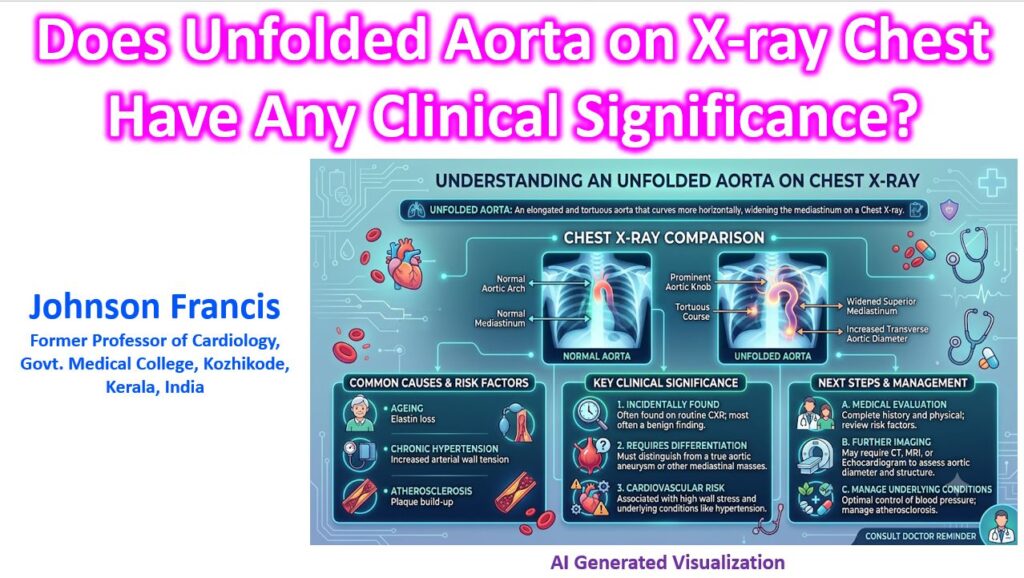

An unfolded (or tortuous) aorta on a chest X-ray is primarily an incidental, age-related morphological change, but it shouldn’t be dismissed as entirely meaningless. While it is usually asymptomatic and doesn’t require direct surgical intervention, its clinical significance lies in being a radiologic proxy for systemic vascular aging and cumulative hemodynamic load.
Because the aorta is tethered at the aortic valve annulus and the diaphragmatic hiatus, the age-related loss of medial elastin and the constant mechanical stress of systole cause the vessel to elongate over time. Since it cannot stretch further longitudinally between those fixed points, it bows outward laterally and anteriorly, pushing into the right and left hemithoraces.
Key Clinical Implications
- Marker for Chronic Hypertension: An unfolded aorta is classic evidence of long-standing, often poorly controlled, systemic hypertension. It represents years of elevated wall stress and the resulting medial degeneration.
- Indicator of Atherosclerotic Burden: This morphological change is frequently accompanied by calcification at the aortic knuckle. A tortuous, calcified aorta strongly correlates with an increased systemic atherosclerotic burden, signaling a higher risk for coronary artery disease (CAD), ischemic stroke, and left ventricular hypertrophy (LVH).
- The “Aneurysm Mimic”: The most immediate clinical challenge is radiographic. The wide swing of the ascending and descending aorta widens the mediastinal shadow, which can easily be misdiagnosed as a true thoracic aortic aneurysm (TAA) or even a dissection in the acute setting, often prompting unnecessary CT angiograms.
- Loss of the Windkessel Effect: The structural changes causing the unfolding—specifically, collagen deposition replacing functional elastin—indicate a significantly stiffened aorta. This loss of arterial compliance increases pulse pressure, directly increasing left ventricular afterload and potentially compromising diastolic coronary perfusion.
Ultimately, while the finding of an unfolded aorta on its own doesn’t dictate immediate treatment, it serves as a visible, physical cue to aggressively optimize blood pressure, assess global cardiovascular risk, and look closer for target organ damage.