


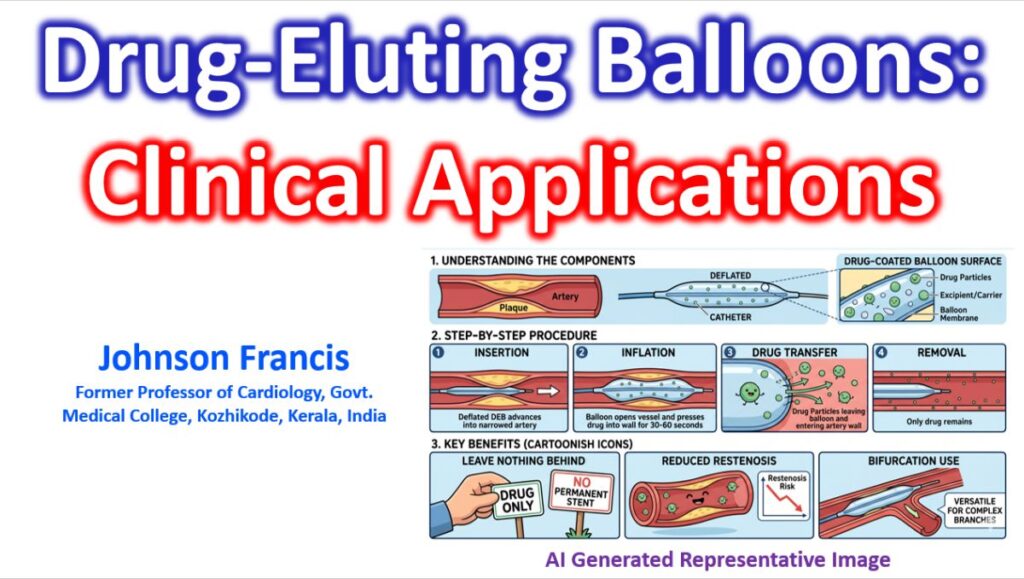

Drug-eluting balloons (DEB), often referred to as drug-coated balloons (DCB), represent a specialized angioplasty technology designed to deliver anti-proliferative medication directly to the arterial wall without the need for a permanent scaffold or metallic implant. The primary “leave nothing behind” philosophy aims to reduce long-term complications associated with permanent stents, such as late stent thrombosis and chronic inflammation.
Mechanism of Action
The balloon is coated with a lipophilic drug and an excipient (a carrier molecule). During inflation—typically lasting 30 to 60 seconds—the drug is rapidly transferred to the vessel wall.
- Drugs Used: Paclitaxel is the most common agent due to its high lipophilicity and rapid uptake. Sirolimus (and its analogs) is also used, though it requires specialized crystalline coating technologies to ensure effective transfer during short inflation times.
- Excipients: These facilitate drug release from the balloon surface and enhance tissue penetration.
Primary Clinical Indications
- In-Stent Restenosis (ISR): This is the most established indication. DCBs are considered a Class I recommendation (Level of Evidence: A) for treating ISR in both bare-metal and drug-eluting stents.
- Small Vessel Disease: In vessels where the diameter is < 2.75 mm, stenting is associated with higher rates of restenosis. DCBs provide an alternative that maintains the natural vessel anatomy.
- Bifurcation Lesions: Specifically useful for the side branch, where stenting can be technically complex and prone to “jail” the branch or cause flow limitations.
- Peripheral Artery Disease (PAD): Widely used in the superficial femoral artery (SFA) and popliteal arteries, where mechanical stress and frequent limb movement make permanent stents more prone to fracture.
Advantages vs. Drug-Eluting Stents (DES)
- Anatomical Integrity: Preserves the vasomotion of the vessel and does not preclude future surgical options like bypass.
- Reduced DAPT Duration: Because there is no permanent metal to endothelialise, the duration of Dual Antiplatelet Therapy (DAPT) can often be shorter compared to DES, which is beneficial for patients with high bleeding risk.
- Homogeneous Drug Delivery: Provides more uniform contact with the vessel wall compared to the discrete struts of a stent.
Procedural Success Factors
The “DCB-only” strategy relies heavily on meticulous lesion preparation. Current consensus suggests that a DCB should only be used if:
- There is no significant residual stenosis (≤ 30%).
- There are no flow-limiting dissections (Type C or higher) after pre-dilatation.
- If these criteria aren’t met, “bail-out” stenting is usually required.