


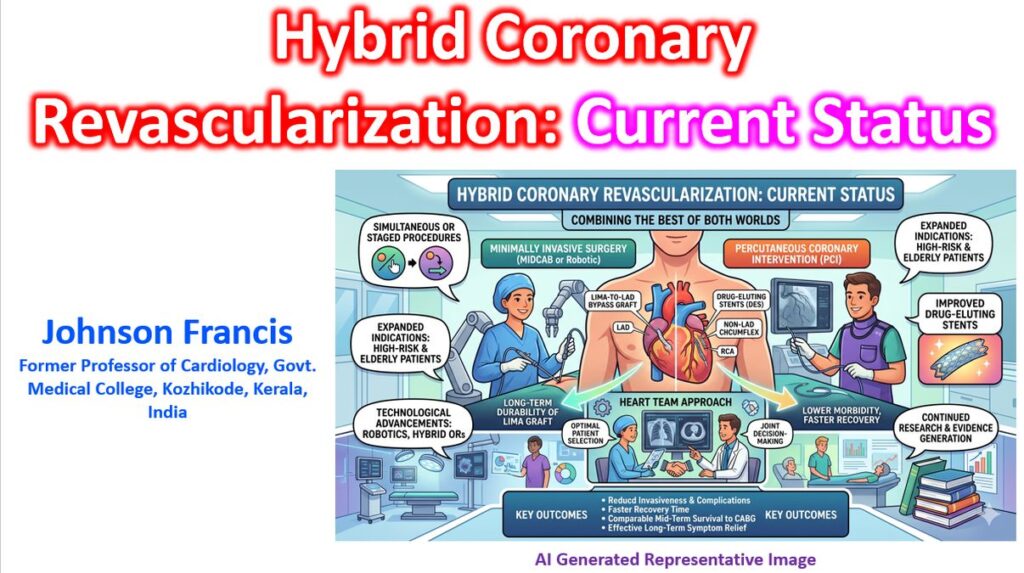

Hybrid coronary revascularization (HCR) continues to evolve as a sophisticated “best of both worlds” strategy for multivessel coronary artery disease (MVCAD). By combining the gold-standard durability of a Left Internal Mammary Artery (LIMA)-to-LAD bypass with the lower morbidity of Percutaneous Coronary Intervention (PCI) for non-LAD lesions, HCR addresses the primary limitations of both standalone CABG and multivessel PCI. Hybrid coronary revascularization typically involved LIMA to LAD bypass with minimally invasive direct coronary artery bypass (MIDCAB) complemented by PCI to non-LAD vessels.
Clinical Efficacy & Outcomes
Recent comparative data suggests that HCR is a viable alternative to traditional CABG, particularly for patients who are high-risk for sternotomy but require the survival benefit of a LIMA-LAD graft.
- Short-term Benefits: HCR consistently demonstrates lower rates of blood transfusion, shorter ICU/hospital stays, and faster return to work compared to conventional CABG.
- Long-term Survival: Mid- and long-term survival (up to 10-11 years) appears comparable between HCR and traditional CABG in appropriately selected cohorts.
- The “Revascularization Gap”: While survival is similar, some studies indicate a higher rate of repeat revascularization in HCR compared to traditional CABG, often driven by the PCI component or the inherent complexity of minimally invasive surgical sites.
Procedural Strategies: Timing & Sequence
The sequence of HCR remains a point of clinical debate, though institutional preference often dictates the workflow:
| Strategy | Rationale | Pros/Cons |
| Simultaneous | Performed in a single session in a hybrid OR suite. | + Immediate LIMA-LAD assessment; – Increased bleeding risk due to DAPT + Heparin. |
| Surgical-First | LIMA-LAD via MIDCAB/Robotic, followed by PCI (days/weeks later). | + Safer DAPT initiation; – Temporary incomplete revascularization. |
| PCI-First | PCI of a non-LAD culprit (e.g., in ACS), followed by surgical LAD bypass. | + Immediate treatment of culprit; – Risk of stent thrombosis during surgery. |
Recent 11-year data suggests that short- and long-term outcomes remain excellent regardless of whether the surgical or PCI component is performed first.
Current Adoption and Challenges
Despite its theoretical advantages, HCR adoption remains low, representing roughly 0.5% to 1% of all revascularization procedures in large databases. Primary barriers include:
- Infrastructure Requirements: The need for specialized hybrid operating suites.
- Expertise: High technical demand for robotic or thoracoscopic LIMA harvesting.
- Heart Team Collaboration: Success requires deep integration between interventionalists and surgeons, which can be logistically challenging.
Long-Term Survival and MACCE
Long-term survival rates for HCR are consistently reported as non-inferior to traditional CABG across various cohorts, extending up to 10–11 years of follow-up.
- Survival Rates: Studies with a median follow-up of 11 years report survival rates of 92% at 3 years and 85% at 5 years for HCR.
- MACCE (Major Adverse Cardiac and Cerebrovascular Events): Total MACCE at 11 years for HCR is approximately 36.7%, with cardiac-related deaths accounting for only 5.5% of the total (Rufa et al., 2024).
- Ischemia Relief: Some data suggest HCR may provide superior long-term symptom relief compared to multivessel PCI, with 2-year results showing lower rates of angina (5.5% vs. 17.2%, p=0.003) and overall MACCE in high-risk patients (Luo et al., 2025).
Repeat Revascularization: The “PCI Factor”
The primary difference in long-term outcomes between HCR and CABG lies in the rate of repeat revascularization, which is typically higher in HCR cohorts.
- Revascularization Rates: Repeat revascularization in HCR ranges from 2% to 7% in mid-term follow-up (Clavijo et al., 2026). It is probably mostly contributed by PCI vessels.
- Graft vs. Stent Performance: While the LIMA-to-LAD graft in HCR maintains excellent long-term patency (approaching 100% in many series), the non-LAD lesions treated with drug-eluting stents (DES) remain subject to the typical limitations of PCI, such as in-stent restenosis.
Summary of Clinical Positioning
Current consensus emphasize that HCR is most appropriate for patients with high-risk features where the “invasiveness-to-benefit” ratio of a full sternotomy is unfavorable. While HCR is considered feasible and safe, the medical community continues to call for larger randomized controlled trials to provide definitive long-term recommendations and better identify patients who will benefit most from this combined approach.
References
Fazmin, I. T., & Ali, J. M. (2025). Hybrid Coronary Revascularisation: Indications, Techniques, and Outcomes. Journal of Clinical Medicine, 14(3), 880. https://doi.org/10.3390/jcm14030880
Hannan, E. L. (2020). Hybrid Coronary Revascularization Versus Conventional Coronary Artery Bypass Surgery. Circulation: Cardiovascular Interventions. https://doi.org/10.1161/CIRCINTERVENTIONS.120.009386
Newman, J. S., Jarral, O. A., Kim, M. C., Brinster, D. R., Singh, V. P., Scheinerman, S. J., & Patel, N. C. (2024). Ten-year outcomes of hybrid coronary revascularization at a single center. Annals of Cardiothoracic Surgery, 13, 425–435. https://doi.org/10.21037/acs-2023-rcabg-0188
Rufa, M., Ursulescu, A., Nagib, R., Albert, M., & Franke, U. F. W. (2024). Hybrid total arterial minimally invasive off-pump coronary revascularization and percutaneous coronary intervention strategy for multivessel coronary artery disease: a cohort study with a median 11-year follow-up. Cardiovascular Diagnosis and Therapy, 14, 272–282. https://doi.org/10.21037/cdt-23-413
Willard, R., Scheinerman, J., Pupovac, S., & Patel, N. C. (2024). The Current State of Hybrid Coronary Revascularization. The Annals of Thoracic Surgery, 118(2), 318–328. https://doi.org/10.1016/j.athoracsur.2024.04.010
Luo, T. (2025). Hybrid coronary revascularization vs. PCI in high-risk multivessel coronary artery disease: a two-center, two-year outcome comparison. Frontiers in Cardiovascular Medicine, 12.
Clavijo, P. E. C. (2026). Minimally Invasive Coronary Artery Revascularization Surgery Versus Conventional Techniques in Patients With Complex Coronary Artery Disease: A Systematic Review of Cardiac Function. Cureus, 18(1).
Guz, G. (2025). Early outcomes of hybrid coronary revascularization in multivessel coronary artery disease with low ejection fraction. Frontiers in Cardiovascular Medicine
Ren, J. (2026). Beyond CABG vs. PCI: Contemporary and Future Coronary Revascularisation from Historical Evolution to Artificial Intelligence, Robotics, and Hybrid Strategies. Journal of Clinical Medicine, 15(7).