


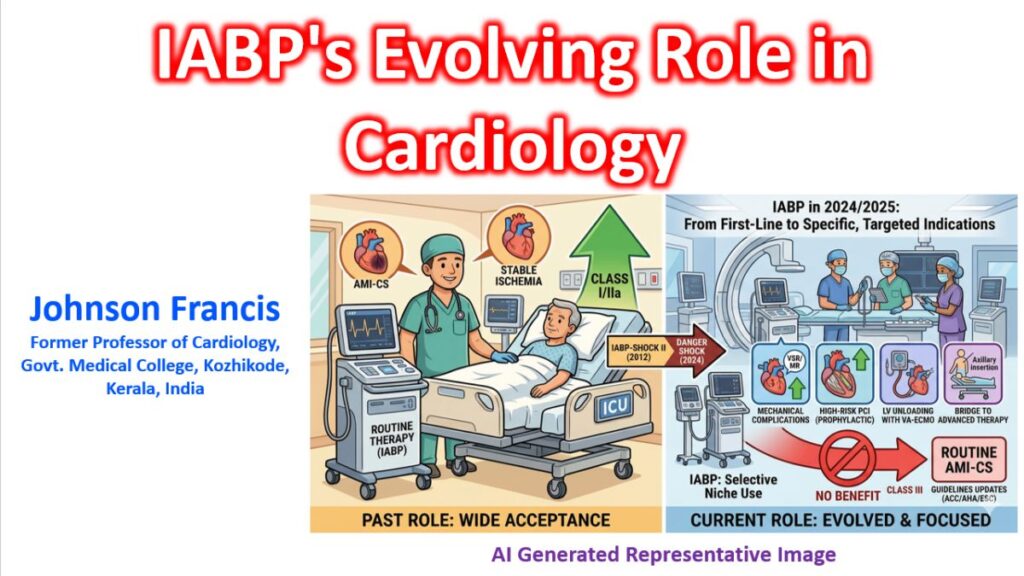
Based on the most recent clinical trial data and guidelines, the role of the Intra-Aortic Balloon Pump (IABP) has shifted from a primary, routine therapy to a highly selective “niche” intervention. While it remains the most commonly used mechanical circulatory support (MCS) device globally due to its relatively low cost and ease of insertion, its clinical standing has been significantly downgraded.
Guideline Recommendations
The most significant recent update is the 2025 ACC/AHA/SCAI Guideline for the Management of ACS, which officially aligned US practice with earlier European restrictions.
| Organization | Condition | Recommendation |
| ACC/AHA (2025) | Routine AMI-Cardiogenic Shock | Class III (No Benefit) |
| ESC (2023) | Routine AMI-Cardiogenic Shock | Class III (No Benefit) |
| ACC/AHA (2025) | Mechanical Complications (VSR/MR) | Class IIa (Reasonable) |
| ESC/ACC | High-Risk PCI | Class IIb (May be considered) |
Routine use in AMI-related cardiogenic shock is now a Class III (Harm/No Benefit) recommendation across all major societies.
Key Clinical Trials & Evidence Base
The downgrading of IABP is rooted in several landmark trials that failed to show a mortality benefit, contrasting with newer data for more powerful devices.
The IABP-SHOCK II Trial (Long-term Data)
The definitive blow to routine IABP use came from this trial. Recent 6-year follow-up data (epub late 2018) showed:
- No difference in all-cause mortality at 30 days, 1 year, or 6 years (approx. 66–67% mortality in both groups).
- No improvement in quality of life or recurrent MI rates.
The DanGer Shock Trial
This trial compared the a microaxial flow pump against standard care (which excluded IABP). 355 patients were included in the final analysis.
- Result: Impella CP reduced 6-month mortality in STEMI-CS compared to standard care (45.8% vs 58.5%). Composite safety endpoint was severe bleeding, limb ischemia, hemolysis, device failure, or worsening aortic regurgitation. There was a higher incidence of composite of adverse events with the use of the microaxial flow pump.
- Impact on IABP: This trial provided the first “high-level” evidence that higher-power unloading (3.5 L/min vs IABP’s <1 L/min indirect increase in cardiac output) is required to influence mortality, further marginalizing IABP as a standalone shock therapy.
The ECLS-SHOCK Trial
- Result: Routine VA-ECMO did not improve mortality in AMI-CS.
- Impact on IABP: Interestingly, many centers still use IABP in combination with ECMO to reduce the afterload of the left ventricle. While some registries suggest benefit, randomized data for IABP as an unloading tool during ECMO remains neutral.
Current “Niche” Indications in Interventional Cardiology
Despite the “No Benefit” label for routine use in shock, IABP is still utilized in specific, high-value scenarios:
- Mechanical Complications of MI: It remains a bridge to surgery for Acute Mitral Regurgitation or Ventricular Septal Rupture (VSR) by reducing afterload and increasing coronary perfusion without the high shear stress of axial pumps. In VSR, IABP has been shown to reduce left to right shunting and improve hemodynamics in patients with and without shock. Favourable hemodynamics have been noted in acute ischemic mitral regurgitation as well.
- High-Risk PCI (Prophylactic): Used in “protected PCI” for patients with precarious hemodynamics, multi-vessel disease, or last-remaining-conduit scenarios where temporary stability is needed during balloon/stent deployments.
- Bridge to Advanced Therapy: In cases of chronic heart failure (HF-CS) worsening, IABP is often used as a bridge to a Left Ventricular Assist Device (LVAD) or Heart Transplant because it allows for patient mobilization (if inserted via the axillary artery).
Summary of Hemodynamic Utility
The IABP provides Diastolic Augmentation and Systolic Unloading.
- Increase: Coronary blood flow, myocardial oxygen supply, Mean Arterial Pressure (MAP).
- Decrease: Afterload, Myocardial Oxygen Demand (MVO2), Pulmonary Capillary Wedge Pressure (PCWP).