


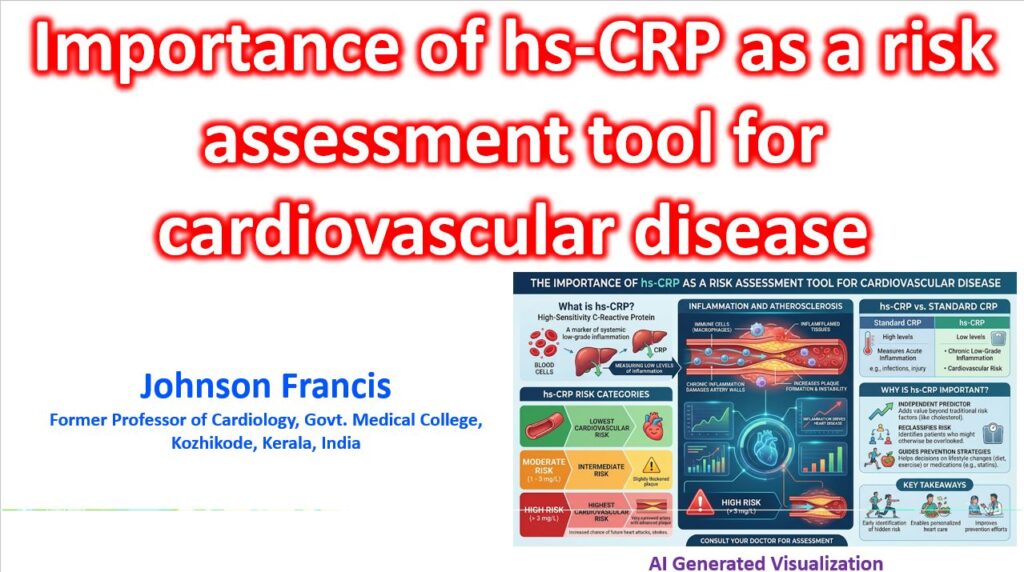

Atherosclerosis is no longer viewed strictly as a lipid related disease; it is fundamentally an inflammatory process. High-sensitivity C-reactive protein (hs-CRP) has emerged as the most clinically validated biomarker to capture this inflammatory risk, serving as a critical tiebreaker in primary prevention and risk stratification.
Here is how hs-CRP fits into current clinical practice, pathophysiology, and patient management.
The Inflammatory Pathophysiology
While LDL cholesterol initiates subendothelial injury, inflammation drives plaque progression and instability, the inflammatory cascade begins with interleukins (primarily IL-1β and IL-6), which stimulate the liver to produce CRP.
Elevated hs-CRP indicates active macrophage infiltration within the arterial wall and the localized secretion of matrix metalloproteinases, which thin the fibrous cap. Therefore, hs-CRP is not just a marker of plaque burden; it is a marker of plaque vulnerability and impending atherothrombosis.
Clinical Utility: Risk Reclassification
The primary value of hs-CRP lies in risk reclassification for patients where the decision to initiate statin therapy is ambiguous.
In the ACC/AHA guidelines, an hs-CRP level of ≥ 2.0 mg/L is officially classified as a risk-enhancing factor.
- Low Risk (< 5% ASCVD) or High Risk (≥ 20% ASCVD): hs-CRP rarely changes management, as the treatment path is already clear.
- Borderline (5% to < 7.5%) or Intermediate Risk (7.5% to < 20%): A repeatedly elevated hs-CRP strongly favors the initiation of moderate-to-high intensity statin therapy.
Tools like the Reynolds Risk Score directly incorporate hs-CRP alongside family history to reclassify patients. This often identifies high-risk individuals—particularly women—who are frequently missed or underscored by standard lipid-centric calculators.
Key insight: Statins possess pleiotropic effects, meaning they lower hs-CRP independent of their LDL-lowering capabilities. Tracking both parameters allows you to monitor both the lipid and the inflammatory response to therapy.
Landmark Clinical Trials
Two pivotal trials established the clinical mandate for evaluating and targeting inflammation:
| Trial | Hypothesis | Key Finding |
| JUPITER (2008) | Do statins benefit patients with LDL | Rosuvastatin reduced major adverse cardiovascular events (MACE) by 44% in patients with LDL < 130 mg/dL but hs-CRP ≥ 2.0 mg/L. |
| CANTOS (2017) | Does targeting inflammation directly (without lowering LDL) reduce risk? | Canakinumab (IL-1β inhibitor) significantly reduced MACE, proving the “inflammatory hypothesis” of cardiovascular disease. |
Practical Measurement Considerations
Because CRP is an acute-phase reactant, it lacks specificity. To use it effectively for cardiovascular risk assessment:
- Timing: It must be measured in a metabolically stable state, free of acute infection, trauma, or active illness.
- Confirmation: A single elevated reading is insufficient. Guidelines recommend two measurements taken at least two weeks apart, using the lower of the two values to guide therapy.
- Extreme Elevations: Values > 10 mg/L usually indicate an acute systemic infection or an active rheumatologic flare, rather than baseline cardiovascular risk. These results should prompt an evaluation for non-cardiovascular causes.
References
JUPITER Trial (2008)
Justification for the Use of Statins in Prevention: an Intervention Trial Evaluating Rosuvastatin
- Article: Rosuvastatin to Prevent Vascular Events in Men and Women with Elevated C-Reactive Protein
- Authors: Paul M. Ridker, Eleanor Danielson, Francisco A.H. Fonseca, et al.
- Journal: New England Journal of Medicine
- Citation: N Engl J Med 2008; 359:2195-2207
- DOI: 10.1056/NEJMoa0807646
- Direct NEJM Link: https://www.nejm.org/doi/full/10.1056/NEJMoa0807646
CANTOS Trial (2017)
Canakinumab Anti-inflammatory Thrombosis Outcomes Study
- Article: Anti-inflammatory Therapy with Canakinumab for Atherosclerotic Disease
- Authors: Paul M. Ridker, Jean G. MacFadyen, Wolfgang Koenig, et al.
- Journal: New England Journal of Medicine
- Citation: N Engl J Med 2017; 377:1119-1131
- DOI: 10.1056/NEJMoa1707914
- Direct NEJM Link: https://www.nejm.org/doi/full/10.1056/NEJMoa1707914