


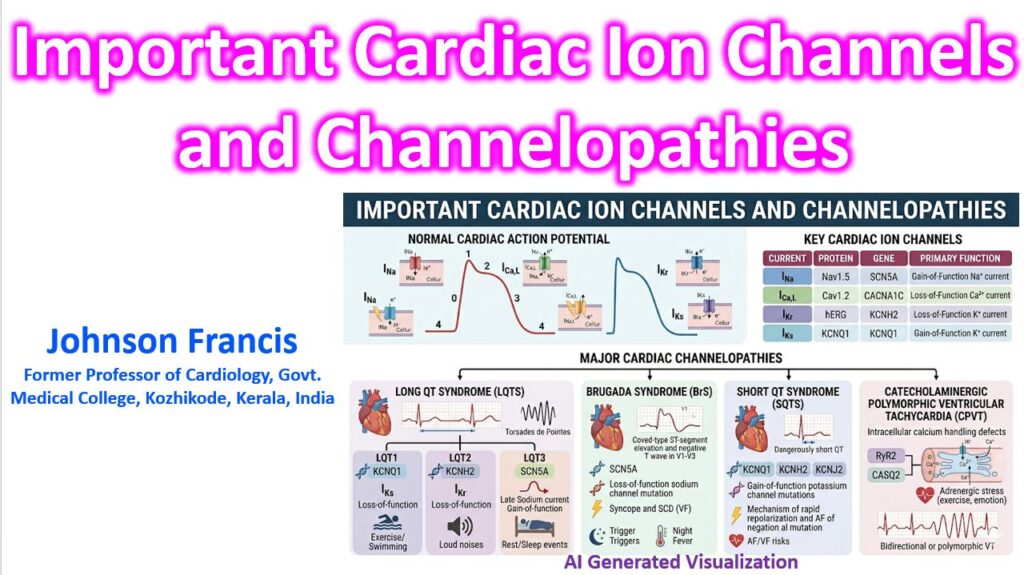

The electrical stability of the heart relies on a highly synchronized sequence of cellular events known as the cardiac action potential. This impulse is governed by the intricate opening and closing of specific voltage-gated ion channels residing in the cardiomyocyte membrane. When genetic mutations alter the structure or regulatory proteins of these channels, it leads to cardiac channelopathies. These are primary electrical disorders that predispose individuals to life-threatening arrhythmias—and potentially sudden cardiac death—often in the absence of any structural heart disease.
Here is a breakdown of the critical cardiac ion channels and the primary channelopathies associated with their dysfunction.
Key Cardiac Ion Channels
The cardiac action potential is shaped by a delicate balance of inward (depolarizing) and outward (repolarizing) currents.
| Current | Protein | Gene | Primary Function |
| INa | Nav1.5 | SCN5A | Phase 0 rapid upstroke (depolarization) |
| ICa,L | Cav1.2 | CACNA1C | Phase 2 plateau and excitation-contraction |
| IKr | hERG (Kv11.1) | KCNH2 | Phase 3 rapid repolarization |
| IKs | KCNQ1 (Kv7.1) | KCNQ1 | Phase 3 slow repolarization |
- Sodium Channels: The Nav1.5 channel (encoded by the SCN5A gene) is responsible for the massive, rapid influx of sodium ions (INa) that initiates the action potential upstroke (Phase 0). Because it dictates how fast the electrical signal travels, abnormalities here often slow cardiac conduction and favor dangerous reentry arrhythmias.
- Potassium Channels: Potassium currents drive repolarization, returning the cell to its resting state. The two most critical are the rapid delayed rectifier current (IKr), generated by the hERG channel, and the slow delayed rectifier current (IKs), generated by the KCNQ1 channel complex.
Major Cardiac Channelopathies
Because these channels are heavily interdependent, a defect in just one can destabilize the entire electrical cycle. The most prominent inherited channelopathies include:
1. Long QT Syndrome (LQTS)
LQTS is characterized by a delayed repolarization of the ventricles, visible on an ECG as a prolonged QT interval. This delay creates a vulnerable window where early afterdepolarizations can trigger Torsades de Pointes—a polymorphic ventricular tachycardia that can degenerate into ventricular fibrillation.
LQTS is classified by the specific mutated gene:
- LQT1: Caused by loss-of-function mutations in KCNQ1 (IKs current). Arrhythmias are often triggered by exercise (especially swimming) or emotional stress.
- LQT2: Caused by loss-of-function mutations in KCNH2 (hERG channel, IKr current). Triggers often include sudden loud noises (like an alarm clock) or emotional stress.
- LQT3: Unlike LQT1 and LQT2, this is caused by a gain-of-function mutation in the SCN5A sodium channel, leading to a persistent, late sodium current that drags out the action potential duration. Events typically occur during rest or sleep.
2. Brugada Syndrome (BrS)
Brugada Syndrome is most frequently associated with a loss-of-function mutation in the SCN5A sodium channel gene. It is diagnosed by a very specific ECG hallmark: a coved-type ST-segment elevation followed by a negative T wave in the right precordial leads (V1-V3). Patients are at high risk for syncope and sudden cardiac death due to ventricular fibrillation, often occurring at night or during a fever.
3. Short QT Syndrome (SQTS)
SQTS is a rare but highly lethal channelopathy characterized by a dangerously short QT interval. It is primarily caused by gain-of-function mutations in potassium channel genes (KCNQ1, KCNH2, or KCNJ2). Because the potassium channels stay open too long or open too forcefully, the action potential repolarizes much faster than normal, shortening the refractory period and allowing atrial and ventricular fibrillation to take hold easily.
4. Catecholaminergic Polymorphic Ventricular Tachycardia (CPVT)
While the channelopathies above primarily involve surface membrane channels, CPVT is a defect in intracellular calcium handling. Mutations in the ryanodine receptor (RyR2) or calsequestrin (CASQ2) cause calcium to leak from the sarcoplasmic reticulum during periods of high adrenergic stress (like intense exercise or emotion). This calcium leak triggers delayed afterdepolarizations, leading to bidirectional or polymorphic ventricular tachycardia.
References
Abriel H, Zaklyazminskaya EV. Cardiac channelopathies: genetic and molecular mechanisms. Gene. 2013 Mar 15;517(1):1-11. doi: 10.1016/j.gene.2012.12.061. Epub 2012 Dec 22. PMID: 23266818.
Brewer KR, Kuenze G, Vanoye CG, George AL Jr, Meiler J, Sanders CR. Structures Illuminate Cardiac Ion Channel Functions in Health and in Long QT Syndrome. Front Pharmacol. 2020 May 4;11:550. doi: 10.3389/fphar.2020.00550. PMID: 32431610; PMCID: PMC7212895.
Garcia-Elias A, Benito B. Ion Channel Disorders and Sudden Cardiac Death. Int J Mol Sci. 2018 Feb 28;19(3):692. doi: 10.3390/ijms19030692. PMID: 29495624; PMCID: PMC5877553.
Lieve KV, Wilde AA. Inherited ion channel diseases: a brief review. Europace. 2015 Oct;17 Suppl 2:ii1-6. doi: 10.1093/europace/euv105. PMID: 26842110.
Rahm AK, Lugenbiel P, Schweizer PA, Katus HA, Thomas D. Role of ion channels in heart failure and channelopathies. Biophys Rev. 2018 Aug;10(4):1097-1106. doi: 10.1007/s12551-018-0442-3. Epub 2018 Jul 17. PMID: 30019205; PMCID: PMC6082303.