


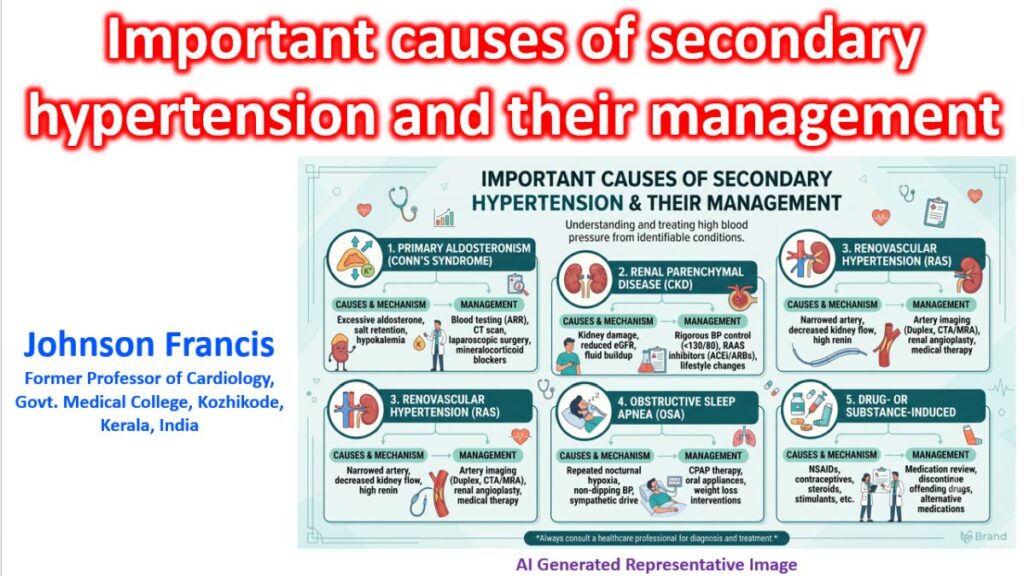

Secondary hypertension refers to an elevated blood pressure caused by an underlying, identifiable, and potentially reversible condition. While long thought to affect only 5% to 10% of patients, clinical guidelines highlight that its true prevalence may be as high as 10% to 35% in specific subsets, such as those with severe or treatment-resistant hypertension. Recognizing secondary causes is crucial. Delayed diagnosis can lead to irreversible vascular damage and disproportionate hypertensive-mediated organ damage.
When to Suspect Secondary Hypertension
Screening the entire hypertensive population is neither cost-effective nor clinically practical. Investigation should be targeted toward patients presenting with specific “red flags”:
- Resistant Hypertension: Uncontrolled BP despite adherence to optimal doses of three antihypertensive agents from different classes, including a diuretic.
- Age of Onset: Abrupt onset or severe hypertension developing before age 30 or after age 55.
- Acute Destabilization: Sudden, severe loss of BP control in a patient whose numbers were previously stable and well-regulated.
- Disproportionate target-organ damage: Severe target-organ damage (e.g., advanced retinopathy, left ventricular hypertrophy, or renal dysfunction) that seems excessive for the known duration or severity of the patient’s high blood pressure.
- Specific Clinical Clues: Unexplained hypokalemia, abdominal bruits, or episodic spells of sweating, palpitations, and headache.
Important Causes & Management Strategies
1. Primary Aldosteronism (Conn’s Syndrome)
Once thought rare, primary aldosteronism is now recognized as one of the most common endocrine causes of secondary hypertension, particularly prevalent in patients with moderate-to-severe or resistant hypertension.
- Screening & Diagnosis: The primary screening tool is the Aldosterone-Renin Ratio (ARR). Guidelines emphasize that screening should occur even in the absence of hypokalemia. To avoid unnecessary screening barriers, patients can continue most of their baseline antihypertensive therapies during testing, with the critical exception of Mineralocorticoid Receptor Antagonists (MRAs) like spironolactone or eplerenone, which must be discontinued. A positive ARR is confirmed via dynamic testing (e.g., oral sodium loading), followed by a CT scan of the adrenal glands and Adrenal Vein Sampling (AVS) to determine lateralization.
- Management:
- Unilateral disease (e.g., aldosterone-producing adenoma): Laparoscopic adrenalectomy offers a high rate of clinical cure or substantial improvement in BP control.
- Bilateral disease (e.g., bilateral adrenal hyperplasia): Managed medically using MRAs (spironolactone or eplerenone) to directly block the downstream effects of aldosterone excess.
2. Renal Parenchymal Disease (Chronic Kidney Disease)
Chronic Kidney Disease (CKD) functions as both a major cause and a direct consequence of long-standing systemic hypertension.
- Screening & Diagnosis: Routine baseline assessment requires checking the estimated Glomerular Filtration Rate (eGFR) alongside a urinary albumin-to-creatinine ratio (UACR) to quantify macro- or microalbuminuria.
- Management: Management centers on rigorous BP control (typically aiming for a target of less than 130/80 mmHg) and slowing renal decline. Renin-Angiotensin-Aldosterone System (RAAS) inhibitors—specifically Angiotensin-Converting Enzyme (ACE) inhibitors or Angiotensin Receptor Blockers (ARBs)—are the preferred first-line agents due to their internal antiproteinuric and renoprotective properties. Caution and close monitoring is needed to exclude worsening hyperkalemia and renal status.
3. Renovascular Hypertension (Renal Artery Stenosis)
Reduced perfusion across one or both renal arteries triggers the RAAS cascade, driving severe, renin-dependent systemic vasoconstriction. It manifests primarily via two distinct pathologies:
- Atherosclerotic Renal Artery Stenosis (ARAS): Typically seen in older adults with generalized cardiovascular disease.
- Fibromuscular Dysplasia (FMD): A non-atherosclerotic vascular disease seen predominantly in younger female patients.
- Screening & Diagnosis: Non-invasive imaging via Renal Artery Duplex Ultrasonography, Computed Tomography Angiography (CTA), or Magnetic Resonance Angiography (MRA) serves as the primary diagnostic approach. A classic clinical clue is an acute decrease in eGFR of greater than 25% shortly after initiating an ACE inhibitor or ARB.
- Management:
- Medical Management: Optimized medical therapy using RAAS inhibitors, statins, and antiplatelet agents is preferred for most patients with ARAS. Caution: ACE inhibitors and ARBs are contraindicated in cases of true bilateral renal artery stenosis or stenosis affecting a solitary functioning kidney.
- Revascularization: Percutaneous renal artery angioplasty (with or without stenting) is indicated for patients with FMD, or individuals with ARAS who experience recurrent flash pulmonary edema, refractory heart failure, or progressive, unexplained renal failure.
4. Obstructive Sleep Apnea (OSA)
OSA is highly prevalent, identified in a vast percentage of patients with resistant hypertension. Intermittent nocturnal hypoxia and hypercapnia drive sustained sympathetic nervous system activation, which often eliminates the normal nocturnal “dipping” phase of blood pressure.
- Screening & Diagnosis: Initial clinical evaluation using validated screening tools (such as the STOP-BANG questionnaire) should be definitively confirmed via nocturnal polysomnography (sleep study). STOP-BANG questionnaire is an 8-item screening tool used to assess risk for obstructive sleep apnea (OSA). A score of 5 or higher indicates a high risk for OSA.
- Management: The mainstay of treatment is Continuous Positive Airway Pressure (CPAP) therapy. While CPAP provides modest net reductions in overall 24-hour ambulatory blood pressure measurements, it significantly improves overnight cardiovascular profiles, daytime somnolence, and metabolic parameters. This is coupled with aggressive lifestyle interventions focused on weight loss.
5. Drug- or Substance-Induced Hypertension
A broad range of prescribed, over-the-counter, or illicit substances can cause or severely exacerbate existing hypertension. Common culprits include Non-Steroidal Anti-Inflammatory Drugs (NSAIDs), oral contraceptives, systemic corticosteroids, sympathomimetics (such as decongestants), calcineurin inhibitors, and stimulants.
- Screening & Diagnosis: Detailed medication reconciliation, including active screening for over-the-counter supplements and illicit substances.
- Management: Where clinically feasible, the offending agent should be down-titrated or completely discontinued. If the medication is essential (e.g., necessary immunosuppression or chemotherapy), baseline antihypertensive regimens must be aggressively optimized to counteract the drug’s pressor effects.
Summary of Secondary Hypertension Screening
| Etiology | Primary Clinical Clues | First-Line Screening Test |
| Primary Aldosteronism | Resistant hypertension, unprovoked hypokalemia (though often normokalemic) | Aldosterone-Renin Ratio (ARR) |
| Renal Parenchymal Disease | Elevated serum creatinine, known kidney disease, history of diabetes | eGFR and Urinary Albumin-to-Creatinine Ratio (UACR) |
| Renal Artery Stenosis | Abdominal bruit, flash pulmonary edema, acute eGFR drop (>25%) with ACEi/ARB | Renal Duplex Ultrasound, CTA, or MRA |
| Obstructive Sleep Apnea | Snoring, witnessed apnea, daytime sleepiness, non-dipping nighttime BP pattern | Polysomnography (Sleep Study) |
| Pheochromocytoma | Paroxysmal “spells” (headache, profuse sweating, palpitations) | Plasma free metanephrines or 24-hour urinary metanephrines |
| Cushing’s Syndrome | Moon facies, central obesity, proximal muscle weakness, wide purple striae | 24-hour urinary free cortisol or late-night salivary cortisol |
| Aortic Coarctation | BP differential between upper/lower extremities, delayed femoral pulses | Echocardiogram or CT/MR Chest Angiography |
References
Elwenspoek, M. M. C. (2026). Evidence-based blood tests for monitoring adults with hypertension in primary care: rapid review, routine data analyses, and consensus study. British Journal of General Practice.
Kanbay, M. (2026). 2025 AHA/ACC/AANP/AAPA/ABC/ACCP/ACPM/AGS/AMA/ASPC/NMA/PCNA/SGIM guideline for the prevention, detection, evaluation and management of high blood pressure in adults: a commentary from the European Renal Best Practice (ERBP). Nephrology Dialysis Transplantation. Advance online publication.
Ott, C., Schneider, M. P., & Schmieder, R. E. (2013). Ruling out secondary causes of hypertension. EuroIntervention, 9, R21–R28.
Rimoldi, S. F., Scherrer, U., & Messerli, F. H. (2013). Secondary arterial hypertension: when, who, and how to screen? European Heart Journal, 35(19), 1245–1254.
Viera, A. J. et al (2010). Diagnosis of secondary hypertension: an age-based approach. American Family Physician, 82(12), 1471–1478.
Writing Committee Members*. (2025). 2025 AHA/ACC/AANP/AAPA/ABC/ACCP/ACPM/AGS/AMA/ASPC/NMA/PCNA/SGIM guideline for the prevention, detection, evaluation and management of high blood pressure in adults. Hypertension, 82(10), e212–e316.