


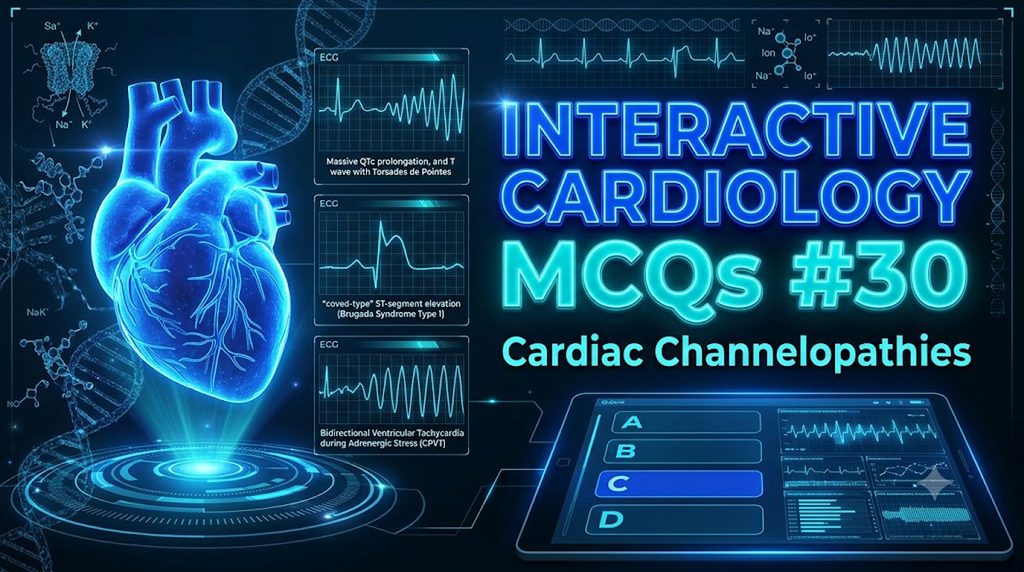
⚡ Advanced Cardiology Series – Part 30
Interactive Cardiology MCQs #30
Post-Graduate Level Masterclass: Cardiac Channelopathies
🧬
Live Scoreboard
0/ 25 Correct
Progress:
0/25
Q1
A 12-year-old boy experiences a syncopal episode while swimming competitively. His resting ECG reveals a QTc of 490 ms. Which subtype of Congenital Long QT Syndrome (LQTS) is most classically triggered by physical exertion, particularly swimming?
Q2
A patient with LQTS Type 3 has a gain-of-function mutation in the SCN5A gene. Based on this specific pathophysiological mechanism, which pharmacological agent is often used as a targeted, gene-specific therapy to shorten the QT interval in these patients?
Q3
What is the strict, diagnostic ECG criteria for a spontaneous Type 1 Brugada ECG pattern?
Q4
A 35-year-old male with a family history of sudden cardiac death undergoes a sodium channel blocker challenge test (using Ajmaline or Flecainide) to unmask a hidden condition. Which channelopathy is this test specifically designed to provoke?
Q5
In a structurally normal heart, Catecholaminergic Polymorphic Ventricular Tachycardia (CPVT) is a highly lethal genetic arrhythmia. Which genetic mutation accounts for the majority of autosomal dominant CPVT cases?
Q6
During an exercise treadmill test, a 14-year-old patient develops frequent premature ventricular complexes (PVCs) that progressively organize into a specific, highly characteristic ventricular tachycardia pattern. What is the hallmark arrhythmia of CPVT?
Q7
Short QT Syndrome (SQTS) is a rare, highly lethal channelopathy characterized by an abnormally short repolarization time. According to current guidelines, at what QTc threshold should a diagnosis of SQTS be strongly considered in an asymptomatic patient?
Q8
Andersen-Tawil Syndrome (Long QT Syndrome Type 7) is characterized by a specific clinical triad resulting from a loss-of-function mutation in the KCNJ2 gene. What three features constitute this triad?
Q9
Timothy Syndrome (Long QT Syndrome Type 8) is a highly lethal, multi-system channelopathy caused by a gain-of-function mutation in CACNA1C. Which ion channel is directly affected by this mutation?
Q10
Jervell and Lange-Nielsen Syndrome is a rare, severe form of Long QT Syndrome associated with profound bilateral sensorineural deafness. How is this specific syndrome genetically inherited?
Q11
Acquired Long QT Syndrome is far more common than congenital forms and is frequently driven by prescription medications. Virtually all drugs that cause acquired LQTS do so by blocking which specific cardiac ion current?
Q12
In patients with Catecholaminergic Polymorphic Ventricular Tachycardia (CPVT) who continue to experience breakthrough arrhythmias despite maximum tolerated beta-blocker therapy, what is the guideline-directed next step in pharmacological management?
Q13
At the cellular level, what is the specific electrophysiological mechanism responsible for triggering Torsades de Pointes in Long QT Syndrome?
Q14
A 45-year-old male with a known Type 1 Brugada ECG pattern presents to the ER with multiple shocks from his ICD due to a ‘Brugada storm’ (incessant ventricular fibrillation). Which intravenous medication is the most effective pharmacological treatment to acutely suppress electrical storms in Brugada Syndrome?
Q15
Early Repolarization Syndrome (ERS) is recognized as a potential cause of idiopathic ventricular fibrillation. What specific ECG morphology in the inferior or lateral leads carries the highest risk for arrhythmic events in ERS?
Q16
A patient’s baseline resting ECG is completely normal, with no QT prolongation and no resting arrhythmias. However, during maximal treadmill exertion, he collapses into ventricular fibrillation. Which channelopathy classically features a completely normal resting ECG but high lethality during adrenergic stress?
Q17
In calculating the Schwartz Score for the clinical diagnosis of Long QT Syndrome, which specific QTc measurement yields the maximum possible points (3 points) in the scoring system?
Q18
Certain clinical scenarios and physiological stressors can mimic a Brugada Type 1 ECG pattern in a patient without the actual genetic syndrome. Which severe electrolyte abnormality is the most famous ‘Brugada phenocopy’?
Q19
Idiopathic Ventricular Fibrillation (IVF) is diagnosed when a patient suffers VF without any identifiable structural or electrocardiographic abnormality. Research has shown these storms are often triggered by very early, short-coupled PVCs originating from which specific anatomical structure?
Q20
Different genetic subtypes of Long QT Syndrome produce distinct T wave morphologies on the ECG. Which of the following accurately matches the LQTS subtype with its classic T wave appearance?
Q21
Pregnancy and the postpartum period carry varying risks for women with congenital Long QT Syndrome depending on their genotype. Which genotype is associated with a massively increased risk of cardiac events during the 9-month postpartum period?
Q22
In patients with Short QT Syndrome, the refractory period of both the ventricles and the atria is significantly shortened. As a direct consequence, what is the most common clinical arrhythmia presentation in these patients, aside from sudden death?
Q23
Brugada Syndrome is heavily influenced by autonomic tone. Which physiologic state or condition famously exacerbates the Brugada Type 1 ECG pattern and dramatically increases the risk of ventricular fibrillation?
Q24
In evaluating a patient with recurrent syncope and a borderline prolonged QTc interval, you order an epinephrine challenge test. During the infusion, the QTc paradoxically lengthens by more than 30 ms. This abnormal response is highly specific for diagnosing which condition?
Q25