



An ITA Composite Graft (most commonly a Y-graft or T-graft) is an advanced surgical configuration where a secondary conduit is attached directly to the Internal Thoracic Artery rather than the aorta. This approach is the cornerstone of “aorta-no-touch” surgery, designed to reduce the risk of stroke by avoiding manipulation of a potentially calcified ascending aorta.
1. Structural Configuration
In a composite setup, the Left Internal Thoracic Artery (LITA) remains attached to its origin (the subclavian artery) and is typically grafted to the LAD. A second conduit is then anastomosed to the side of the LITA.
- T-Graft / Y-Graft: A secondary conduit—usually the Radial Artery (RA), or a Saphenous Vein (SVG)—is joined to the LITA in a “T” or “Y” shape.
- Total Arterial Revascularization (TAR): This configuration is frequently used to achieve TAR, providing the entire heart with arterial blood flow using only two inflow points (LITA and RITA).
2. Physiological Advantages
The ITA is not just a tube; it is a “living” conduit with unique biological properties that benefit the attached composite segment:
- Nitric Oxide (NO) Reservoir: The ITA produces high levels of NO, which diffuses into the attached composite graft, promoting vasodilation and inhibiting intimal hyperplasia in the secondary segment.
- Flow Autoregulation: The ITA is highly responsive to the metabolic demands of the myocardium, increasing its diameter and flow velocity as needed.
- Aortic Sparing: By eliminating the need for a proximal anastomosis on the aorta, surgeons significantly reduce the risk of embolizing atherosclerotic debris, which is a primary cause of perioperative stroke.
3. The “Competitive Flow” Risk
The primary challenge with composite grafts is the reliance on a single inflow (the LITA) to supply multiple coronary territories.
- The Stenosis Threshold: For a composite graft to function well, the target native vessels must have high-grade stenosis (usually >70–90%).
- Flow Competition: If the native vessel has only moderate blockage, the native heart flow may “compete” with the graft. Because the composite graft is a long, high-resistance circuit, the native flow can win, leading to the “string sign” (narrowing/atrophy) or early occlusion of the composite limb.
4. Outcomes and Natural History
Long-term data suggest that composite grafts are highly durable, provided they are constructed with arterial conduits.
- LITA-RITA Y-Graft: Ten-year patency for RITA used as a composite graft is significantly higher than when SVGs are used.
- LITA-Radial Y-Graft: Large-scale studies show that the Radial artery performs better as a composite graft from the LITA than as a direct graft from the aorta, likely due to the protective hormonal environment of the ITA.
SVG-ITA Composite Graft
An SVG-ITA Composite Graft is a specific surgical configuration where a Saphenous Vein Graft (SVG) is attached to the side of an Internal Thoracic Artery (ITA), rather than being connected directly to the aorta. While total arterial revascularization (using only arteries) is often preferred, using a vein as part of a composite graft is a strategic alternative when arterial conduits are limited or patient anatomy dictates a more flexible approach.
1. The Configuration (Y-Graft or T-Graft)
In this setup, the LITA (Left Internal Thoracic Artery) is harvested and grafted to the LAD (Left Anterior Descending) artery as usual. The SVG is then “piggybacked” onto the LITA:
- Proximal Anastomosis: The vein is sewn into the side of the LITA (forming a “Y” or “T” junction).
- Distal Anastomosis: The other end of the vein is grafted to a secondary target, such as the Circumflex (OM) or Right Coronary Artery (RCA) branches.
2. Why Use the ITA as an Inflow for a Vein?
Using the ITA as the “source” for the vein graft offers several physiological and surgical benefits:
- Nitric Oxide Diffusion: The ITA is a highly bioactive vessel that produces nitric oxide. When an SVG is attached to it, the vein is exposed to this vasodilator-rich environment, which may help prevent the vein from developing early atherosclerosis.
- Aorta-No-Touch Technique: By avoiding the aorta entirely, the surgeon eliminates the need to “clamp” or manipulate the aorta. This drastically reduces the risk of dislodging plaque that could lead to a perioperative stroke.
- Pressure Dampening: The ITA provides a more “physiological” pressure wave than the direct, high-pressure pulsatile flow of the aorta, which may reduce the mechanical stress on the vein wall.
3. Natural History and Patency
The performance of a vein in a composite setup differs slightly from a traditional aorta-to-coronary vein graft.
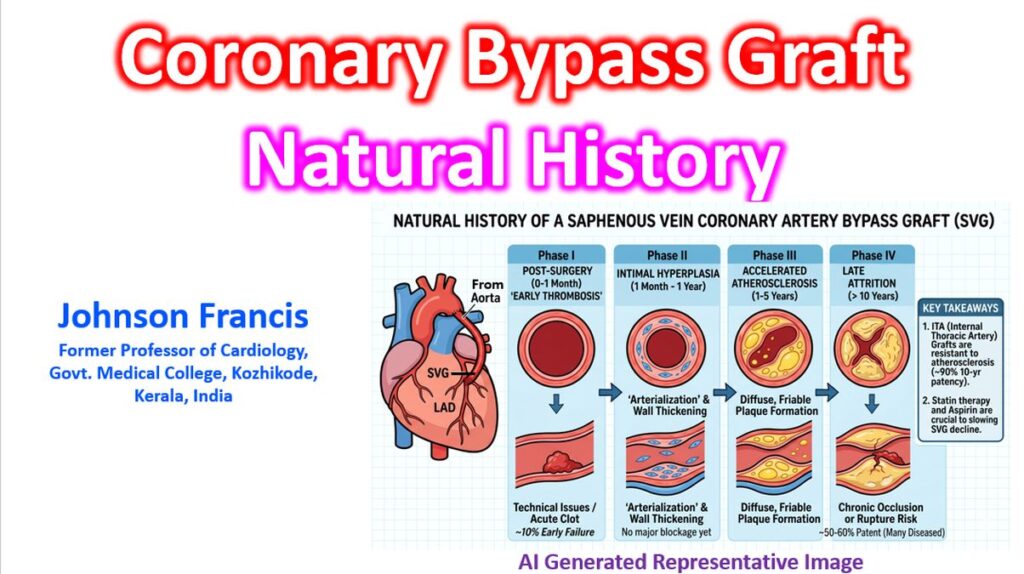
- The First Year: Like all SVGs, the risk of intimal hyperplasia remains. However, because the SVG is attached to an artery (the LITA), it undergoes “arterialization” more smoothly.
- Flow Limitation: The primary risk is that the LITA must now provide enough blood for two (or more) coronary territories. If the LITA diameter is too small, it may not be able to meet the demand during peak exercise, leading to “flow reserve” issues.
- Patency Data: Some studies suggest that SVG-ITA composite grafts have superior patency compared to traditional aorta-SVG grafts, likely due to the protective endothelial factors provided by the ITA.
4. Comparison Summary
| Feature | Aorta-SVG Graft | SVG-ITA Composite Graft |
| Inflow Source | Ascending Aorta | Internal Thoracic Artery |
| Stroke Risk | Higher (Aortic manipulation) | Lower (Aorta-no-touch) |
| Bioactivity | Minimal | High (Nitric Oxide from ITA) |
| Surgical Complexity | Standard | High (Requires precise Y-junction) |
| Ideal Use | Diffuse disease, large targets | Calcified aorta, limited conduits |
Key Reference
Hwang, H. Y., & Kim, K. B. (2018). Saphenous vein as a composite graft from the internal thoracic artery. Annals of Cardiothoracic Surgery. This paper highlights that the saphenous vein, when used as a composite graft, may benefit from the superior biological environment of the ITA, potentially extending its lifespan beyond that of a traditional vein graft.