


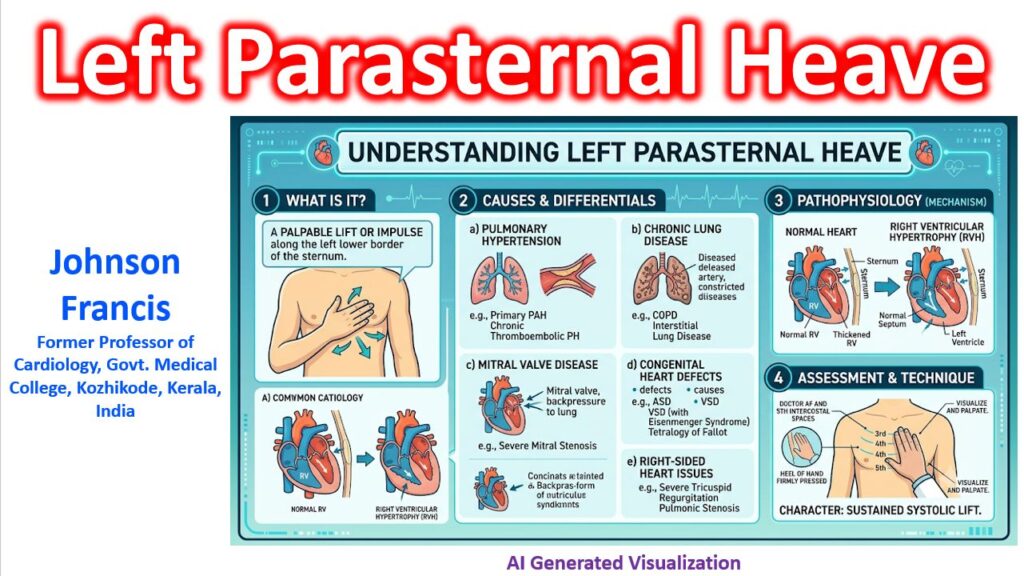

A left parasternal heave (or parasternal lift) is a sustained, palpable precordial impulse that visibly and physically lifts the heel of the examiner’s hand during ventricular systole. That is systolic elevation of left costal cartilages. It is the hallmark physical sign of right ventricular hypertrophy (RVH) or severe right ventricular pressure and volume overload.
Pathophysiology
Because the right ventricle is the most anterior cardiac chamber, lying directly beneath the lower half of the sternum, any significant muscular thickening or forceful dilation of the RV transmits mechanical force directly outward against the anterior chest wall.
Key Clinical Differentials
The presence of a parasternal heave points directly to right-sided pathology or pulmonary vascular disease. The standard differential includes:
- Pulmonary Hypertension (PH): Primary pulmonary arterial hypertension or secondary causes (e.g., chronic thromboembolic pulmonary hypertension – CTEPH).
- Valvular Disease:
- Mitral Stenosis: The classic left-sided lesion that transmits backward pressure through the pulmonary bed, eventually causing secondary RVH.
- Pulmonic Stenosis: Causes direct right ventricular pressure overload.
- Severe Tricuspid Regurgitation: Leads to massive right-sided volume overload (often presenting with a rocking precordial motion rather than a pure heave).
- Chronic Lung Disease (Cor Pulmonale): Advanced COPD or interstitial lung disease leading to chronic right heart strain. Left parasternal heave may be obscured in emphysema due to hyperinflation of the lungs.
- Congenital Heart Lesions:
- Atrial Septal Defect (ASD) (chronic right-sided volume overload)
- Tetralogy of Fallot – heave is not that common
- Eisenmenger Syndrome (late-stage VSD or PDA with reversed shunting)
Examination Pearl
One technique involves placing the “heel” (the proximal hypothenar and thenar eminence) of the right hand firmly, but gently, parallel to the left lower sternal border spanning the 3rd, 4th, and 5th intercostal spaces. Another method is to keep ulnar aspect of the palm parallel to the sternum, in the left parasternal region with the palm in the vertical plane, with patient supine.
- A heave is a sustained systolic outward lift against the hand.
- This should not be confused with a palpable P2 (a brief, sharp “tap” felt higher up in the 2nd left intercostal space), though both frequently coexist in patients with severe pulmonary hypertension.