


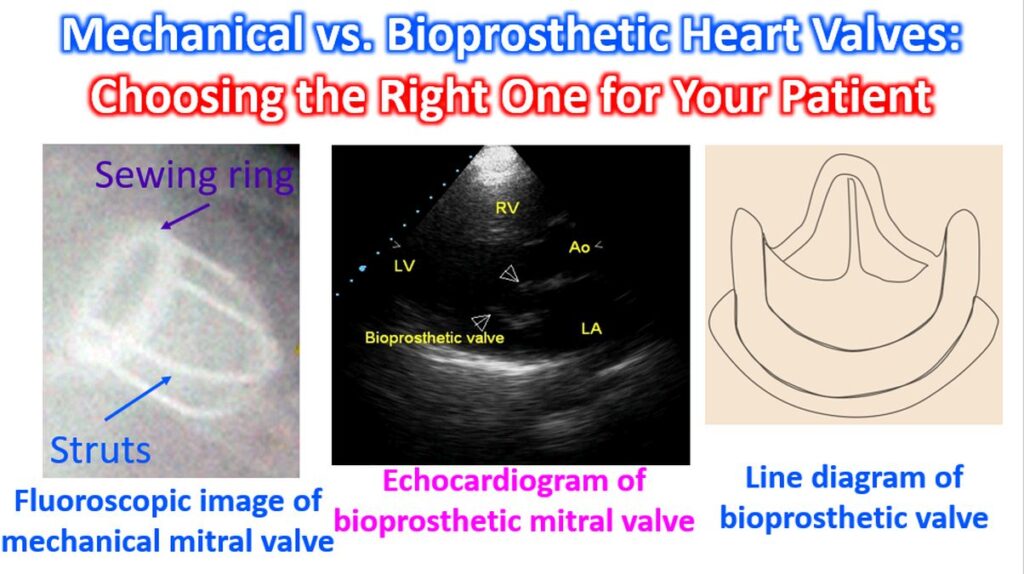
Choosing the right heart valve is no longer a simple binary decision based on age; it is a complex, “lifetime management” strategy. With the 2025 ESC/EACTS and the upcoming 2026 AHA/ACC updates, the decision-making process has shifted toward more nuanced, patient-centered variables.
Here is a breakdown of the key factors for choosing between mechanical and bioprosthetic valves.
1. The Core Trade-off
The fundamental tension remains a balance between durability and safety from anticoagulation.
| Feature | Mechanical Valves | Bioprosthetic Valves |
| Durability | Virtually lifetime (20–30+ years). | Limited (10–15 years; faster wear in younger patients). |
| Anticoagulation | Lifelong Warfarin (VKA) required. | Usually only short-term (3–6 months) unless AFib is present. |
| Main Risk | Thromboembolism and major bleeding. | Structural Valve Deterioration (SVD) and reoperation. |
| Clicking Sound | Often audible to the patient. | Silent (like a natural valve). |
2. Age Thresholds: The “Gray Zone”
Recent guidelines have refined the age cut-offs, though a significant “gray zone” exists between 50 and 65 years where patient preference is paramount.
- < 50 Years Old: Mechanical valves are generally recommended (Class IIa). Bioprosthetic valves in this group have a very high rate of failure, often requiring multiple reoperations over a lifetime.
- 50 to 65 Years Old (The Gray Zone): This is where most debate occurs.
- Aortic Position: Guidelines are leaning more toward bioprosthetics because of the success of TAVI (Transcatheter Aortic Valve Implantation) for future “valve-in-valve” procedures.
- Mitral Position: Mechanical valves still show a survival benefit up to age 70 in some studies because mitral reoperations are higher risk than aortic ones.
- > 65 Years Old: Bioprosthetic valves are typically preferred (Class I/IIa), as the valve’s expected lifespan often matches or exceeds the patient’s life expectancy, avoiding the risks of anticoagulation in an aging population.
3. Clinical & Lifestyle Selection Criteria
Beyond age, several factors can tip the scales in one direction:
Favor Mechanical If:
- The patient is already on lifelong anticoagulation for other reasons (e.g., permanent Atrial Fibrillation).
- The patient has a small aortic root (mechanical valves often have better hemodynamics in smaller sizes, reducing the risk of “Patient-Prosthesis Mismatch”).
- The patient has a high risk for reoperation (e.g., previous chest radiation or complex anatomy).
Favor Bioprosthetic If:
- Pregnancy Plans: Warfarin is teratogenic; women of childbearing age often choose bioprosthetics despite the high risk of early SVD.
- Lifestyle/Occupation: High-risk activities (contact sports, remote travel, or jobs with injury risk) make long-term anticoagulation dangerous.
- Frailty: Patients who are older or have a higher bleeding risk (HAS-BLED score).
- Future Options: The patient is a good candidate for a future Valve-in-Valve TAVI, which can avoid a second open-heart surgery.
4. Emerging Trends in 2025–2026
- The TAVI Effect: The lowering of TAVI age thresholds (to 70 or even 65 in some regions) is making bioprosthetic valves more attractive to younger “borderline” patients who want to avoid Warfarin.
- Precision Imaging: The 2025 ESC guidelines emphasize 3D-CT and Transesophageal Echo for earlier detection of subclinical leaflet thrombosis, which can help manage bioprosthetic valves more effectively.
- On-X Valves: These newer mechanical valves allow for a lower INR target (1.5–2.0), potentially reducing the bleeding risk traditionally associated with mechanical options.
Key Takeaway: The “Heart Team” approach is now the gold standard. Decisions should be documented as “Shared Decision Making,” ensuring the patient understands that a bioprosthetic valve is often a “two-procedure” strategy, while a mechanical valve is a “one-procedure” strategy with a “lifetime-medication” burden.