


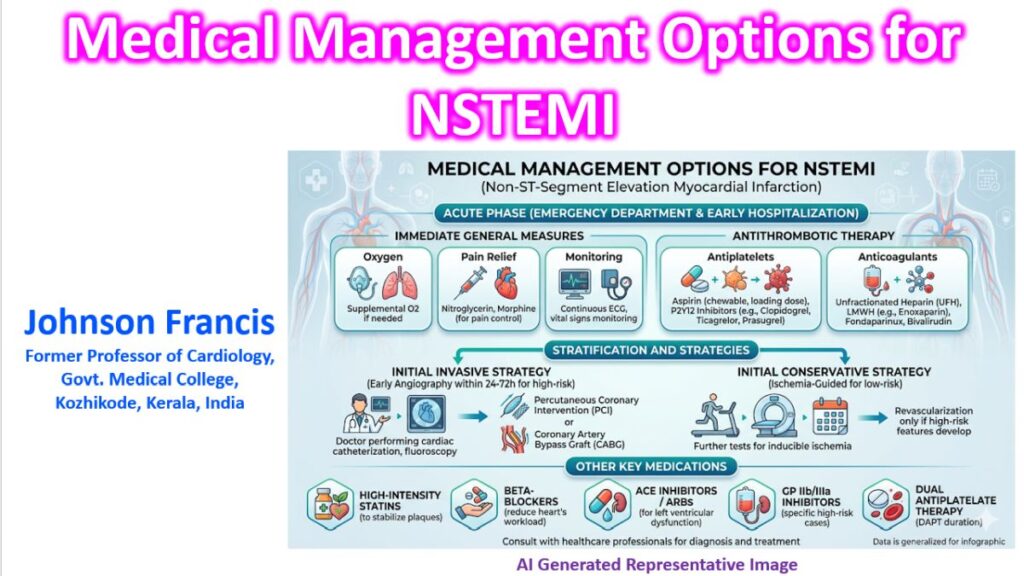

The medical management of Non-ST-Elevation Myocardial Infarction (NSTEMI) hinges on rapid risk stratification, optimal antithrombotic therapy, and determining the appropriate timing for an invasive strategy. The current approach, heavily informed by the 2023 ESC Guidelines for the management of Acute Coronary Syndromes (ACS) and ACC/AHA guidelines, focuses on a rapid “rule-in/rule-out” algorithm and tailoring intervention to risk profiles.
Initial Assessment & Risk Stratification
The cornerstone of modern NSTEMI diagnosis is the use of high-sensitivity cardiac troponin (hs-cTn) assays.
- 0/1-hour or 0/2-hour Algorithms: Utilized for rapid rule-in or rule-out based on baseline levels and absolute changes within the first 1 to 2 hours.
- Risk Scoring: The GRACE risk score remains the standard for objectively assessing mortality risk and guiding the timing of invasive management.
Pharmacological Therapy
Medical management prioritizes balancing ischemia resolution with bleeding risk.
1. Anti-Ischemic Therapy
- Nitrates: Sublingual or intravenous nitroglycerin for ongoing ischemic pain. Avoid if systolic BP < 90 mmHg or if phosphodiesterase type 5 inhibitors were recently used.
- Beta-Blockers: Initiate early (within 24 hours) in patients without contraindications (e.g., cardiogenic shock, active heart failure, PR interval > 0.24s).
- Calcium Channel Blockers: Non-dihydropyridines (verapamil/diltiazem) are indicated for recurrent ischemia if beta-blockers are contraindicated, provided there is no severe LV dysfunction.
2. Antiplatelet Therapy
Dual antiplatelet therapy (DAPT) consisting of aspirin and a potent P2Y12 inhibitor is standard.
- Aspirin: Loading dose followed by a maintenance dose.
- P2Y12 Inhibitors: Prasugrel or Ticagrelor are preferred over clopidogrel. Note on Pre-treatment: Routine pre-treatment with a P2Y12 receptor inhibitor in NSTEMI patients whose coronary anatomy is not known and who are scheduled for an early invasive management is not recommended by the latest ESC guidelines due to increased bleeding risk without ischemic benefit.
3. Anticoagulation
Parenteral anticoagulation is recommended for all patients at the time of diagnosis and should be discontinued immediately after PCI in those without an indication for long-term oral anticoagulation.
- Unfractionated Heparin (UFH): Needs a weight-adjusted IV bolus.
- Enoxaparin: SC every 12 hours.
- Fondaparinux: SC daily (requires UFH bolus during PCI to prevent catheter thrombosis).
- Bivalirudin: Considered as an alternative to UFH, particularly in patients with a high bleeding risk or a history of Heparin-Induced Thrombocytopenia (HIT).
Invasive Strategy Timing
The decision and timing for coronary angiography depend entirely on the patient’s clinical risk profile.
| Risk Category | Clinical Criteria | Timing of Angiography |
| Very High Risk | Hemodynamic instability, cardiogenic shock, recurrent/refractory chest pain despite medical therapy, life-threatening arrhythmias, mechanical complications, acute heart failure. | Immediate (< 2 hours) |
| High Risk | Confirmed diagnosis of NSTEMI (hs-cTn), dynamic ST- or T-wave changes, GRACE score > 140. | Early (< 24 hours) |
| Low Risk | None of the above high-risk features. Symptoms stabilized. | Selective / Non-invasive testing |
Long-Term Secondary Prevention
Post-discharge management requires a “lifetime management” strategy to prevent recurrence:
- Lipid-Lowering: High-intensity statins initiated early to target LDL-C < 55 mg/dL (1.4 mmol/L) and a ≥50% reduction from baseline. Ezetimibe or PCSK9 inhibitors are added if targets are not met.
- ACE Inhibitors / ARBs: Indicated for patients with heart failure, LVEF ≤ 40%, diabetes, or CKD.
- Mineralocorticoid Receptor Antagonists (MRAs): For patients with LVEF ≤ 40% and heart failure or diabetes, provided no significant renal failure or hyperkalemia.