


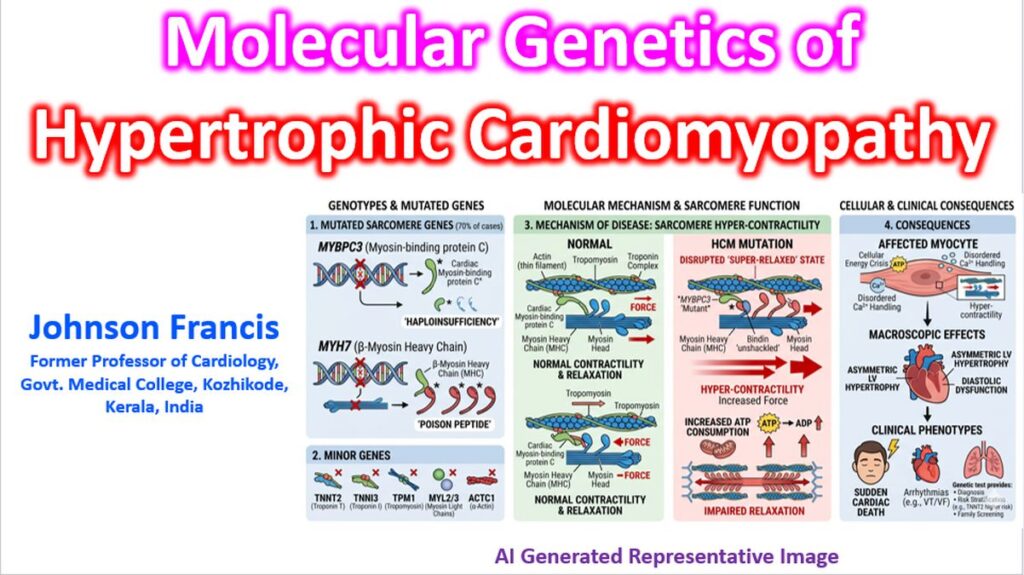

Hypertrophic Cardiomyopathy (HCM) is primarily recognized as a disease of the sarcomere—the fundamental contractile unit of the cardiac muscle cell. It is the most common transitionally inherited cardiac disorder, typically following an autosomal dominant pattern.
Genetic Architecture
The majority of identifiable mutations in HCM occur in genes encoding proteins of the thick and thin filaments of the sarcomere.
1. The “Big Two”
- MYBPC3 (Myosin-binding protein C, cardiac): Mutations often lead to “haploinsufficiency,” where the cell doesn’t produce enough functional protein, leading to gradual structural changes.
- MYH7 (β-myosin heavy chain): These are typically “missense” mutations, where the mutant protein interferes with the function of the normal protein.
Each of these have been identified in about 20% each of HCM cases and higher number in larger families
2. Other Core Sarcomeric Genes
- TNNT2 (Cardiac troponin T): Notable because mutations here can sometimes cause mild hypertrophy but a high risk of sudden cardiac death (SCD).
- TNNI3 (Cardiac troponin I)
- TPM1 (α-tropomyosin)
- MYL2 & MYL3 (Myosin light chains): These are uncommon causes of HCM, together being responsible for <1% of the HCM cases
- ACTC1 (α-cardiac actin)
Pathophysiology: The Molecular Mechanism
The central paradox of HCM at the molecular level is that the mutations often cause hypercontractility rather than weakness.
- The “Super-Relaxed” State (SRX): Recent research highlights that many mutations (especially in MYBPC3 and MYH7) disrupt the “super-relaxed state” of myosin. This unshackles the myosin heads, making them ready to bind to actin more frequently.
- Increased ATP Consumption: Because more myosin heads are active, the heart consumes more energy, leading to a cellular energy crisis.
- Impaired Relaxation: The excess cross-bridge formation prevents the muscle from relaxing fully, leading to the hallmark diastolic dysfunction seen in HCM.
Clinical Implications of Genetics
| Feature | Description |
| Genetic Yield | Comprehensive testing identifies a causative mutation in roughly 30% to 60% of patients with a clear clinical phenotype. |
| Genotype-Negative HCM | Patients who meet clinical criteria but have no identifiable mutation often have a later onset and a lower risk of family transmission. |
| Phenocopies | Some genetic disorders “mimic” HCM but involve different pathways, such as Danon disease (LAMP2), Fabry disease (GLA), or Friedreich ataxia (FXN). |
Therapeutic Advances
The molecular understanding of HCM has led to the development of Cardiac Myosin Inhibitors (e.g., Mavacamten). These drugs specifically target the molecular defect by shifting myosin heads back into the “super-relaxed” state, reducing the hyper-contractility and relieving the outflow tract obstruction.
Genetic Influence on Arrhythmia Risk
The relationship between genotype and arrhythmogenesis is one of the most complex areas of HCM management. While hypertrophy itself creates a substrate for re-entry, the molecular defects often precede structural changes, suggesting a “pro-arrhythmic” state at the cellular level. The specific gene involved can significantly alter the electrophysiological profile and the risk of Sudden Cardiac Death (SCD):
1. TNNT2 (Troponin T) – The “Malignant” Variant
Mutations in TNNT2 are classically associated with a high risk of SCD despite only mild or even absent hypertrophy. This is a critical clinical “red flag.”
- Mechanism: These mutations often increase calcium sensitivity, which shortens the action potential duration and increases susceptibility to ventricular arrhythmias.
2. MYH7 vs. MYBPC3
- MYH7: Patients often present earlier in life with more significant hypertrophy and a higher incidence of atrial fibrillation (AFib) due to progressive left atrial remodeling.
- MYBPC3: Often associated with a later onset of symptoms, but once hypertrophy develops, the risk of ventricular tachycardia (VT) remains comparable to other variants.
Redefining ICD Selection
Current guidelines primarily use clinical markers for ICD placement, but genetics is increasingly being used to “tip the scale”:
- The “Multiple Mutation” Effect: Approximately 5% of patients carry more than one mutation (compound or double heterozygous). These patients typically have a much more aggressive course and a higher threshold for early ICD consideration.
- Sarcomere-Positive vs. Sarcomere-Negative: Patients with an identifiable sarcomere mutation generally have a higher risk of SCD compared to those with “genotype-negative” HCM, who often have a more benign clinical course.
- Non-Sustained Ventricular Tachycardia (NSVT): The frequency and duration of NSVT on Holter monitoring are more concerning in patients with high-risk mutations (like TNNT2 or ACTC1).
Emerging Electrophysiological Markers
Research is shifting toward identifying “pre-phenotypic” markers in family members who are G+/P- (Genotype positive, Phenotype negative):
- ECG Changes: Deep S-waves in V2/V3 or T-wave inversions can precede wall thickening.
- Mechanical Dispersion: Using strain imaging to find subtle delays in contraction that correlate with future VT/VF risk.