


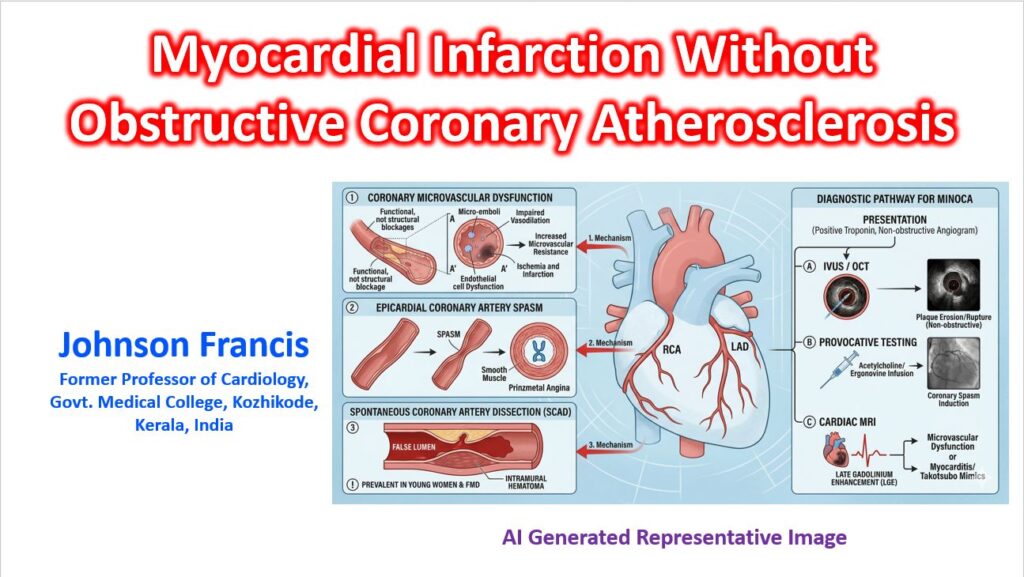
The occurrence of a myocardial infarction (MI) in the absence of obstructive coronary artery disease (CAD) is a well-recognized clinical entity known as MINOCA (Myocardial Infarction with Non-Obstructive Coronary Arteries). While traditional MI is caused by plaque rupture and thrombosis, MINOCA involves various alternative pathophysiological mechanisms.
1. Coronary Microvascular Dysfunction (CMD)
CMD involves abnormalities in the tiny distal vessels of the coronary tree that cannot be seen on a standard angiogram. It includes impaired vasodilation or increased microvascular resistance.
- Mechanism: Inadequate blood flow to the myocardium despite “clean” epicardial arteries. Abnormalities of function and structure of coronary microcirculation can occur in patients without obstructive coronary atherosclerosis, but with risk factors or with myocardial disease as well as in patients with obstructive atherosclerosis. Coronary microvascular dysfunction can also be iatrogenic.
- Key Reference: Coronary microvascular dysfunction: an update
2. Coronary Artery Spasm
Prinzmetal or variant angina involves an intense, transient constriction of an epicardial coronary artery.
- Mechanism: Severe spasm causes total or subtotal vessel occlusion, leading to transmural ischemia. The criteria suggested by the COVADIS group were: (i) nitrate-responsive angina, (ii) transient ischaemic electrocardiogram changes, and (iii) documented coronary artery spasm.
- Key Reference: Beltrame, J. F., et al. (2017). “International standardization of diagnostic criteria for vasospastic angina.” European Heart Journal.
- The COVADIS (Coronary Vasomotion Disorders International Study) Group provides the global standard for identifying spasm as a cause of MINOCA.
3. Spontaneous Coronary Artery Dissection (SCAD)
SCAD is a non-atherosclerotic tear in the coronary artery wall, creating a “false lumen” that compresses the “true lumen.”
- Mechanism: Blood enters the tunica media, creating a hematoma that obstructs blood flow. It is particularly prevalent in younger women and those with fibromuscular dysplasia.
- Key Reference: Hayes, S. N., et al. (2018). “Spontaneous Coronary Artery Dissection: Current State of the Science: A Scientific Statement From the American Heart Association.” Circulation.
4. Coronary Embolism
Blood clots can travel from elsewhere (the heart or venous system via a patent foramen ovale) and lodge in a coronary artery.
- Mechanism: Emboli from atrial fibrillation, valvular disease, or hypercoagulable states. Long term survival is worse than expected according to the baseline cardiovascular risk.
- Key Reference: Popovic, B., et al. (2018). “Coronary Embolism Among ST-Segment-Elevation Myocardial Infarction Patients: Mechanisms and Management.” Circ Cardiovasc Interv.
5. Myocardial Supply-Demand Mismatch
This occurs when a secondary condition causes an imbalance between myocardial oxygen supply and demand without a primary coronary event.
- Mechanism: Severe anemia, tachyarrhythmias, severe bradyarrhythmia, respiratory failure, or septic shock.
- Key Reference:Thygesen, K., et al. (2018). “Fourth Universal Definition of Myocardial Infarction.” Journal of the American College of Cardiologyhttps://www.ahajournals.org/doi/10.1161/CIR.0000000000000617.
- This document formally distinguishes Type 2 MI (mismatch) from Type 1 MI (plaque-related).
Summary Table: MINOCA Diagnostic Framework
| Cause | Diagnostic Tool | Reference Focus |
| Plaque Disruption | Intravascular Ultrasound (IVUS) | Small ruptures missed by Angio |
| Spasm | Provocative testing (Acetylcholine) | Vasoreactive disorders |
| Microvascular | Index of Microcirculatory Resistance (IMR) | Distal vessel dysfunction |
| Dissection | Optical Coherence Tomography (OCT) | Visualizing the false lumen |
Key Consensus Document
For a comprehensive overview of how to manage these patients, the AHA Scientific Statement is the gold standard: