


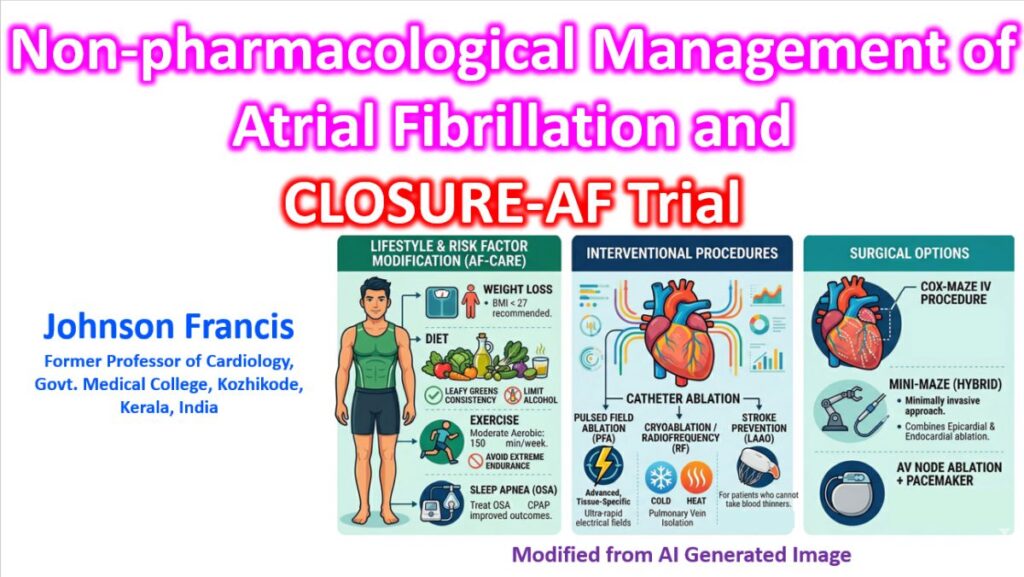
The non-pharmacological management of atrial fibrillation has evolved into a comprehensive “fourth pillar” of care, alongside anticoagulation, rate control, and rhythm control. Emphasis is on early intervention and aggressive lifestyle modification to prevent atrial remodeling. The approach is generally categorized into lifestyle modifications, interventional procedures, and surgical options. CLOSURE-AF Trial comparing left atrial appendage closure with best medical therapy in those with atrial fibrillation and high risk for both stroke and bleeding, was published on 18 March 2026 at NEJM.org.
Lifestyle and Risk Factor Management (The “AF-CARE” Model)
2024 ESC guidelines prioritize the AF-CARE pathway, where “C” stands for Comorbidity management. Modifying these factors can reduce AF burden as much as medical or procedural therapy. “A” stands for avoiding stroke and thromboembolism, “R” for rate and rhythm control and “E” for evaluation and reassessment individualized to every patient.
- Weight Loss: Aim for a BMI < 27. Losing ≥ 10% of body weight has been shown to increase arrhythmia-free survival.
- Sleep Apnea (OSA) Treatment: CPAP therapy may be useful. Untreated OSA can increase the risk of AF recurrence after cardioversion or ablation. ORBIT-AF (Outcomes Registry for Better Informed Treatment of AF) cohort demonstrated that those with sleep disordered breathing who were using CPAP were less likely to have progression of AF disease to more permanent AF.
- Exercise: 150 min/week moderate-intensity aerobic exercise or 75 min/week of vigorous-intensity aerobic exercise improves cardiovascular health. Regular aerobic exercise may also improve AF-related symptoms, quality of life, and exercise capacity. However, “extreme” endurance training may actually increase AF risk.
- Alcohol Cessation: Alcohol is a potent trigger (“Holiday Heart Syndrome”). Even one drink a day can increase risk; complete abstinence is often recommended for symptomatic patients.
- Diet: The Mediterranean diet (rich in olive oil, fruits, and vegetables) is highly recommended. If you are on warfarin, maintain a consistent intake of Vitamin K-rich leafy greens (spinach/kale) to avoid fluctuating INR levels.
Interventional Procedures
When medications are ineffective or not tolerated, interventional options aim to “fix” the heart’s electrical pathways.
- Catheter Ablation: Now frequently considered as a first-line therapy for symptomatic paroxysmal AF.
- Pulsed Field Ablation (PFA): Unlike traditional thermal methods (heat/cold), PFA uses ultra-rapid electrical fields that are tissue-specific, reducing the risk of damaging nearby structures like the esophagus or phrenic nerve.
- Cryoablation & Radiofrequency (RF): Established methods used to isolate the pulmonary veins.
- Left Atrial Appendage Occlusion (LAAO): Devices are used for patients at high stroke risk who cannot tolerate long-term anticoagulant therapy. But recent 2026 data from the CLOSURE-AF Trial suggests LAAO should be carefully weighed against “best medical therapy” (DOACs), as it may not be superior in all high-risk populations.
Surgical Options
Reserved for patients with persistent AF or those already undergoing heart surgery for other reasons.
- Cox-Maze IV Procedure: It involves creating a “maze” of scar tissue to direct electrical signals. Often performed during mitral valve or bypass surgery.
- Hybrid Mini-Maze: A minimally invasive approach that combines surgical epicardial ablation with a follow-up catheter-based procedure.
- AV Node Ablation + Pacemaker: It is a strategy for patients where other methods fail. The AV node is ablated to stop the fast irregular rhythm from reaching the ventricles, and a permanent pacemaker is implanted to maintain the heart rate.
CLOSURE-AF Trial
CLOSURE-AF Trial was a recent multicenter randomized trial from Germany, which assigned patients with atrial fibrillation and a high risk for stroke as well as bleeding into either left atrial appendage closure or physician-directed best medical care including direct oral anticoagulants if eligible. It was a noninferiority trial with primary composite endpoint which included any stroke, systemic embolism, major bleeding or cardiovascular or unexplained death in a time-to-event analysis. Non-inferiority margin was a hazard ratio of 1.3. The study had 912 adult patients with mean CHA2DS2-VASc score of 5.2 and mean HAS-BLED score was 3.0. The study concluded that left atrial appendage closure was NOT noninferior to physician-directed best medical care. Left atrial appendage closure was associated with a higher risk of primary composite endpoint event over a median follow-up of 3 years.