


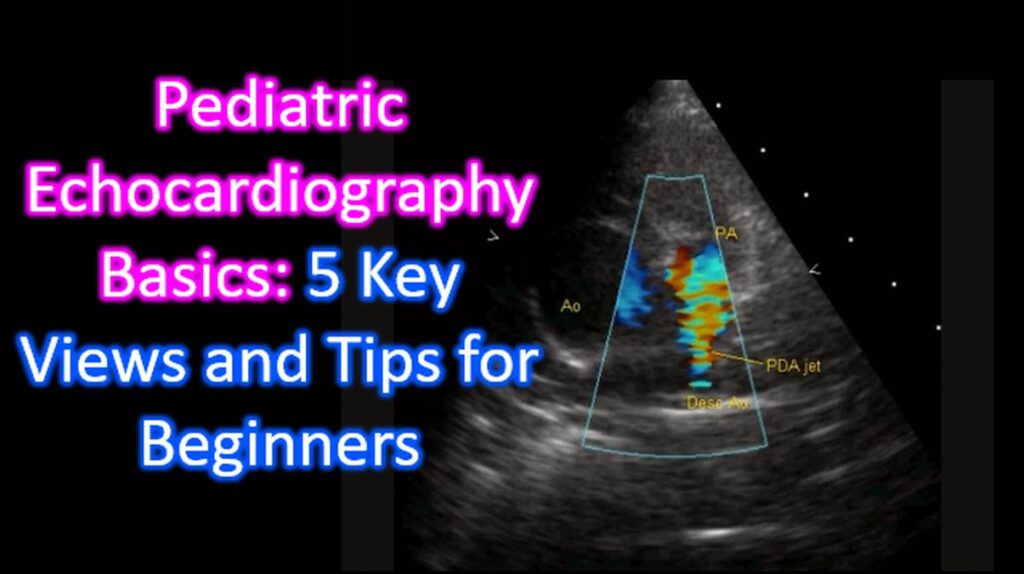
Pediatric echocardiography requires a specialized approach due to the high prevalence of congenital heart disease (CHD) and the need for high-resolution imaging in small patients. Unlike adult echo, which often follows a standard sequence, a pediatric study must be comprehensive enough to rule out complex structural anomalies.
Here are the 5 key views and essential tips for beginners.
1. Subcostal (Subxiphoid) View
In pediatrics, the exam often starts here. Because children have more compliant abdominal walls and a more horizontal heart position, the subcostal window provides excellent clarity.
- What to look for: Abdominal situs (liver/stomach position), the atrial septum (best view for ASDs), and the IVC/SVC drainage.
- Pro Tip: Use the liver as an acoustic window. This view is often the least threatening to a child and provides a “roadmap” of the heart’s orientation.
2. Parasternal Long Axis (PLAX)
Obtained by placing the transducer at the left sternal border.
- What to look for: The “classic” view of the left ventricle (LV), left atrium (LA), and the mitral and aortic valves. It is essential for assessing LV contractility and checking for ventricular septal defects (VSDs).
- Anatomy: You should see the right ventricle (RV) at the top, the IVS in the middle, and the LV at the bottom.
3. Parasternal Short Axis (PSAX)
By rotating the probe 90° clockwise from the PLAX view, you transition to the short axis.
- What to look for: This view is a “sweep” from the base to the apex. At the base (the “Mercedes-Benz” sign), you see the aortic valve and the origin of the coronary arteries—a critical part of any pediatric echo.
- Clinical Value: Sweeping down to the papillary muscle level helps assess LV function and “D-shaping” of the septum, which indicates high right-side pressures.
4. Apical Four-Chamber (A4C)
Located at the point of maximal impulse (apex).
- What to look for: All four chambers simultaneously. It is the gold standard for comparing the sizes of the left and right sides of the heart and assessing the tricuspid and mitral valves.
- Doppler: This is the primary window for spectral Doppler measurements (e.g., inflow velocities) because the blood flow is most parallel to the ultrasound beam here.
5. Suprasternal Notch View
The probe is placed in the hollow of the neck, with the child’s head tilted back.
- What to look for: The aortic arch and its branches. This is the only way to reliably rule out coarctation of the aorta or a patent ductus arteriosus (PDA).
- Beginner Tip: Place a small roll under the child’s shoulders to extend the neck; this opens the “window” and makes imaging much easier.
3 Essential Tips for Beginners
Hold the Probe Like a “Pencil”
Do not grip the handle high up. Hold it close to the head (the footprint) and anchor your hand against the child’s chest using your palm. This prevents the probe from sliding when the child moves or breathes.
Use the Correct Transducer
In pediatrics, frequency is key. Use the highest frequency probe that allows you to reach the required depth.
- Neonates: 8–12 MHz (High resolution, low penetration)
- Older children: 5–8 MHz
- Large adolescents: 3–5 MHz
Master the “Environmental Control”
A crying child makes for a difficult scan (tachycardia and lung interference).
- Distraction: Use a tablet with cartoons or a pacifier for infants.
- Warm Gel: Cold gel is a common trigger for crying. Always use a gel warmer.
- Comfort: If the child is scared, perform the subcostal or apical views while they are sitting in their parent’s lap.