


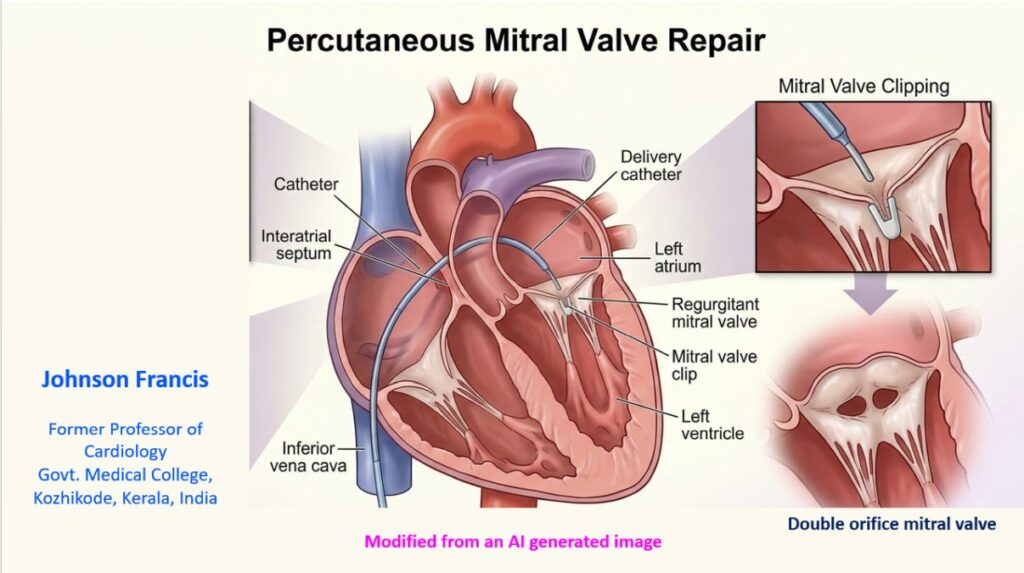

Percutaneous mitral valve repair (PMVR) is a minimally invasive procedure used to treat mitral regurgitation (MR)—a condition where the heart’s mitral valve doesn’t close tightly, causing blood to flow backward. Unlike traditional open-heart surgery, this procedure is performed through a catheter, typically inserted via the femoral vein in the groin.
Primary Techniques
1. Transcatheter Edge-to-Edge Repair (TEER)
This is the most common PMVR method.
- The Procedure: A clip is delivered to the heart and attached to the two leaflets of the mitral valve.
- The Result: It creates a “double-orifice” valve, effectively “stapling” the leaky middle section together to reduce backflow while still allowing blood to pass through the sides.
- Best for: Patients with degenerative MR (structural issues) or functional MR (heart failure-related) who are at high risk for surgery.
2. Percutaneous Mitral Annuloplasty
This mimics surgical annuloplasty by targeting the annulus (the ring of tissue around the valve).
- Indirect Annuloplasty: A device is placed in the coronary sinus (a vein near the valve) to cinching the annulus from the outside.
- Direct Annuloplasty: Anchors are placed directly into the annulus from inside the heart chamber to pull the valve leaflets closer together.
3. Chordal Replacement
This involves inserting synthetic chordae to replace broken or stretched natural chordae that usually hold the valve leaflets in place. Success rates of transcatheter chordal replacement is currently lower than surgical chordal replacement.
Benefits vs. Risks
| Benefits | Potential Risks |
| No sternotomy (opening the chest) | Access site complications (bleeding) |
| Shorter hospital stay (often 1–3 days) | Device detachment or embolization |
| Faster recovery time | Residual or recurrent regurgitation |
| Significant improvement in heart failure symptoms | Need for emergent surgery (rare) |
Patient Selection
PMVR is typically reserved for patients who meet specific criteria:
- Symptomatic Grade 3+ or 4+ MR.
- High Surgical Risk: Determined by a “Heart Team” (cardiologists, surgeons etc) based on age, frailty, or comorbidities.
- Favorable Anatomy: The valve shape and the gap between leaflets must be compatible with the clipping or cinching devices.
Clinical Management Note
Following the procedure, patients are usually started on a regimen of antiplatelet therapy (like aspirin or clopidogrel) to prevent clots from forming on the implants.